Mastering the Velocity Equation
📋 In this guide
The velocity equation is a fundamental concept in physics that measures the rate at which an object changes its position over time. In its simplest form, the velocity equation is the ratio of the displacement to the time taken. Understanding this equation is crucial for students, yet many struggle with it due to its abstract nature and the various contexts in which it can be applied. This article will guide you through the intricacies of the velocity equation, helping you comprehend its different forms and applications.
Students often find the velocity equation challenging because it requires a clear understanding of both mathematical concepts and physical principles. Many students confuse velocity with speed, not realizing that velocity is a vector quantity, meaning it has both magnitude and direction. This article aims to clarify these distinctions and provide a comprehensive understanding of how to apply the velocity equation in various scenarios.
By the end of this article, you will have a clear understanding of the velocity equation, including its key formula, how to solve problems step-by-step, and how it connects to related concepts like the angular velocity equation and the escape velocity equation. We'll also cover common mistakes to avoid and real-world applications of velocity, enhancing your ability to tackle this topic confidently.
Step-by-Step: How to Solve Velocity Equation
Step 1: Understand the Problem
The first step in solving any problem involving the velocity equation is to comprehend what is being asked. Identify the given values such as the displacement and the time taken. Pay attention to the units used and convert them if necessary to ensure consistency. For instance, if displacement is given in kilometers and time in hours, ensure the velocity is in kilometers per hour.
Step 2: Apply the Velocity Equation
With the problem understood, the next step is to apply the velocity equation: velocity = displacement / time. Substitute the given values into the equation. This is where understanding the distinction between displacement and distance becomes critical. Remember, displacement considers direction, which can affect your calculation if the path taken is not straight.
Step 3: Calculate and Interpret
Perform the calculation to find the velocity. Use appropriate mathematical techniques to simplify fractions if necessary. Once you have the numerical answer, interpret it in the context of the problem. Ensure that your answer reflects the physical situation, considering both magnitude and direction.
Step 4: Verify and Reflect
Finally, verify your solution by checking your calculations and ensuring the units are consistent. Reflect on whether the answer makes sense logically. If the velocity seems too high or low, revisit your steps to identify any possible errors. This reflection helps reinforce your understanding and improves accuracy in future problems.
🤖 Stuck on a math problem?
Take a screenshot and let our AI solve it step-by-step in seconds
⚡ Try MathSolver Free →Worked Examples
Example 1
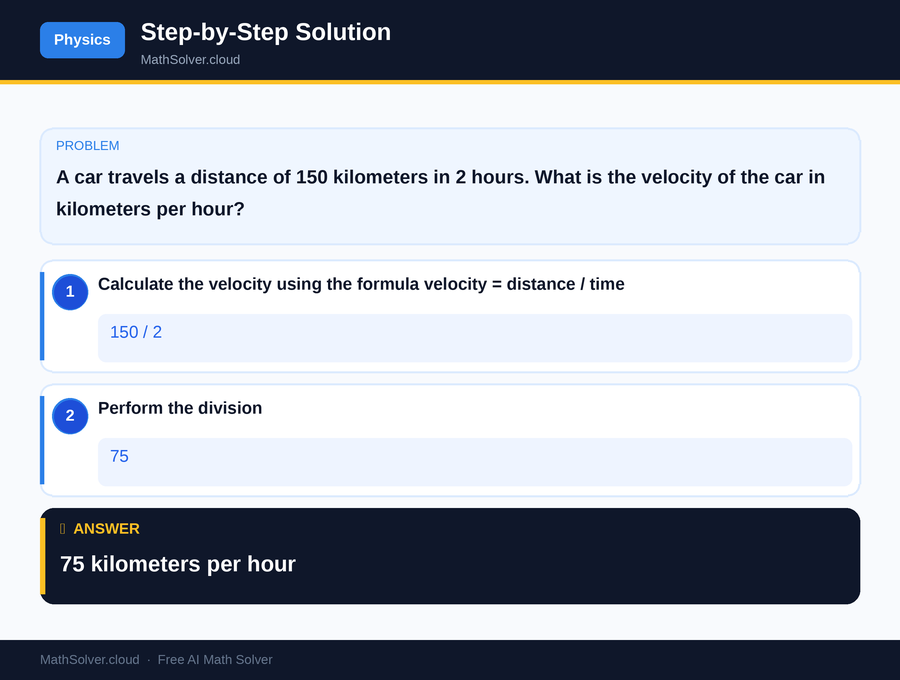
MathSolver Chrome extension solving this problem step-by-step
Example 2
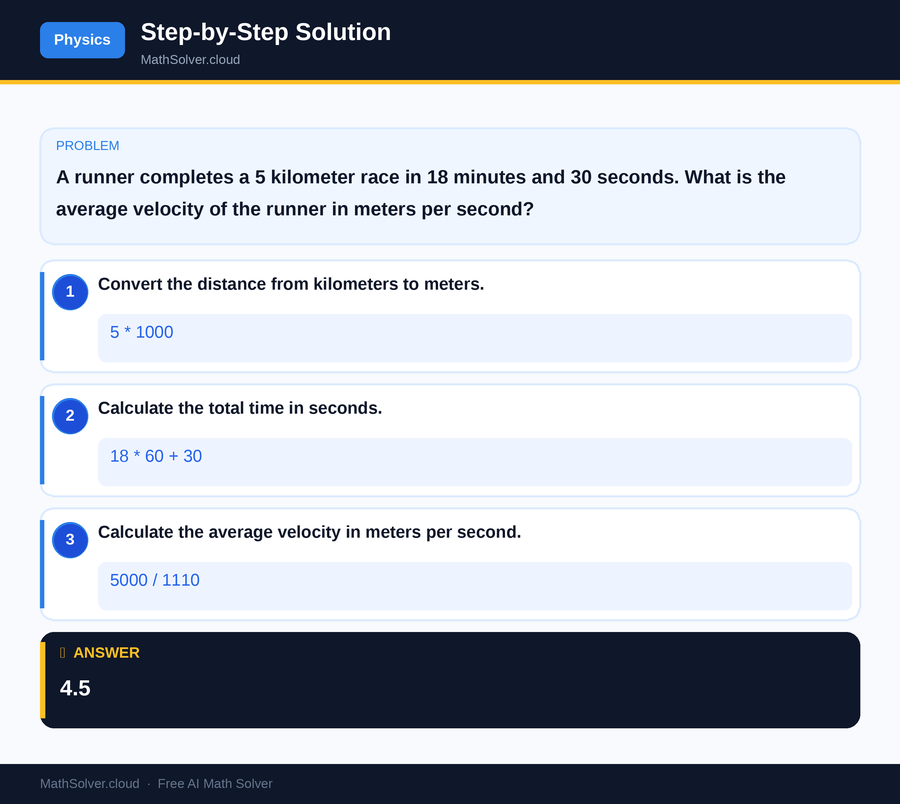
MathSolver Chrome extension solving this problem step-by-step
Common Mistakes to Avoid
One common mistake students make is confusing speed with velocity. Remember, velocity is directional, while speed is not. Always consider the direction when calculating velocity, especially in problems that involve vectors. Another frequent error is mismanaging units. It's crucial to ensure that the units for displacement and time are consistent before performing calculations.
Another pitfall is neglecting to verify answers. After solving a problem, always revisit your calculations to confirm accuracy. Reflect on whether the result logically aligns with the physical scenario described in the problem. This habit not only catches errors but also deepens your understanding of the velocity equation.
Real-World Applications
The velocity equation is widely used in various real-world contexts. In engineering, it helps design safer vehicles by understanding how quickly they can change speed and direction. In sports, coaches analyze the velocity of athletes to enhance performance and strategize for competition.
Moreover, in fields like astronomy, the velocity equation is invaluable. It aids in calculating escape velocity, which is the minimum speed needed for an object to break free from a planet's gravitational pull. This application is crucial for launching spacecraft and exploring beyond Earth.
Frequently Asked Questions
❓ What is the velocity equation used for?
❓ How is the velocity equation different from speed?
❓ How can AI help with the velocity equation?
❓ What is the angular velocity equation?
❓ How is the velocity equation applied in space exploration?
🚀 Solve any math problem instantly
2,000+ students use MathSolver every day — join them for free
📥 Add to Chrome — It's Free