Understanding and Mastering Math Formulas
📋 In this guide
Math formulas are the backbone of mathematics, serving as essential tools that help us solve various problems in different fields. Students often struggle with math formulas because they can seem abstract and overwhelming, especially when first introduced. The complexity of these formulas can make them difficult to memorize and apply correctly. In this article, we'll explore what math formulas are, why they are important, and how you can master them to excel in your studies. By the end of this article, you'll have a better understanding of how to approach math formulas, making them less intimidating and more manageable.
The challenge with math formulas isn't just about memorizing them; it's about understanding how and when to use them. Each formula has a specific application and knowing the context in which it applies is crucial for success. Whether you're preparing for standardized tests like the SAT or ACT, or tackling everyday problems, mastering math formulas can significantly enhance your problem-solving skills. We'll explore some basic math formulas and discuss how they can be applied to real-world scenarios.
Furthermore, we'll address some common mistakes students make and provide strategies to avoid them. Additionally, we'll delve into the role of math formulas in various professions, illustrating their value beyond the classroom. This article will also highlight the contributions of historical figures like Blaise Pascal, who not only invented significant mathematical concepts but also developed famous math formulas that are still in use today.
Step-by-Step: How to Solve Math Formulas
Step 1: Identify the Problem
The first step in using math formulas is to clearly identify the problem you are trying to solve. Read the problem statement carefully and determine what is being asked. This involves recognizing the known variables and what needs to be calculated. For example, if you are given a problem involving potential energy, you need to identify the mass, gravitational force, and height of the object in question.
Step 2: Select the Appropriate Formula
Once you have identified the problem, the next step is to select the appropriate formula. This involves matching the problem's requirements with a formula that can help you find the solution. Understanding the components of the formula and how they relate to the problem is crucial. For instance, in a problem involving potential energy, you would use the formula PE = m * g * h, where m is mass, g is gravitational acceleration, and h is height.
Step 3: Substitute Known Values
After selecting the formula, substitute the known values into the formula. This step involves replacing the variables in the formula with the values provided in the problem statement. Ensure that all units are consistent before performing any calculations. For example, if the mass is given in kilograms and the height in meters, the gravitational acceleration should also be in meters per second squared.
Step 4: Solve and Check
The final step is to perform the calculations and solve for the unknown variable. Once you have a solution, double-check your work to ensure accuracy. This includes verifying that the units are correct and that the result makes sense in the context of the problem. If the solution seems off, revisit previous steps to identify any errors in substitution or calculation.
🤖 Stuck on a math problem?
Take a screenshot and let our AI solve it step-by-step in seconds
⚡ Try MathSolver Free →Worked Examples
Example 1
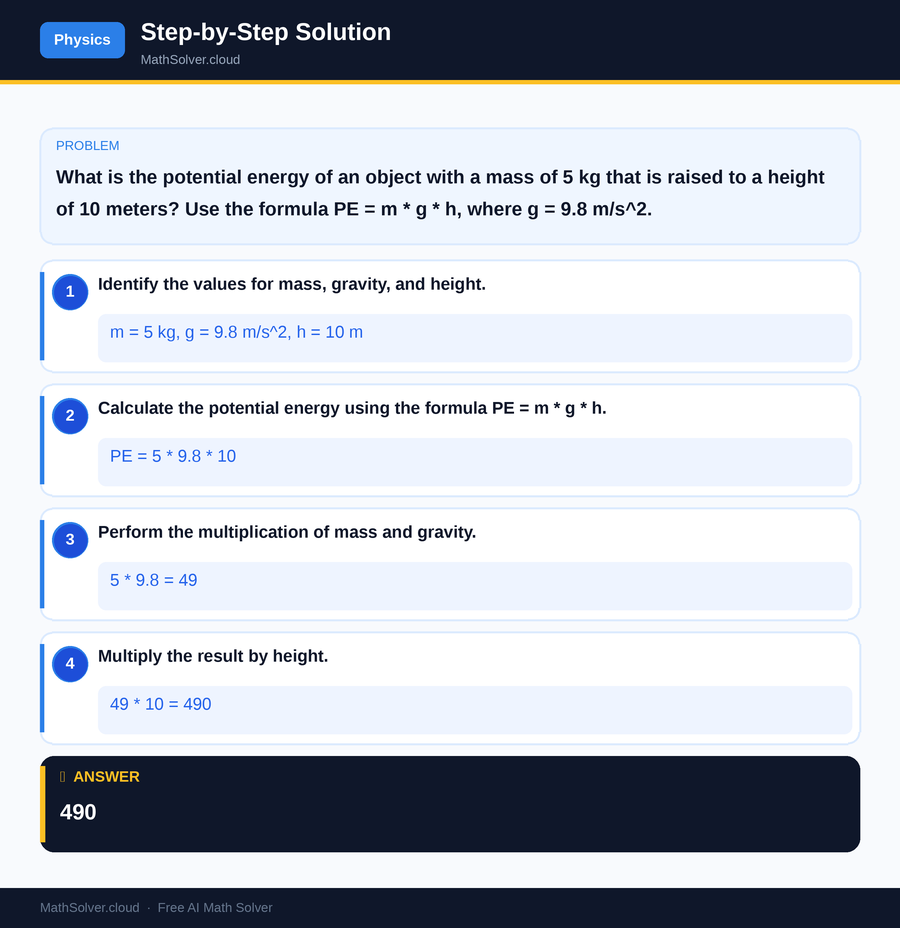
MathSolver Chrome extension solving this problem step-by-step
Example 2
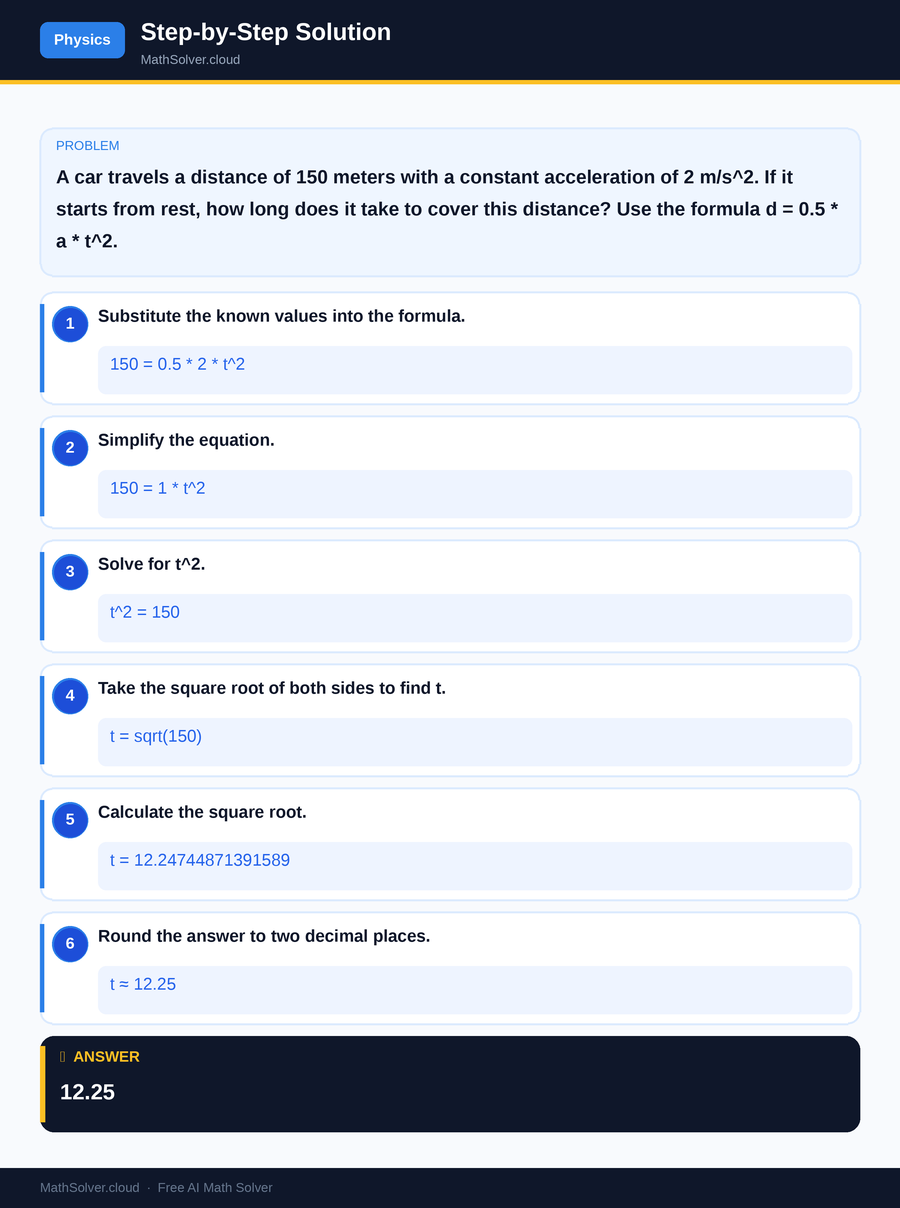
MathSolver Chrome extension solving this problem step-by-step
Common Mistakes to Avoid
One common mistake when using math formulas is failing to convert units properly. If the units of the given values do not match the standard units required by the formula, incorrect results may occur. Always ensure that units are consistent before substituting values into a formula. Another frequent error is misplacing numbers or signs during substitution. Double-check your work to avoid simple arithmetic mistakes.
Another pitfall is not fully understanding the formula's purpose. Students sometimes apply the wrong formula to a problem due to a lack of understanding of its components. To overcome this, review the formula thoroughly and understand each variable's role before applying it. Practice regularly to become familiar with various formulas and their applications.
Real-World Applications
Math formulas are used extensively in various real-world applications. In engineering, they are crucial in designing structures and systems, ensuring they function safely and efficiently. For instance, the angular velocity equation is vital in mechanical engineering to determine the rotation speed of objects.
In medicine, med math formulas are used to calculate correct dosages for patients. Accurate calculations ensure that patients receive the proper amount of medication, minimizing the risk of adverse effects. Math formulas are also essential in finance, helping analysts predict market trends and assess investment risks.
Frequently Asked Questions
❓ What are math formulas used for?
❓ What are some common student questions about math formulas?
❓ How can AI help with math formulas?
❓ What is the difference between SAT math formulas and ACT math formulas?
❓ Did Blaise Pascal have any famous inventions or math formulas?
🚀 Solve any math problem instantly
2,000+ students use MathSolver every day — join them for free
📥 Add to Chrome — It's Free