Mastering the Angular Velocity Equation
📋 In this guide
The angular velocity equation is a fundamental concept in physics and mathematics that describes how quickly an object rotates around a specific point or axis. Many students find this topic challenging because it involves understanding rotational motion, which can be less intuitive than linear motion. Additionally, the need to switch between different units, such as revolutions per minute and radians per second, adds another layer of complexity. In this article, you'll learn what the angular velocity equation is, how to apply it in different scenarios, and how to avoid common pitfalls.
Understanding the angular velocity equation is crucial for students who wish to excel in fields that involve rotational dynamics, such as physics and engineering. This equation helps describe the rotational speed of objects, which is essential for calculating other important variables like torque and centripetal force. By mastering the angular velocity equation, students can unlock a deeper understanding of both theoretical concepts and practical applications.
Moreover, this article will provide you with a step-by-step guide to solving problems related to angular velocity, complete with detailed examples. You'll also discover how this equation is applied in real-life scenarios, from the wheels of a car to the blades of a wind turbine. By the end of this article, you'll be well-equipped to tackle questions involving angular velocity with confidence.
Step-by-Step: How to Solve Angular Velocity Equation
Understanding Angular Displacement
The first step in using the angular velocity equation is to understand angular displacement, which is the angle through which an object has rotated about a fixed axis. This angle is typically measured in radians. To convert from degrees to radians, remember that 1 degree equals pi/180 radians. Knowing the initial and final angles allows you to calculate the total angular displacement, which is essential for determining angular velocity.
Measuring Time
Once you've determined the angular displacement, the next step is to measure the time taken for this rotation. Time is a straightforward measurement, usually recorded in seconds. It's essential to ensure that the time period is accurately measured, as even a small error can significantly affect the calculated angular velocity. Accurate timing is particularly crucial in experiments and real-life applications where precise rotational speeds are needed.
Applying the Angular Velocity Equation
With both the angular displacement and the time period in hand, you can now apply the angular velocity equation: omega = theta / t. Divide the angular displacement by the time to find the angular velocity. Ensure that your units are consistent, particularly that the angle is in radians and the time is in seconds, to avoid errors. This will give you the angular velocity in radians per second.
Converting Units if Necessary
In some cases, you might need to convert the angular velocity to different units, such as from radians per second to revolutions per minute. To do this, remember that 1 revolution equals 2*pi radians, and 1 minute equals 60 seconds. Use these conversion factors to switch between units as needed, making sure to maintain consistency in your calculations.
🤖 Stuck on a math problem?
Take a screenshot and let our AI solve it step-by-step in seconds
⚡ Try MathSolver Free →Worked Examples
Example 1
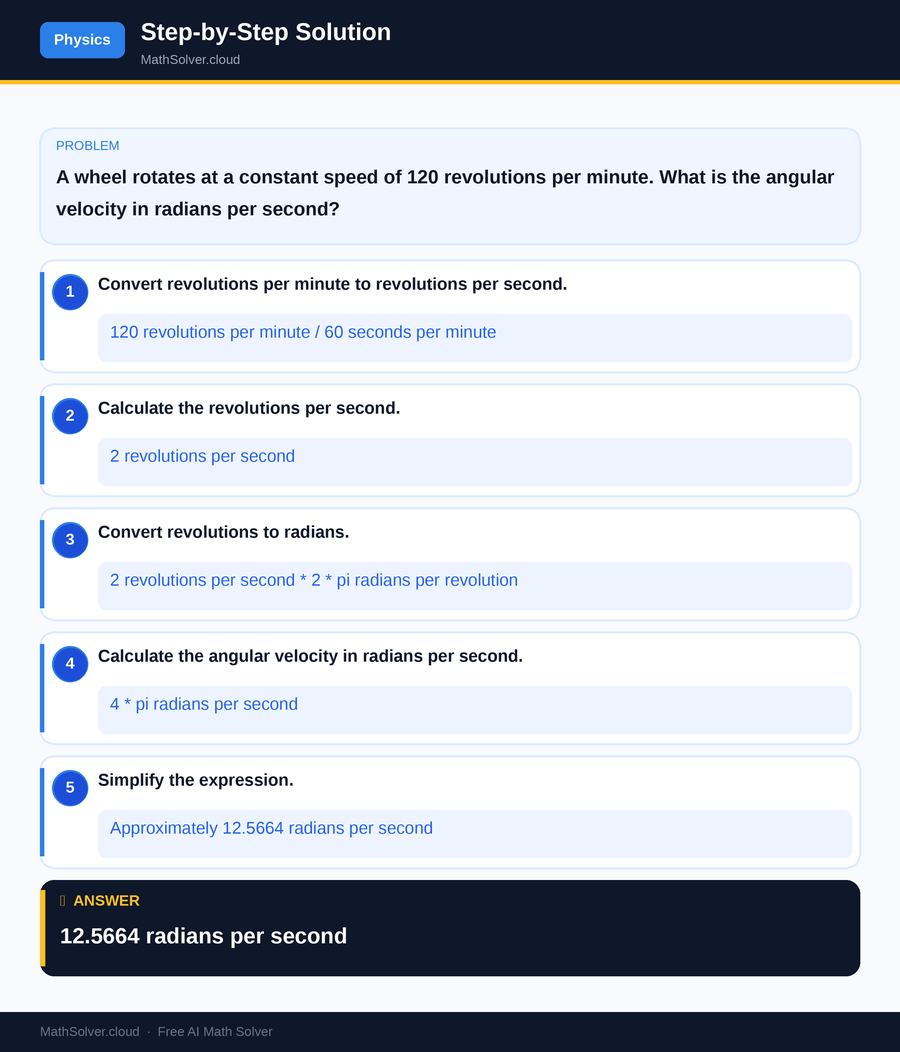
MathSolver Chrome extension solving this problem step-by-step
Example 2
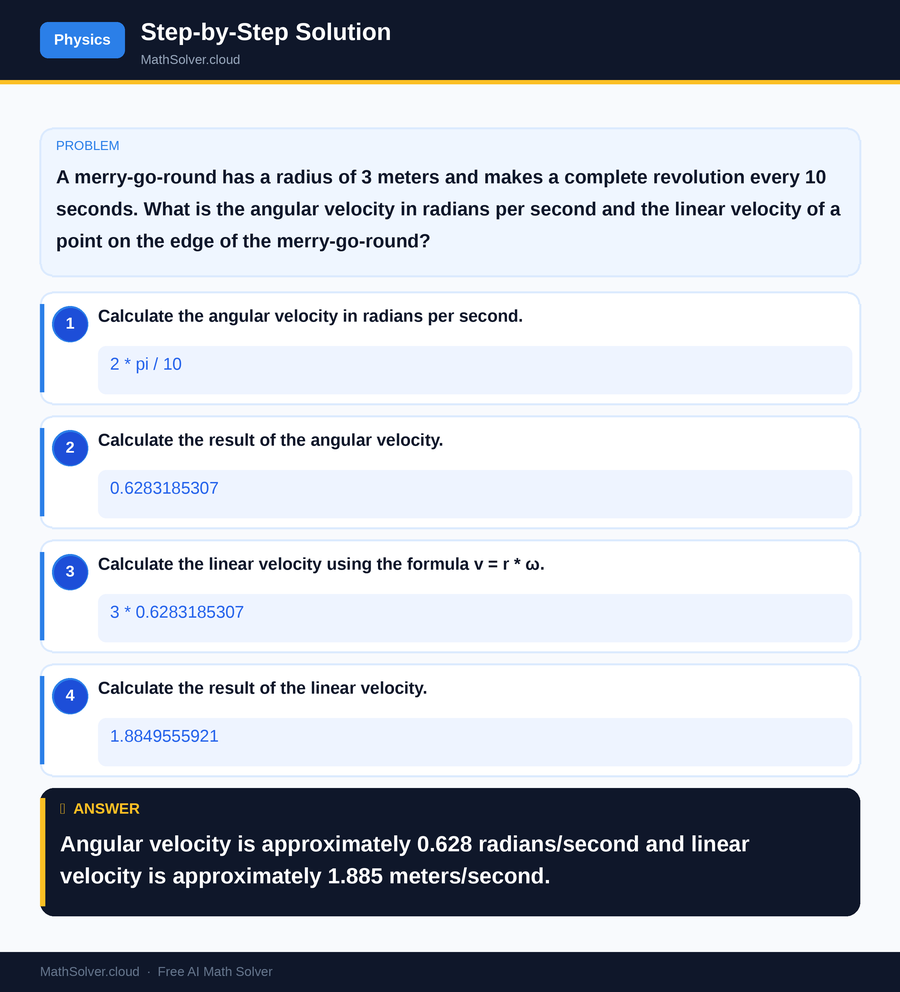
MathSolver Chrome extension solving this problem step-by-step
Common Mistakes to Avoid
One common mistake students make is confusing linear velocity with angular velocity. Remember that linear velocity refers to how fast a point on the edge of the rotating object is moving in a straight line, whereas angular velocity refers to how fast the object is rotating around its axis. Another frequent error is neglecting to convert angles from degrees to radians, which can lead to inaccurate results. Always double-check your unit conversions and ensure consistency across your calculations.
Another pitfall is misinterpreting the time period. Ensure that the time used in your calculations corresponds to the exact duration of the rotational motion. Mistakes here can lead to significant discrepancies in your final answer. It's always a good idea to verify your calculations with alternative methods or examples to ensure accuracy.
Real-World Applications
The angular velocity equation is widely used in various real-world applications. For instance, in automotive engineering, understanding angular velocity is crucial for designing the components of car engines and calculating the rotational speeds of wheels. This ensures that vehicles operate efficiently and safely on the road.
In the field of renewable energy, angular velocity plays a significant role in the design and operation of wind turbines. By calculating the angular velocity of turbine blades, engineers can optimize energy capture and improve the efficiency of power generation. These real-world applications highlight the importance of mastering the angular velocity equation for students interested in pursuing careers in science and technology.
Frequently Asked Questions
❓ What is the angular velocity equation used for?
❓ Why do students struggle with the angular velocity equation?
❓ How can AI help with the angular velocity equation?
❓ How is angular velocity different from linear velocity?
❓ What are some practical examples of angular velocity?
🚀 Solve any math problem instantly
2,000+ students use MathSolver every day — join them for free
📥 Add to Chrome — It's Free