Demystifying the AP Physics Equation Sheet
📋 In this guide
The AP Physics equation sheet is an essential tool for students tackling the Advanced Placement Physics exams. These exams are known for their complexity, and the equation sheets are designed to help students quickly access necessary formulas during the test. However, many students find themselves overwhelmed by the sheer number of equations and struggle to understand which formula applies to which problem. This guide will demystify the AP Physics equation sheet, making it a valuable asset rather than a source of stress.
Students often struggle with the AP Physics equation sheet because it encompasses a wide range of topics, including kinematics, dynamics, electromagnetism, and more. Each section contains multiple formulas, and without a clear understanding of the underlying concepts, it's easy to get lost. By learning how to effectively use the equation sheet, students can enhance their problem-solving efficiency and accuracy during exams.
In this article, you'll find a comprehensive breakdown of the key formulas included in the AP Physics equation sheet. We'll provide a step-by-step guide to using these formulas, complete with worked examples to illustrate their application. Whether you're preparing for the AP Physics exam in 2025 or reviewing the AP Physics equation sheet from 2015, this guide will equip you with the knowledge you need to succeed.
Step-by-Step: How to Solve Ap Physics Equation Sheet
Step 1: Understanding the Sections of the Equation Sheet
The AP Physics equation sheet is divided into sections, each corresponding to different topics in physics, such as mechanics, electricity, and magnetism. Begin by familiarizing yourself with these sections so you can quickly locate the formulas you need. For instance, if you are solving a problem related to motion, turn your attention to the mechanics section where kinematic equations are found.
Step 2: Identifying the Problem Type
Once you identify the section of the equation sheet, the next step is to determine the type of problem you are solving. Are you dealing with a problem involving forces, energy, or motion? By categorizing the problem, you can narrow down the list of potential formulas, making it easier to select the correct one. This step is crucial because selecting the wrong formula can lead to incorrect solutions.
Step 3: Selecting the Correct Formula
With the problem type in mind, scan the relevant section of the AP Physics equation sheet for the formula that fits your problem. Pay close attention to the variables in your problem and match them with the variables in the formulas. For example, if you are given initial velocity, acceleration, and time, you might use the formula d = vt + 0.5at^2 to calculate distance.
Step 4: Applying the Formula
Once you have selected the appropriate formula, substitute the known values into the equation. Carefully perform the calculations, ensuring that you keep track of units throughout the process. Double-check your work to avoid simple arithmetic mistakes. Practicing this process will increase your confidence and speed during the actual AP Physics exam.
🤖 Stuck on a math problem?
Take a screenshot and let our AI solve it step-by-step in seconds
⚡ Try MathSolver Free →Worked Examples
Example 1
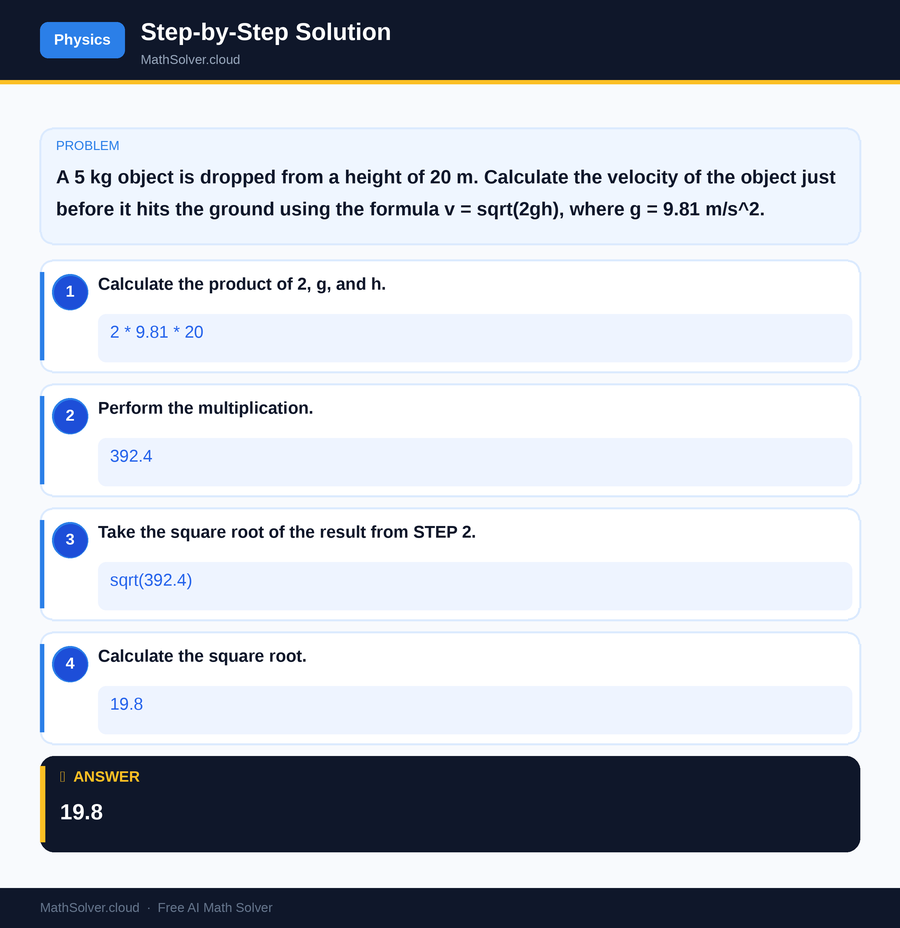
MathSolver Chrome extension solving this problem step-by-step
Example 2
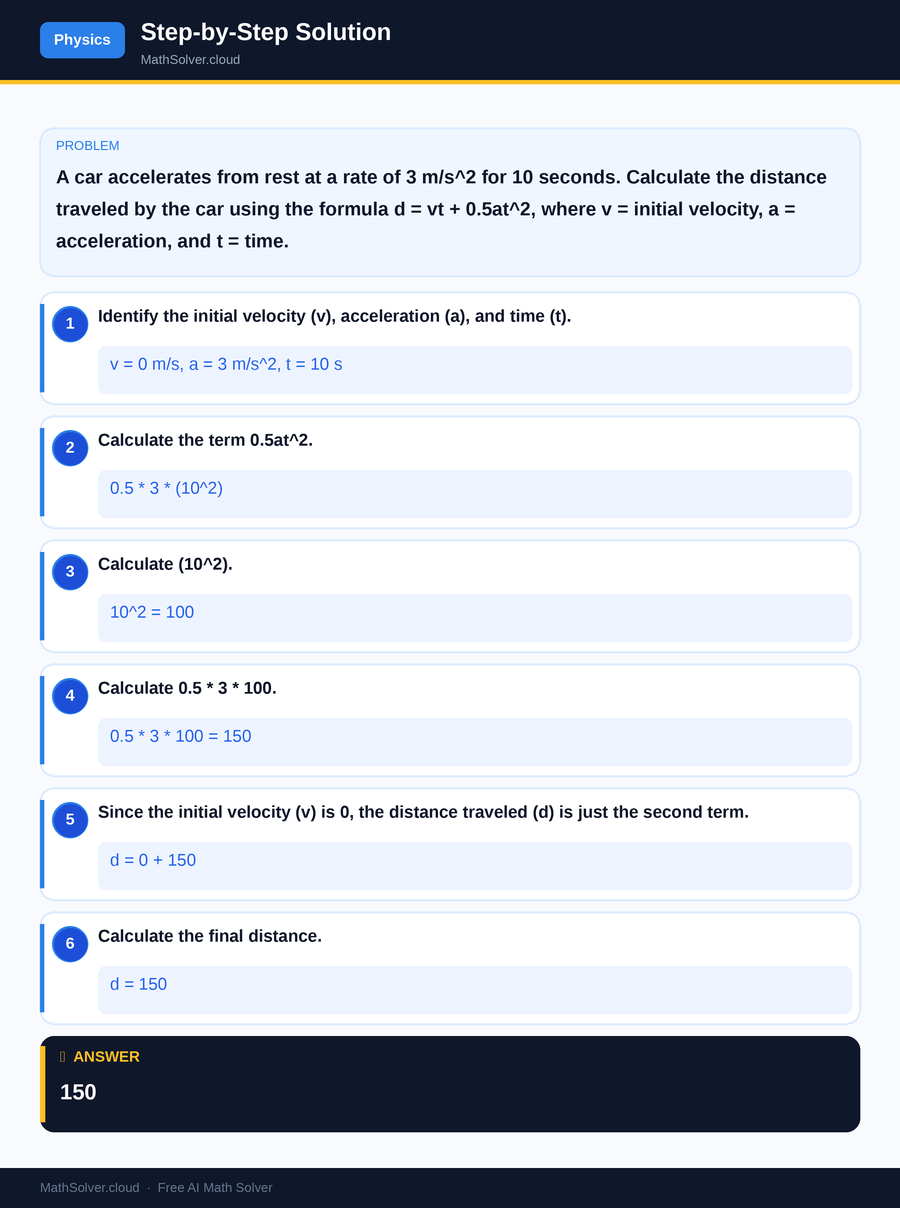
MathSolver Chrome extension solving this problem step-by-step
Common Mistakes to Avoid
A frequent mistake students make when using the AP Physics equation sheet is misidentifying the problem type. This can lead to using incorrect formulas, resulting in wrong answers. Always take the time to understand what the problem is asking before jumping into calculations. Carefully matching your variables with the equation is a crucial step.
Another common error is neglecting units. Physics calculations often involve different units, and failing to keep track of them can lead to significant mistakes. For example, ensuring that all units are consistent before solving a problem can prevent confusion and incorrect results. Always double-check your units, especially in complex calculations.
Real-World Applications
The AP Physics equation sheet isn't just a tool for exams; it's also relevant in real-world scenarios. Engineers use these equations to design structures, calculate forces, and ensure safety. For example, civil engineers might use kinematic equations to calculate the forces acting on a bridge under varying loads.
In the automotive industry, the principles derived from the AP Physics equation sheet are applied to improve vehicle safety and performance. Understanding acceleration, velocity, and force helps in designing efficient braking systems and enhancing fuel efficiency. These applications demonstrate the practical importance of mastering the AP Physics equations.
Frequently Asked Questions
❓ What is the AP Physics equation sheet, and how can I use it effectively?
❓ What should I do if I struggle to remember all the formulas?
❓ How can AI help with the AP Physics equation sheet?
❓ How often do the AP Physics equation sheets change?
❓ Why is it important to understand algebra equations for AP Physics?
🚀 Solve any math problem instantly
2,000+ students use MathSolver every day — join them for free
📥 Add to Chrome — It's Free