Unlocking the AP Physics Equation Sheet C
📋 In this guide
The AP Physics Equation Sheet C is a crucial resource for students preparing for the AP Physics C exams, covering both Mechanics and Electricity & Magnetism. This sheet is a comprehensive collection of the essential formulas and equations needed for solving complex physics problems on the exam. Many students find themselves struggling with the AP Physics Equation Sheet C due to the sheer volume of information and the complexity of the topics covered. This article aims to demystify the equation sheet, providing a clear guide on how to use it effectively, as well as practical examples to enhance your understanding.
Students often feel overwhelmed by the AP Physics Equation Sheet C because it encapsulates a wide range of physics concepts, from kinematics and dynamics to electromagnetism and rotational motion. Learning to navigate and apply these equations correctly is crucial for success in the exam. By breaking down the equations into manageable sections, students can better understand the underlying principles and improve their problem-solving skills.
In this guide, you'll learn about the key formulas included in the AP Physics Equation Sheet C, how to approach problems step-by-step, and see worked examples that illustrate the application of these formulas. Additionally, we'll cover common mistakes to avoid, real-world applications of these equations, and answer frequently asked questions to further support your learning journey. Let's dive into the world of AP Physics C and unlock the potential of the equation sheet!
Step-by-Step: How to Solve Ap Physics Equation Sheet C
Step 1: Understanding the Problem
The first step in utilizing the AP Physics Equation Sheet C effectively is to thoroughly understand the problem you are trying to solve. Carefully read the problem statement and identify what is being asked. Determine the known variables and what you need to find. This process involves translating the word problem into a mathematical form, which often requires you to recognize which specific equations or concepts from the equation sheet apply to the scenario. For instance, determine whether the problem pertains to linear motion, rotational dynamics, or electromagnetism, as this will guide your equation selection.
Step 2: Selecting the Appropriate Equation
Once you have a clear understanding of the problem, the next step is to select the appropriate equation from the AP Physics Equation Sheet C. Refer back to the key formulas and identify which one fits the scenario based on the variables involved. Consider whether you need algebra equations, kinematic equations, or other specific formulas like the quadratic equation for certain types of motion. Selecting the correct equation is crucial for solving the problem accurately, so take your time to ensure your choice aligns with the given data and what you are trying to find.
Step 3: Substituting the Known Values
After selecting the correct equation, substitute the known values into the equation. This involves replacing the variables in the equation with the numerical values provided in the problem statement. Be careful with units and ensure consistency; for example, if time is given in seconds, velocity should be in meters per second for consistency in kinematic equations. This step requires precision, as any mistake in substitution can lead to incorrect results. Double-check your substitutions to reduce errors.
Step 4: Solving and Analyzing the Results
With the equation set up and the known values substituted, proceed to solve for the unknown variable. Perform the necessary algebraic manipulations to isolate the desired variable, and calculate its value. After obtaining the result, analyze it to ensure it is reasonable and makes sense in the context of the problem. If the outcome seems off, revisit your steps to check for any errors in calculation or equation use. Understanding the implications of your result is crucial, as it deepens your comprehension of the physics involved.
🤖 Stuck on a math problem?
Take a screenshot and let our AI solve it step-by-step in seconds
⚡ Try MathSolver Free →Worked Examples
Example 1

MathSolver Chrome extension solving this problem step-by-step
Example 2
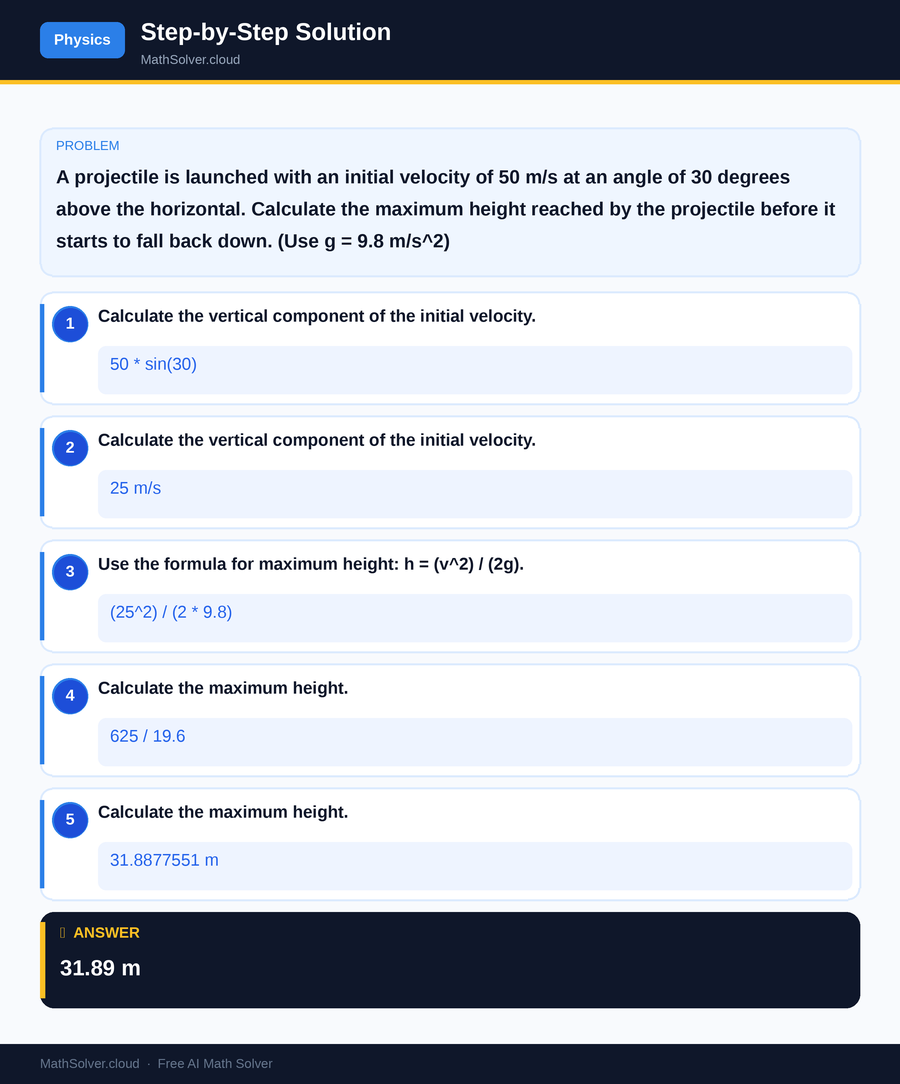
MathSolver Chrome extension solving this problem step-by-step
Common Mistakes to Avoid
One common mistake students make when using the AP Physics Equation Sheet C is selecting the wrong equation for the problem at hand. This often happens when students don't fully understand the concepts behind the equations or rush through the problem without careful consideration. To avoid this, take the time to thoroughly analyze the problem and ensure that you are using the correct formula. Another frequent error is incorrect unit conversion, which can lead to erroneous results. Always check that your units are consistent throughout the calculation process.
Another pitfall is neglecting the vector nature of certain quantities, such as velocity and force. Remember that these quantities have both magnitude and direction. Failing to account for direction can lead to incorrect solutions, especially in problems involving angles or multiple dimensions. Pay attention to the vector components and ensure that you are applying the equations correctly in each direction.
Real-World Applications
The equations on the AP Physics Equation Sheet C are not just theoretical; they have real-world applications across various fields. For example, engineers use these equations to design safer vehicles by understanding motion dynamics and collision impacts. In the field of sports science, analyzing the motion of objects, such as a soccer ball or a gymnast, relies on kinematic equations to improve performance and safety.
Another application is in the field of astronomy, where scientists use these equations to calculate the orbits of planets and the trajectories of spacecraft. By understanding the principles of motion and gravity, astronomers can predict celestial events and design missions to explore distant parts of our solar system. These examples highlight the importance of mastering the AP Physics Equation Sheet C, as the knowledge gained extends far beyond the classroom.
Frequently Asked Questions
❓ What is the AP Physics Equation Sheet C used for?
❓ Why do students struggle with the AP Physics Equation Sheet C?
❓ How can AI help with the AP Physics Equation Sheet C?
❓ How does mastering the AP Physics Equation Sheet C benefit students?
❓ What is the importance of vector components in solving physics problems?
🚀 Solve any math problem instantly
2,000+ students use MathSolver every day — join them for free
📥 Add to Chrome — It's Free