Understanding Vector Equation
📋 In this guide
The vector equation is a fundamental concept in mathematics that involves representing geometric figures using vectors. Students often face challenges with vector equations due to their abstract nature and the need to visualize geometric interpretations. This article will guide you through the essentials of vector equations, including their definitions, applications, and how you can effectively solve them. By the end of this article, you will be able to understand the vector equation of a line, plane, and its various applications in real-world scenarios.
Vector equations are crucial in fields such as physics, engineering, and computer graphics, where they help in describing paths, forces, and transformations. Despite their importance, many students struggle with vector equations because they require a firm grasp of both algebraic manipulation and geometric intuition. This article will provide a step-by-step guide to help demystify vector equations and make them more approachable.
Through examples and explanations, you will learn how to derive vector equations, understand their components, and solve related problems. Whether you're interested in the unit vector equation, projection vector equation, or eigenvector equation, the insights here will enhance your understanding and confidence in handling vector equations.
Step-by-Step: How to Solve Vector Equation
Step 1: Understanding the Components
Before diving into solving vector equations, it's crucial to understand their components. A vector equation involves a position vector and one or more direction vectors. The position vector locates a point in space, while the direction vectors indicate the direction and orientation of the line or plane. For instance, in the vector equation of a line r = a + tb, a is the position vector, and b is the direction vector. Recognizing these components helps in setting up the equation correctly.
Step 2: Setting Up the Vector Equation of a Line
To derive the vector equation of a line, identify a point through which the line passes and a vector parallel to the line. The point becomes your position vector a, and the parallel vector becomes your direction vector b. The line's vector equation is then r = a + tb. Here, t is a scalar that varies to give you different points along the line. This setup is essential in ensuring that the line is accurately represented in vector form.
Step 3: Constructing the Vector Equation of a Plane
Similar to a line, a plane in space can also be represented using vectors. To construct the vector equation of a plane, you need a point on the plane and two non-parallel vectors lying on the plane. These vectors, along with the position vector, form the equation r = a + su + tv, where a is the position vector, and u and v are the direction vectors. The parameters s and t allow you to locate any point on the plane.
Step 4: Solving Vector Equations
Solving vector equations involves finding specific values of the parameters that satisfy the equation. For lines, this could mean finding intersection points with other lines or planes. For planes, it might involve determining if a point lies on the plane. The key is to set up the equation using known points and vectors, then solve for the parameters. This often involves algebraic manipulation and substitution, making it vital to keep track of each component.
🤖 Stuck on a math problem?
Take a screenshot and let our AI solve it step-by-step in seconds
⚡ Try MathSolver Free →Worked Examples
Example 1
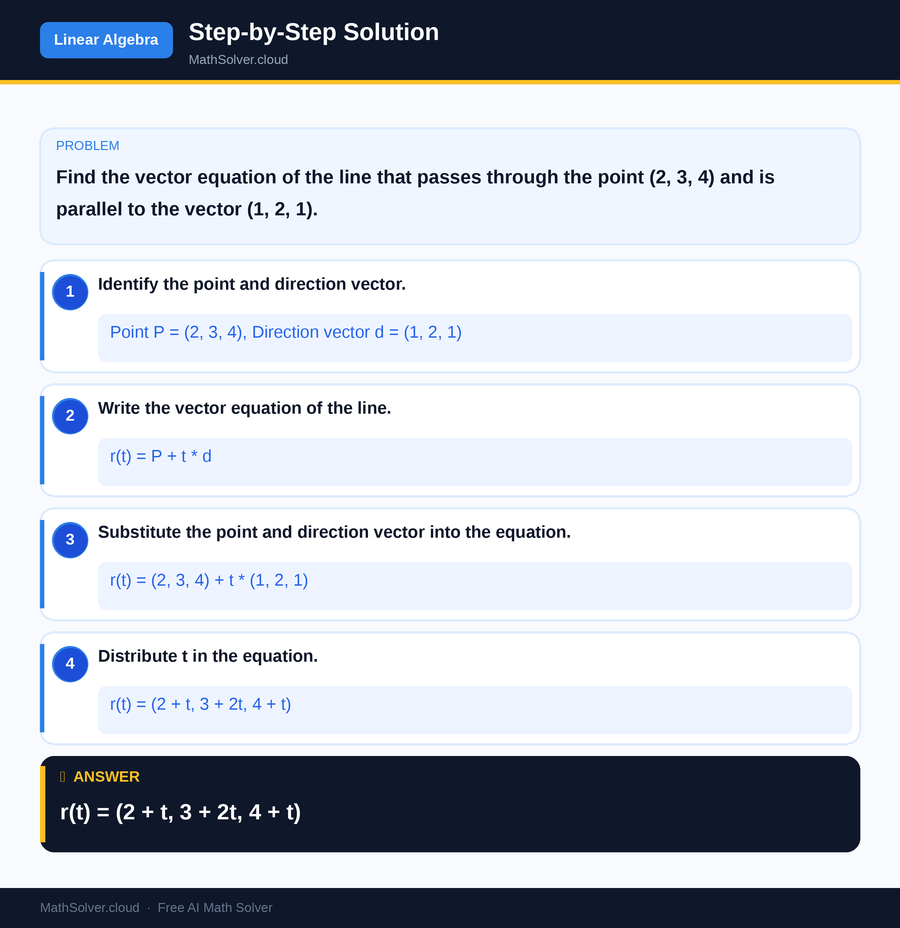
MathSolver Chrome extension solving this problem step-by-step
Example 2
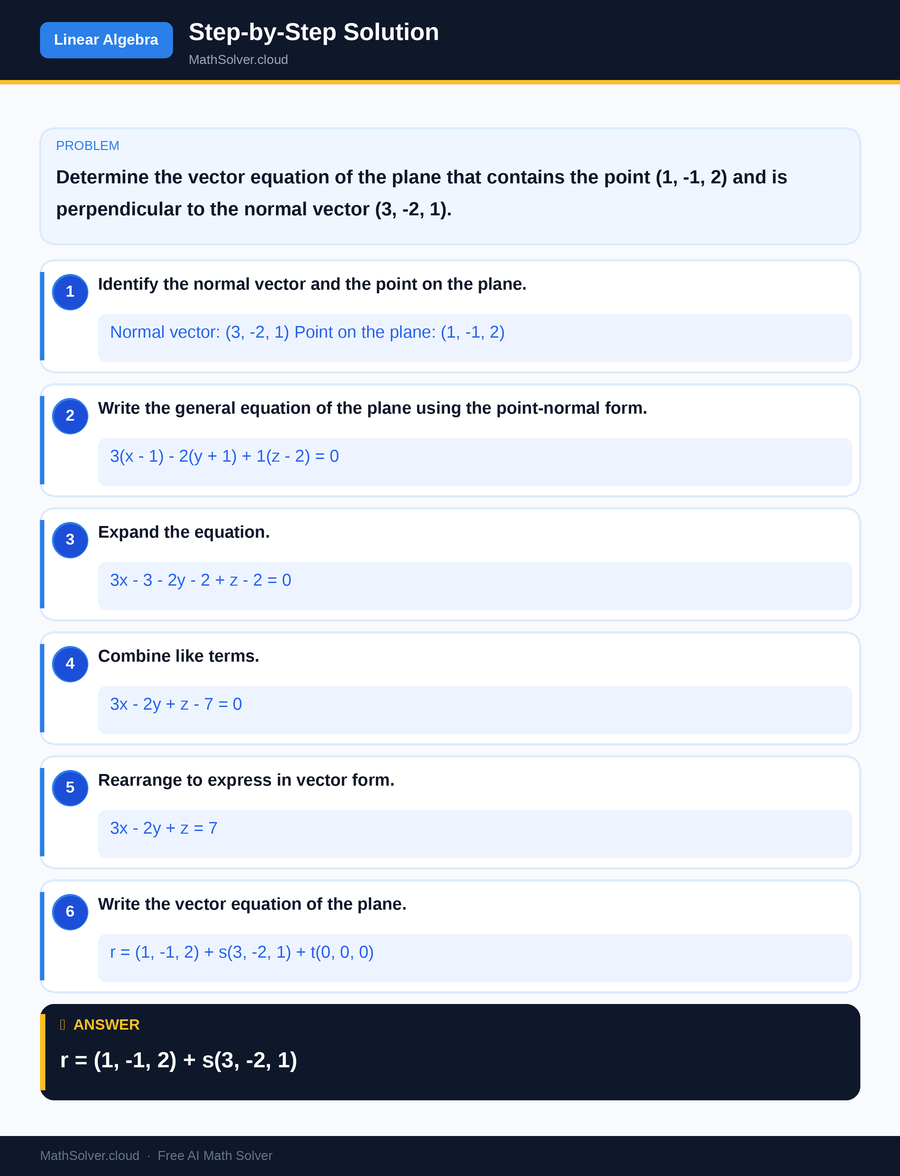
MathSolver Chrome extension solving this problem step-by-step
Common Mistakes to Avoid
One common mistake is confusing position and direction vectors. Remember, the position vector is a specific point, while the direction vector indicates movement. Another error is incorrectly setting up the equation by not aligning vectors correctly, which can lead to misleading results. Always verify that your vectors are properly defined and that you're using the correct formula for lines or planes.
Additionally, students often forget to check the validity of their solutions. Ensure that the derived equations are consistent by plugging back values to see if they satisfy the original conditions. This step is crucial in confirming the accuracy of your vector equations.
Real-World Applications
Vector equations have numerous real-world applications. In physics, they describe the motion of objects, capturing both direction and magnitude, essential in fields like mechanics and electromagnetism. In engineering, vector equations are used to model forces and predict the behavior of structures under various loads.
In computer graphics, vector equations are fundamental in rendering images and animations. They help in defining shapes, paths, and transformations, allowing for realistic simulations and visuals. Understanding these applications emphasizes the importance of mastering vector equations for practical problem-solving.
Frequently Asked Questions
❓ What is a vector equation?
❓ How do you find the vector equation of a line?
❓ How can AI help with vector equation?
❓ What is the difference between a unit vector equation and a regular vector equation?
❓ How are vector equations used in navigation?
🚀 Solve any math problem instantly
2,000+ students use MathSolver every day — join them for free
📥 Add to Chrome — It's Free