Mastering the Determinant Matrix Solver
📋 In this guide
A determinant matrix solver is a vital tool in linear algebra that helps students calculate the determinant of a matrix, which is a unique number associated with square matrices. Students often find determinants challenging because they involve intricate calculations and require a good grasp of mathematical concepts. Understanding determinants is crucial because they play a significant role in solving systems of linear equations, finding inverse matrices, and understanding properties of transformations. In this article, you will learn how to use a determinant matrix solver effectively, along with the steps to manually calculate determinants of matrices, ensuring a solid understanding of the topic.
Many students struggle with the concept of determinants due to their abstract nature and the precision required in calculations. Mistakes can easily occur, especially when dealing with larger matrices. This article aims to break down the process into manageable steps, providing a clear and friendly guide. Whether you are a beginner or looking to refine your skills, this guide will help you navigate the complexities of determinants with confidence.
By the end of this article, you will understand the key formula for finding a determinant, learn a step-by-step method to calculate it manually, and explore real-world applications of determinants. Additionally, you'll discover how AI tools like the MathSolver Chrome extension can simplify the process, offering instant, step-by-step solutions. With this comprehensive guide, you'll be well-equipped to tackle determinants and enhance your understanding of linear algebra.
Step-by-Step: How to Solve Determinant Matrix Solver
Step 1: Identify the Size of the Matrix
Before calculating the determinant, determine the size of the matrix as the method varies with the matrix dimension. A 2x2 matrix uses a straightforward formula, whereas a 3x3 matrix involves more complex calculations. Knowing the matrix size helps you choose the correct approach and prevents unnecessary confusion. For larger matrices, consider breaking them down into smaller components or use a reliable determinant matrix solver to simplify the process.
Step 2: Applying the Formula for a 2x2 Matrix
For a 2x2 matrix, apply the determinant formula directly. Multiply the elements along the main diagonal and subtract the product of the off-diagonal elements. This simple calculation is often the first step students learn in understanding determinants. Practicing with several examples will help reinforce the concept and build confidence in manually computing the determinant for smaller matrices.
Step 3: Expanding the Determinant for a 3x3 Matrix
When dealing with a 3x3 matrix, the process involves expanding the determinant along a row or a column. Choose any row or column, then multiply each element by the determinant of the 2x2 matrix that remains after removing the row and column of the element considered. Remember to alternate the signs starting with a positive sign for the top-left element. This step requires careful attention to detail to ensure accuracy and avoid common pitfalls.
Step 4: Verify the Calculations
After computing the determinant, it's crucial to verify your calculations, especially for larger matrices. Check each step meticulously and re-calculate if necessary. Using an AI math solver or a determinant matrix solver can help confirm your results and provide instant feedback. This step helps reinforce your understanding and ensures that you have arrived at the correct solution.
🤖 Stuck on a math problem?
Take a screenshot and let our AI solve it step-by-step in seconds
⚡ Try MathSolver Free →Worked Examples
Example 1
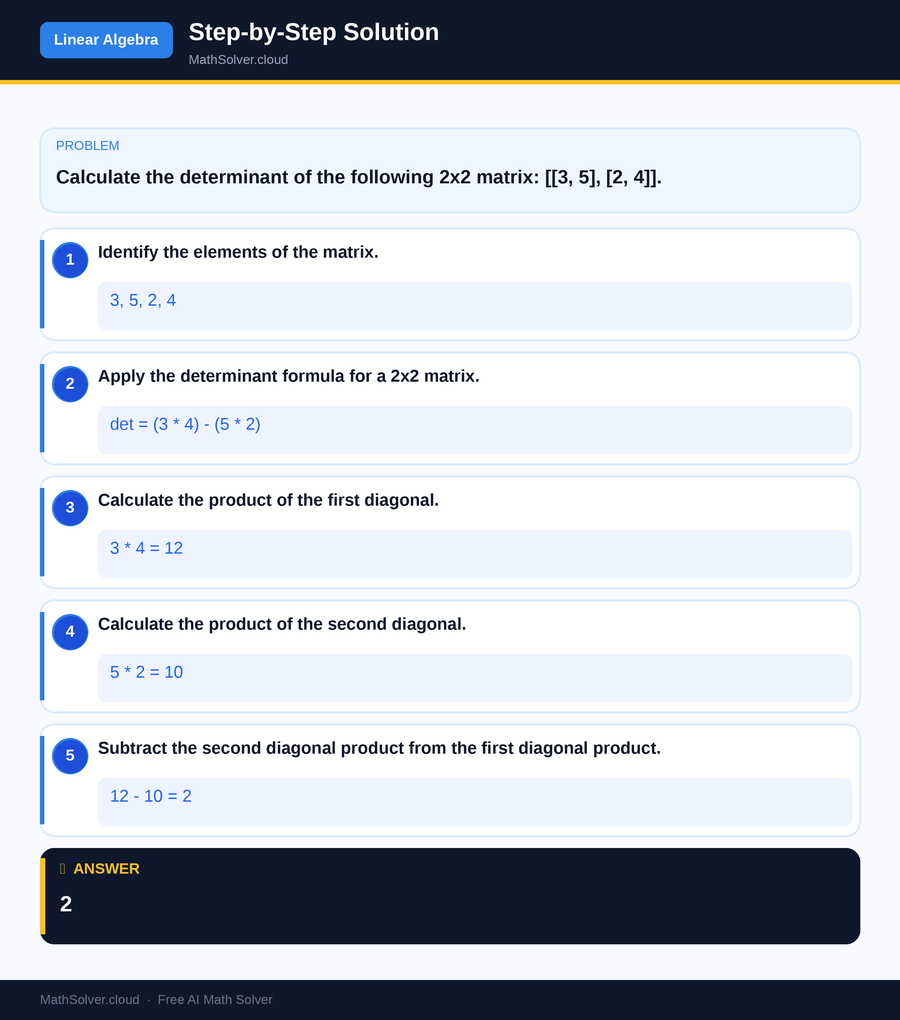
MathSolver Chrome extension solving this problem step-by-step
Example 2
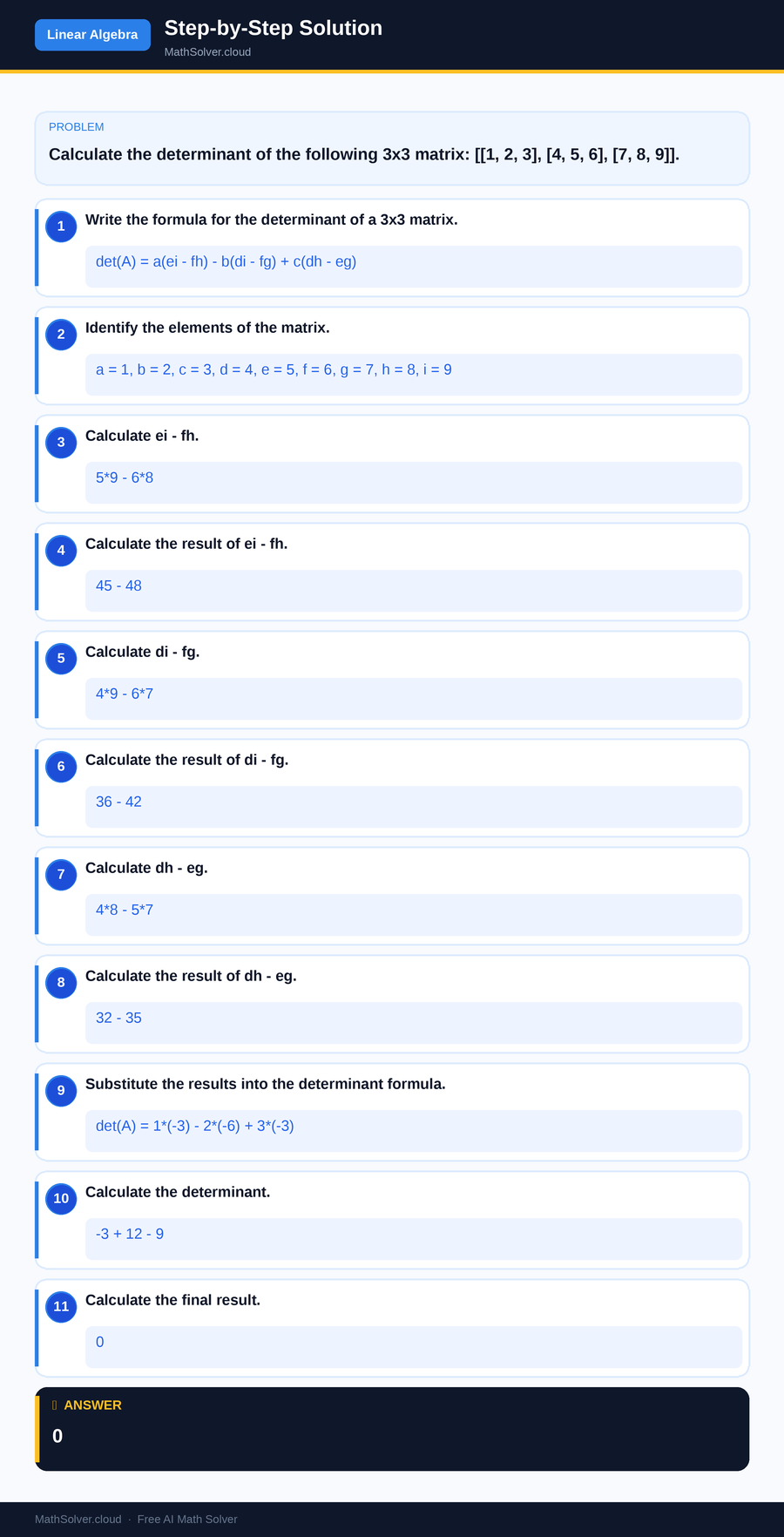
MathSolver Chrome extension solving this problem step-by-step
Common Mistakes to Avoid
One common mistake is miscalculating the products of elements, especially when dealing with negative numbers and alternating signs in 3x3 matrices. To avoid this, carefully write each step and double-check your arithmetic. Another frequent error is improper matrix expansion, particularly in larger matrices. Always ensure the correct minors are used, and maintain the correct sign for each term.
Another mistake students make is skipping the verification step. It's easy to overlook minor errors that can lead to incorrect results. Always go back and review your calculations, or better yet, use a determinant matrix solver or a math AI solver like Microsoft Math Solver to confirm your answers.
Real-World Applications
Determinants are used in various real-world applications, particularly in fields that require an understanding of linear transformations and systems of equations. In engineering, determinants help in analyzing electrical circuits and mechanical systems. In computer graphics, they play a role in transformations and projections, ensuring images are rendered correctly.
In economics, determinants are used in input-output models to study economic systems and predict changes. Determinants also find applications in physics, particularly in quantum mechanics, where they are used to solve systems of linear equations that describe quantum states.
Frequently Asked Questions
❓ What is the purpose of a determinant matrix solver?
❓ Why do students struggle with determinants?
❓ How can AI help with determinant matrix solver tasks?
❓ How is the determinant used in solving equations?
❓ Can determinants be calculated for non-square matrices?
🚀 Solve any math problem instantly
2,000+ students use MathSolver every day — join them for free
📥 Add to Chrome — It's Free