Mastering the Unit Vector Equation
📋 In this guide
The concept of the unit vector equation is fundamental in mathematics, especially in vector calculus and physics. A unit vector is a vector with a magnitude of 1, which points in the same direction as the original vector. Understanding how to compute a unit vector is essential for students tackling more advanced topics in algebra and physics. Students often struggle with the unit vector equation because it involves both conceptual understanding and precise calculations. This article will guide you through the intricacies of the unit vector equation, ensuring you gain a strong grasp of this important concept.
By the end of this article, students will have a comprehensive understanding of the unit vector equation. We will break down the definition and formula, provide a step-by-step guide to finding unit vectors, and solve example problems to illustrate the process clearly. Additionally, we will highlight common mistakes and how to avoid them, as well as explore real-world applications of unit vectors. Whether you're a high school student tackling algebra equations or a college student delving into kinematic equations, this guide will equip you with the necessary skills to master unit vectors.
This article aims to demystify the unit vector equation and provide practical insights into its applications. By learning about unit vectors, students can enhance their problem-solving skills and apply these concepts to various disciplines, from physics to engineering. Understanding the unit vector equation is not only crucial for academic success but also for solving real-world problems that require vector analysis.
Step-by-Step: How to Solve Unit Vector Equation
Step 1: Calculate the Magnitude of the Vector
The first step in finding a unit vector is to calculate the magnitude of the original vector. The magnitude is the length of the vector and can be found using the formula |v| = sqrt(x^2 + y^2 + z^2) for a vector v = (x, y, z). If the vector is in two dimensions, as in v = (x, y), the magnitude is |v| = sqrt(x^2 + y^2). Calculating the magnitude accurately is crucial because it ensures that the resulting unit vector has a magnitude of 1.
Step 2: Divide Each Component by the Magnitude
Once you have the magnitude, the next step is to divide each component of the vector by this magnitude. This operation scales the vector to have a length of 1 while maintaining its direction. For a vector v = (x, y, z), the unit vector u is calculated as u = (x/|v|, y/|v|, z/|v|). This process requires careful arithmetic to ensure each component is divided correctly, a step where students often need to double-check their work.
Step 3: Verify the Unit Vector
After calculating the unit vector, it's important to verify that the resulting vector truly has a magnitude of 1. This step involves recalculating the magnitude of the unit vector using the formula |u| = sqrt((x/|v|)^2 + (y/|v|)^2 + (z/|v|)^2). The magnitude should equal 1, confirming that the vector is indeed a unit vector. Verification helps prevent errors and reinforces the understanding of the unit vector equation.
Step 4: Practice with Different Vectors
The final step is to practice finding unit vectors with various examples to reinforce understanding. Working through different vectors, including those with negative components or in three dimensions, ensures familiarity with the process. Practicing also involves solving related problems, such as using the unit vector equation within kinematic equations or relating it to a photosynthesis equation in biology, highlighting its versatility across disciplines.
🤖 Stuck on a math problem?
Take a screenshot and let our AI solve it step-by-step in seconds
⚡ Try MathSolver Free →Worked Examples
Example 1
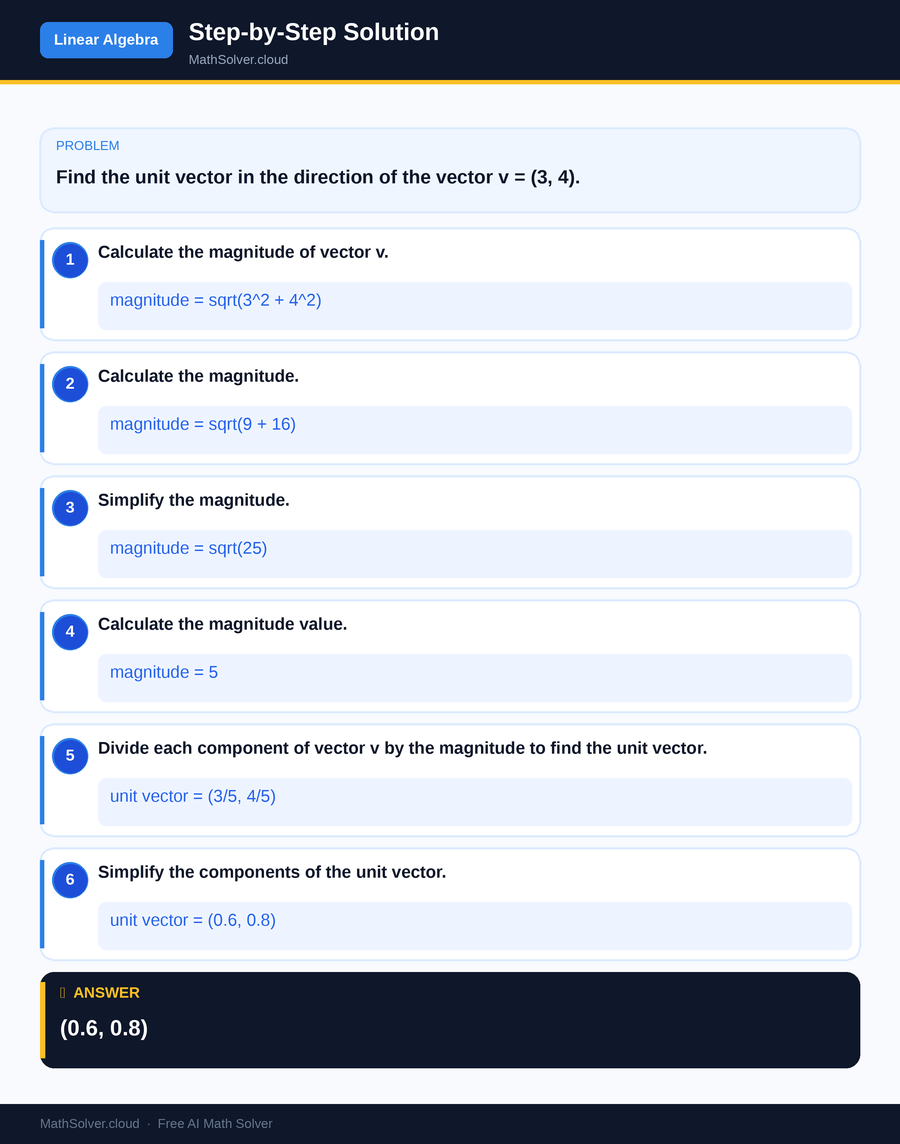
MathSolver Chrome extension solving this problem step-by-step
Example 2
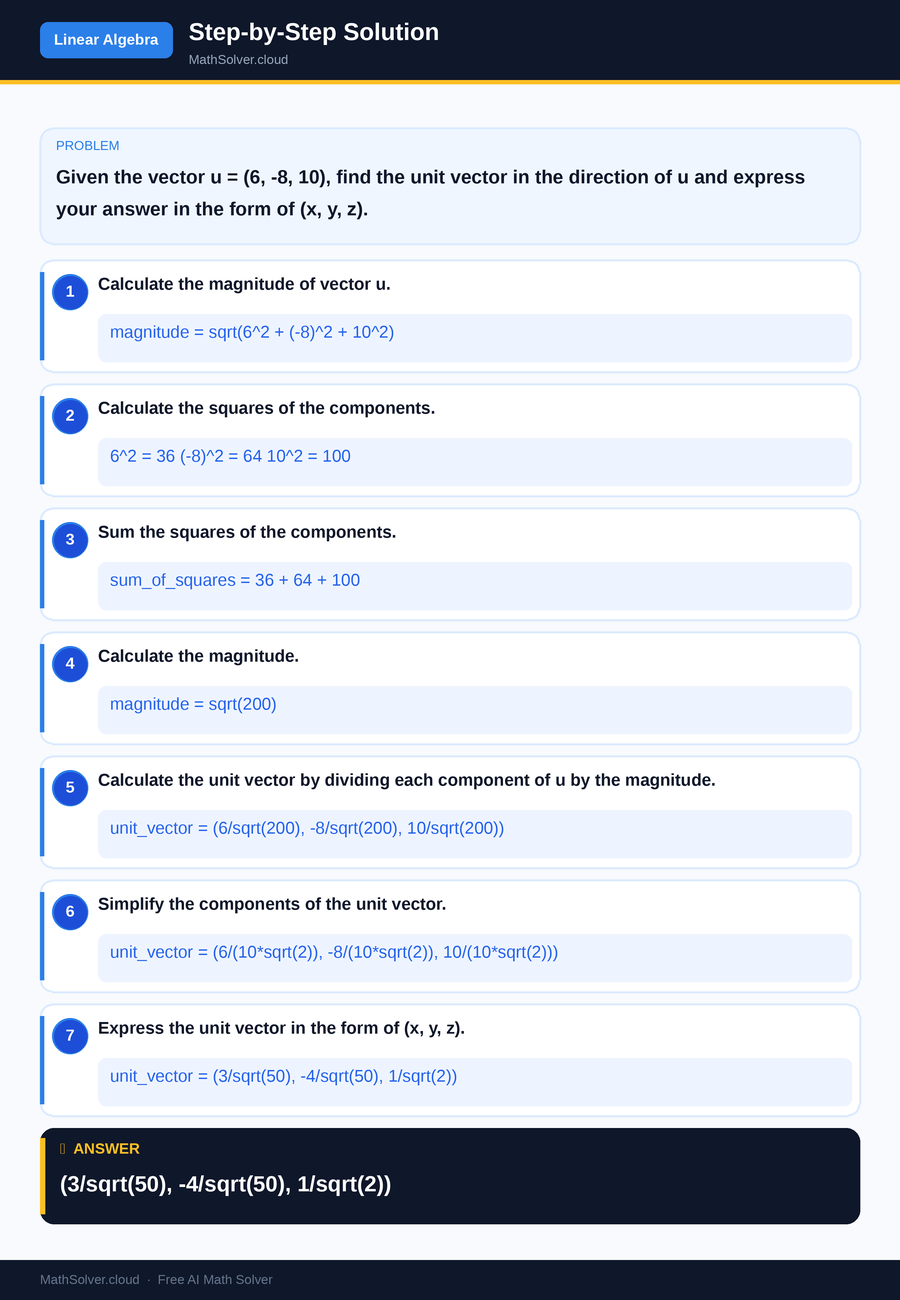
MathSolver Chrome extension solving this problem step-by-step
Common Mistakes to Avoid
One common mistake is miscalculating the magnitude of the vector, which directly affects the accuracy of the unit vector. Students should ensure they square each component correctly and sum these squares before taking the square root. Another frequent error is failing to divide each component of the vector by the magnitude, leading to a vector that is not a true unit vector. Double-checking calculations at each step can prevent these errors.
Another pitfall is assuming that the unit vector will have integer or simple fractional components. In reality, the components often involve square roots or irrational numbers. Students should be comfortable working with these numbers and simplifying expressions accurately. Consistent practice and attention to detail are key to mastering the unit vector equation.
Real-World Applications
Unit vector equations are used extensively in physics, particularly in representing directions of forces and velocities. For instance, in kinematic equations, unit vectors help break down motion into components, allowing for more manageable calculations. Engineers also use unit vectors to describe orientations and rotations in three-dimensional space, essential for designing mechanical systems and structures.
In computer graphics, unit vectors are crucial for defining the direction of lighting and camera angles, contributing to realistic rendering of scenes. In biology, while not directly related, the concept of vectors is employed in modeling processes like diffusion, which can be analogous to understanding the directionality in a photosynthesis equation. These applications demonstrate the versatility and importance of mastering unit vector equations.
Frequently Asked Questions
❓ What is the unit vector equation?
❓ Why is it important to learn about unit vectors?
❓ How can AI help with unit vector equations?
❓ What are some related mathematical topics to unit vectors?
❓ How are unit vectors used in engineering?
🚀 Solve any math problem instantly
2,000+ students use MathSolver every day — join them for free
📥 Add to Chrome — It's Free