Mastering the Matrix Multiplication Solver
📋 In this guide
A matrix multiplication solver is a powerful tool for students and professionals who need to handle complex matrix operations efficiently. Many students find matrix multiplication challenging due to the intricacies involved in aligning rows and columns correctly, and ensuring each multiplication and addition is performed accurately. In this article, you'll learn how to use a matrix multiplication solver effectively, understand the fundamental concepts behind matrix multiplication, and explore real-world applications where these skills are essential.
Matrix multiplication is a core concept in linear algebra, which is a foundational subject in various fields of science and engineering. Students often struggle with the mechanics of matrix multiplication because it requires precision and attention to detail. Misaligning a row or column, or missing a multiplication step, can lead to incorrect results. This guide will help demystify the process, providing a clear, step-by-step approach to mastering matrix multiplication.
By the end of this article, you will not only be able to solve matrix multiplication problems confidently but also understand where and how these skills apply in real-world scenarios. We'll also discuss common mistakes and how to avoid them, ensuring you have a solid grasp of this essential mathematical technique. Let's dive in and explore how a matrix multiplication solver can simplify these tasks.
Step-by-Step: How to Solve Matrix Multiplication Solver
Step 1: Understanding Matrix Dimensions
Before you begin multiplying matrices, it is crucial to understand the dimensions of the matrices involved. When multiplying two matrices, the number of columns in the first matrix must match the number of rows in the second matrix. For example, if you have matrix A with dimensions m x n and matrix B with dimensions n x p, you can multiply them to get a resulting matrix with dimensions m x p. If these conditions aren't met, matrix multiplication is not defined.
Step 2: Align Rows and Columns
Once you've confirmed that matrix multiplication is possible, align the rows of the first matrix with the columns of the second matrix. This alignment is critical because it ensures that each element in the resulting matrix is computed correctly. For each element in the resulting matrix, you will compute the sum of the products of corresponding entries from the row of the first matrix and the column of the second matrix.
Step 3: Compute the Dot Product
For each element in the resulting matrix, calculate the dot product of the corresponding row from the first matrix and the column from the second matrix. This involves multiplying each pair of corresponding elements and then summing those products. Be systematic in your approach, calculating each element one at a time to avoid errors. This methodical process ensures accuracy in your computations.
Step 4: Construct the Resulting Matrix
After computing the dot products for each row-column pair, construct the resulting matrix by placing each computed value in its respective position. The resulting matrix will have the same number of rows as the first matrix and the same number of columns as the second matrix. Double-check each element to ensure that no calculations were overlooked or performed incorrectly.
🤖 Stuck on a math problem?
Take a screenshot and let our AI solve it step-by-step in seconds
⚡ Try MathSolver Free →Worked Examples
Example 1

MathSolver Chrome extension solving this problem step-by-step
Example 2
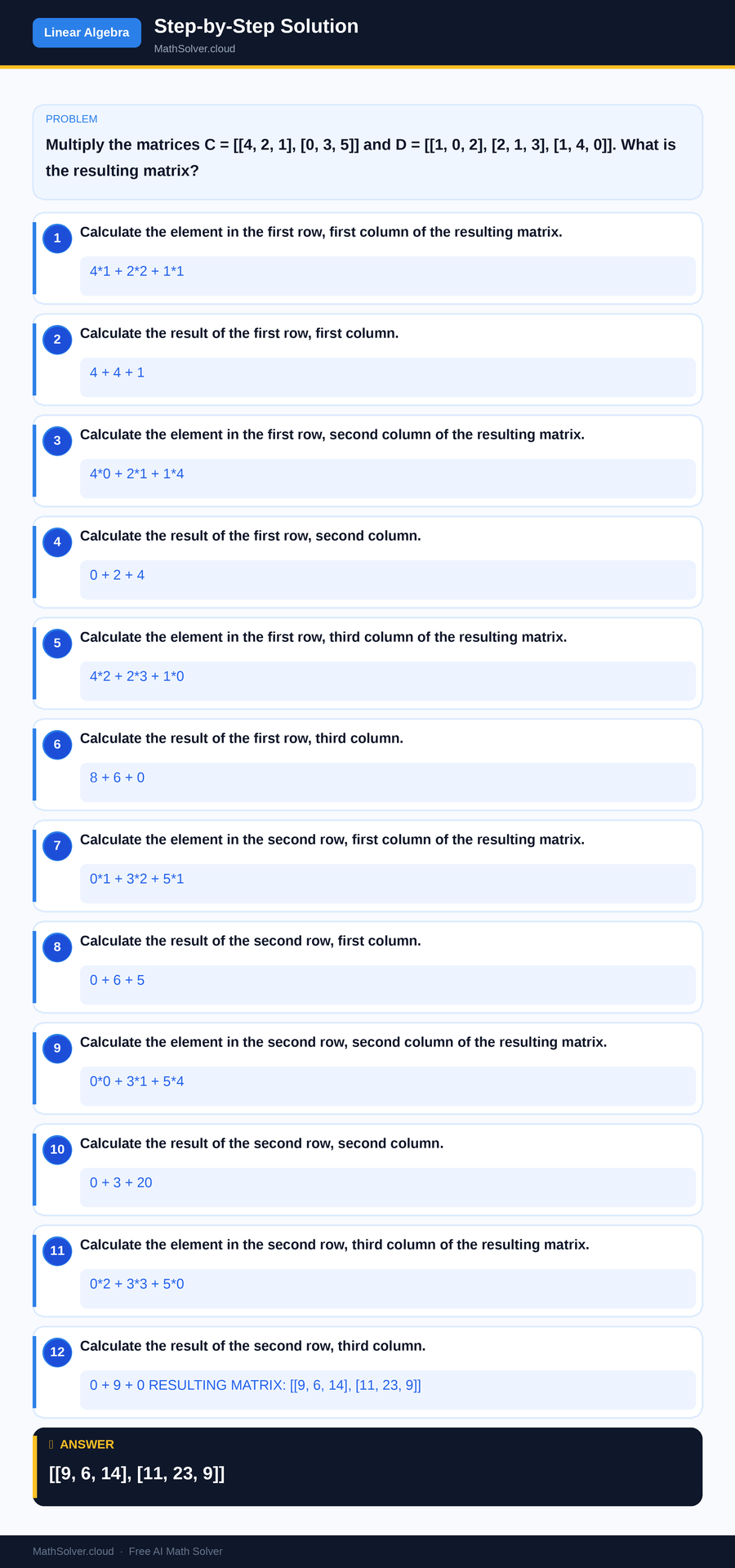
MathSolver Chrome extension solving this problem step-by-step
Common Mistakes to Avoid
One of the most common mistakes in matrix multiplication is misaligning the rows and columns. Students often confuse the order of multiplication, leading to incorrect results. To avoid this, always double-check the dimensions before performing any calculations and ensure the number of columns in the first matrix matches the number of rows in the second matrix.
Another frequent error is forgetting to sum the products when calculating each element of the resulting matrix. It's easy to multiply the pairs of elements but forget to add them together to get the final value. To prevent this, write down each step as you compute the dot products, and verify your calculations to ensure accuracy.
Real-World Applications
Matrix multiplication solvers have significant applications in various fields. In computer graphics, for example, matrices are used to perform transformations such as rotations, translations, and scaling of 3D models. By multiplying matrices representing these transformations, complex animations and visual effects can be achieved efficiently.
In data science, matrices are used to represent datasets, and matrix multiplication is a key operation in many machine learning algorithms. These algorithms rely on matrix operations to process and analyze large volumes of data, making matrix multiplication an essential tool for data scientists and engineers.
Frequently Asked Questions
❓ What is a matrix multiplication solver?
❓ Why is matrix multiplication considered challenging?
❓ How can AI help with matrix multiplication solver?
❓ What happens if the matrices cannot be multiplied?
❓ How is matrix multiplication related to unit vector equations?
🚀 Solve any math problem instantly
2,000+ students use MathSolver every day — join them for free
📥 Add to Chrome — It's Free