Comprehensive Guide to Inverse Matrix Solver
📋 In this guide
An inverse matrix solver is a mathematical tool used to find the inverse of a square matrix, a task that can be quite challenging for many students. The inverse of a matrix is crucial in solving systems of linear equations, among other applications. However, understanding the process of finding an inverse matrix can be daunting, involving complex calculations and specific conditions that must be met for an inverse to even exist. In this article, we'll demystify the process, guiding you through each step and providing clear examples to enhance your understanding.
Students often struggle with inverse matrices because of the intricate nature of the calculations involved, including determinants and matrix multiplication. The confusion can be compounded by the need to remember various mathematical rules and conditions. This article aims to simplify these complexities by breaking down the process into manageable steps and providing practical examples to illustrate each concept effectively.
By the end of this article, you'll have a comprehensive understanding of the inverse matrix solver, equipped with the knowledge to tackle both theoretical and practical problems. We'll explore the key formula, walk through a detailed guide on solving inverse matrices, and provide examples and tips to avoid common mistakes. Whether you're preparing for an exam or looking to apply these concepts in real-world scenarios, this guide is designed to build your confidence and competence in handling inverse matrices.
Step-by-Step: How to Solve Inverse Matrix Solver
Step 1: Determine If the Inverse Exists
Before attempting to find the inverse of a matrix, it's essential to determine whether an inverse exists. This involves calculating the determinant of the matrix. For a 2x2 matrix A = [[a, b], [c, d]], the determinant is given by det(A) = ad - bc. If the determinant is zero, the matrix does not have an inverse, and the process stops here. If the determinant is non-zero, the matrix is invertible, and you can proceed to the next steps.
Step 2: Use the Formula for 2x2 Matrices
Once you have confirmed that the matrix is invertible, you can apply the inverse formula specific to 2x2 matrices. The inverse of matrix A = [[a, b], [c, d]] is given by A^(-1) = (1/det(A)) * [[d, -b], [-c, a]]. This formula involves swapping the positions of a and d, changing the signs of b and c, and multiplying the entire matrix by the reciprocal of the determinant. This step ensures that when the original matrix is multiplied by its inverse, the result is the identity matrix.
Step 3: Apply the Formula to Larger Matrices
For larger matrices, such as 3x3, the process involves more complex steps including finding the matrix of minors, the cofactor matrix, and the adjugate matrix. First, you need to calculate the determinant of the 3x3 matrix. Then, find the matrix of minors by calculating the determinant of each 2x2 submatrix. Next, create the cofactor matrix by applying a checkerboard pattern of positive and negative signs to the minors. Transpose this cofactor matrix to get the adjugate matrix. Finally, multiply the adjugate matrix by 1/det(A) to find the inverse.
Step 4: Verify Your Results
After calculating the inverse, it's crucial to verify your results by performing matrix multiplication. Multiply the original matrix by its calculated inverse. If the result is the identity matrix, your inverse is correct. This step not only confirms your solution but also reinforces your understanding of the relationship between a matrix and its inverse. If the product is not the identity matrix, revisit your calculations to identify and correct any errors.
🤖 Stuck on a math problem?
Take a screenshot and let our AI solve it step-by-step in seconds
⚡ Try MathSolver Free →Worked Examples
Example 1
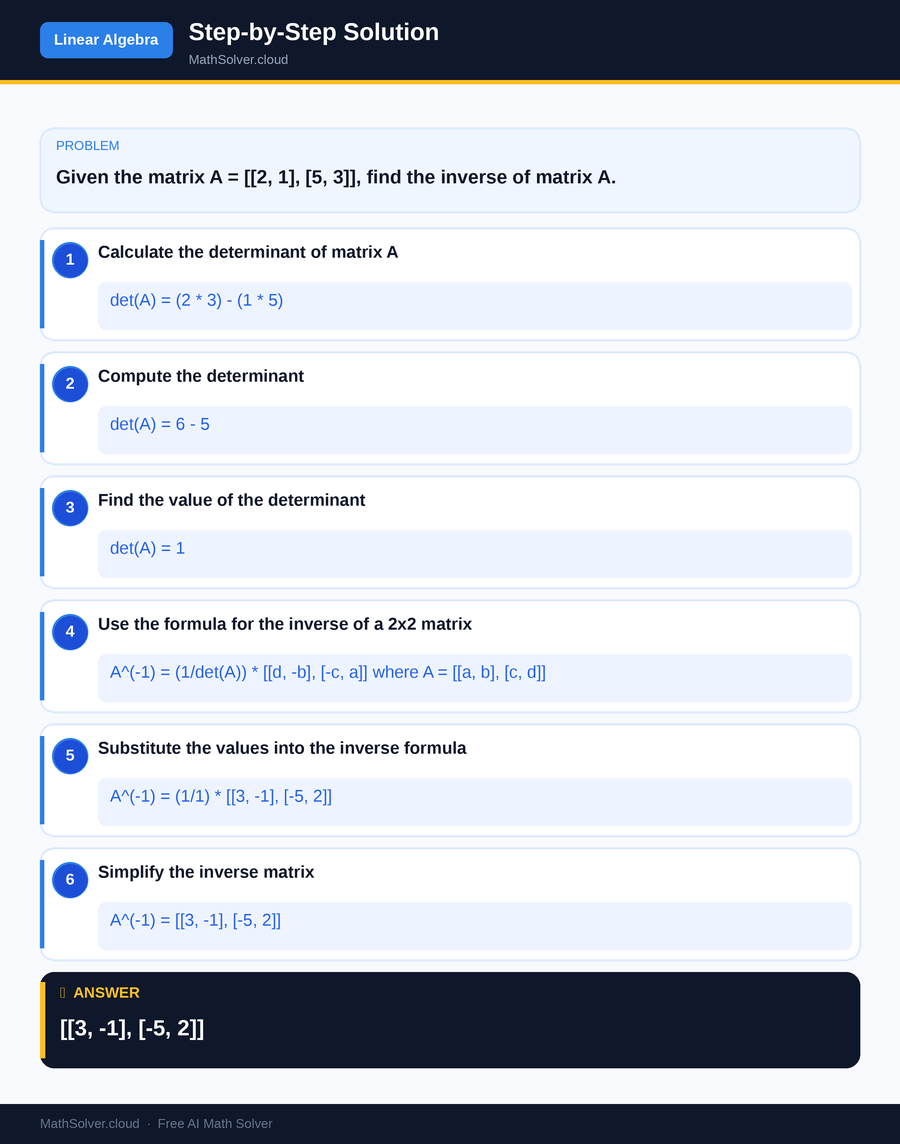
MathSolver Chrome extension solving this problem step-by-step
Example 2
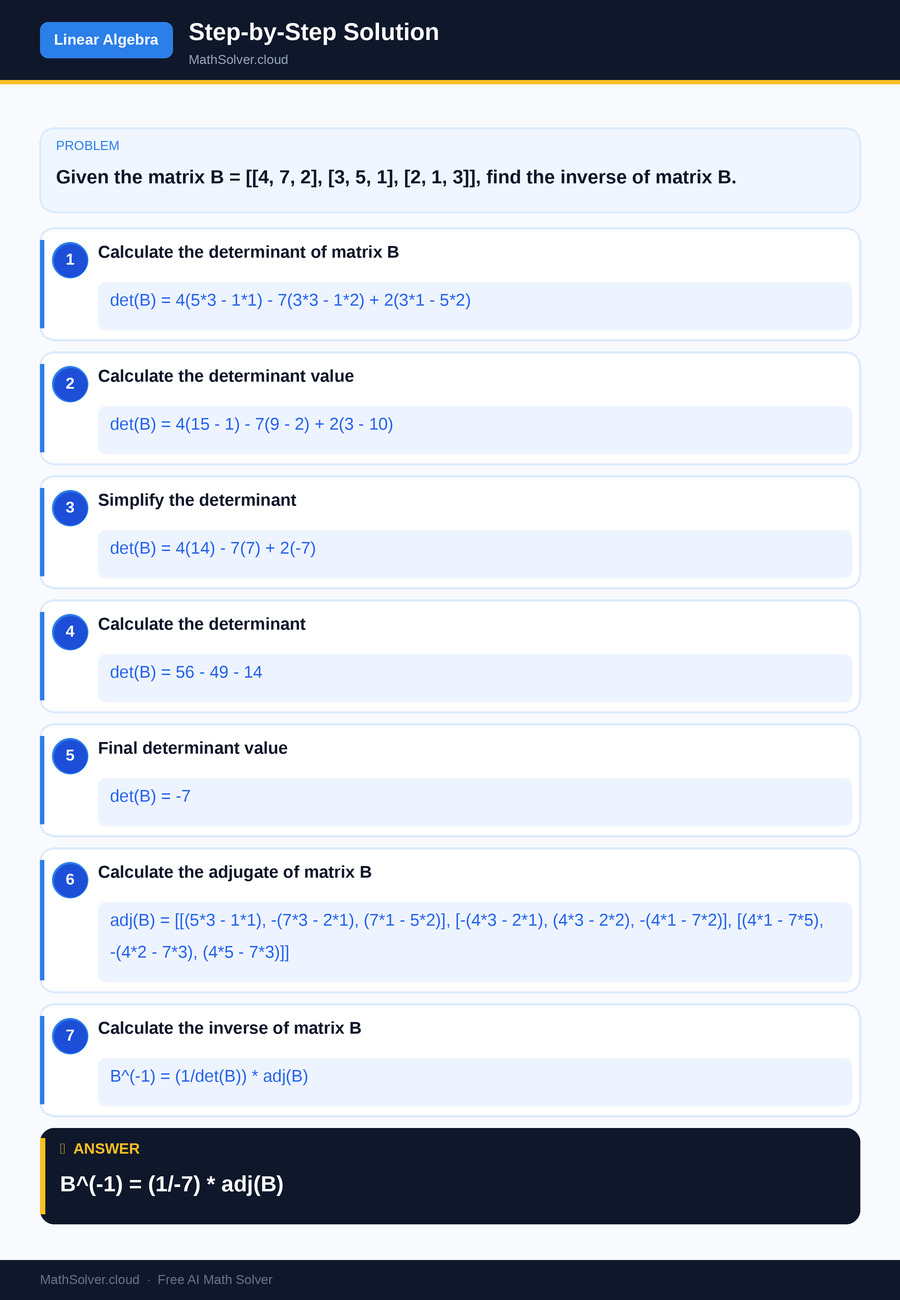
MathSolver Chrome extension solving this problem step-by-step
Common Mistakes to Avoid
One common mistake students make when using an inverse matrix solver is neglecting to check whether the determinant is zero before attempting to find the inverse. A zero determinant means the matrix is not invertible, and any further calculations are invalid. Always calculate the determinant first to avoid unnecessary work.
Another frequent error is in the sign application when finding the cofactor matrix. When creating the cofactor matrix, remember to apply a checkerboard pattern of positive and negative signs. This step is crucial for correctly calculating the adjugate matrix, which is essential for finding the inverse of larger matrices.
Real-World Applications
Inverse matrix solvers are widely used in various real-world applications. For instance, in computer graphics, inverse matrices are used to transform shapes and images, allowing for the efficient manipulation and rendering of 3D models. This application is crucial in video game development and simulations.
In the field of engineering, inverse matrices are employed in systems modeling and control. Engineers use them to analyze and design complex systems, such as electrical circuits and mechanical structures, ensuring stability and optimal performance. The ability to compute inverse matrices accurately is essential in these applications to predict and control system behavior.
Frequently Asked Questions
❓ What is an inverse matrix solver and how can it help in mathematics?
❓ Why can't all matrices have an inverse?
❓ How can AI help with inverse matrix solver problems?
❓ What is the relationship between inverse matrices and unit vector equations?
❓ When should I use a matrix multiplication solver instead of finding an inverse?
🚀 Solve any math problem instantly
2,000+ students use MathSolver every day — join them for free
📥 Add to Chrome — It's Free