Mastering the Vector Equation of a Line
📋 In this guide
The vector equation of a line is a fundamental concept in linear algebra and vector calculus that students often find challenging. It provides a way to describe a line in terms of vectors, which can be both a powerful and abstract way to think about geometry. This approach is essential for understanding more advanced topics in mathematics, physics, and engineering, where lines are not just static objects but dynamic entities that can be manipulated and transformed. However, many students struggle with the vector equation of a line due to the abstraction involved and the need to understand both vector operations and the geometric interpretations simultaneously.
In this article, you will learn what the vector equation of a line is, the key formula associated with it, and how to apply it in various scenarios. By the end of this guide, you will be equipped with the knowledge to confidently solve problems involving vector equations of lines, from basic to more complex applications. We will also explore common pitfalls students encounter and how to avoid them, ensuring that you have a comprehensive understanding of the topic.
Furthermore, we will delve into real-world applications of the vector equation of a line, illustrating its importance beyond the classroom. Whether you are preparing for an exam or seeking to deepen your understanding, this article will serve as a valuable resource in your mathematical journey. So, let's dive into the world of vectors and lines, and discover the elegant and practical uses of the vector equation of a line.
Step-by-Step: How to Solve Vector Equation Of A Line
Step 1: Identify the Point and Direction Vector
To begin finding the vector equation of a line, you first need to identify a point through which the line passes, usually denoted as P(x_1, y_1, z_1), and a direction vector, v(a, b, c). The point gives you a specific location on the line, while the direction vector indicates how the line extends in space. This step is crucial because these components are the building blocks of the vector equation.
Step 2: Write the Position Vector of the Point
Convert the point P(x_1, y_1, z_1) into a position vector r_0, which is simply
Step 3: Formulate the Vector Equation
Using the point's position vector r_0 and the direction vector v(a, b, c), you can formulate the vector equation of the line as r(t) = r_0 + t * v. In this equation, t is a scalar that can take any real number value, allowing you to find any point along the line by varying t. This vector equation encapsulates the continuous nature of a line.
Step 4: Verify the Equation with Specific Values
Finally, to ensure your vector equation is correct, substitute specific values of t into the equation and verify that the resulting points lie on the intended line. For instance, when t = 0, the equation should yield the original point r_0. Checking different values of t can help confirm that the direction vector is correctly describing the line's path.
🤖 Stuck on a math problem?
Take a screenshot and let our AI solve it step-by-step in seconds
⚡ Try MathSolver Free →Worked Examples
Example 1
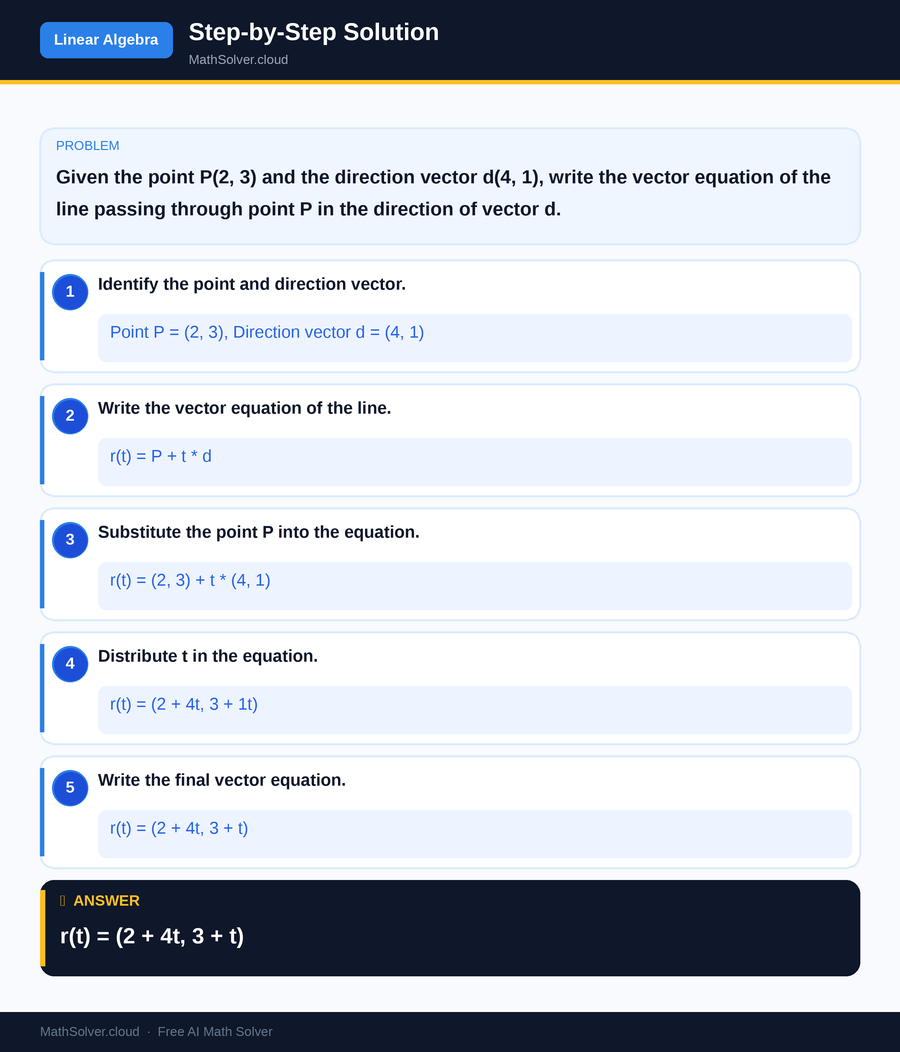
MathSolver Chrome extension solving this problem step-by-step
Example 2
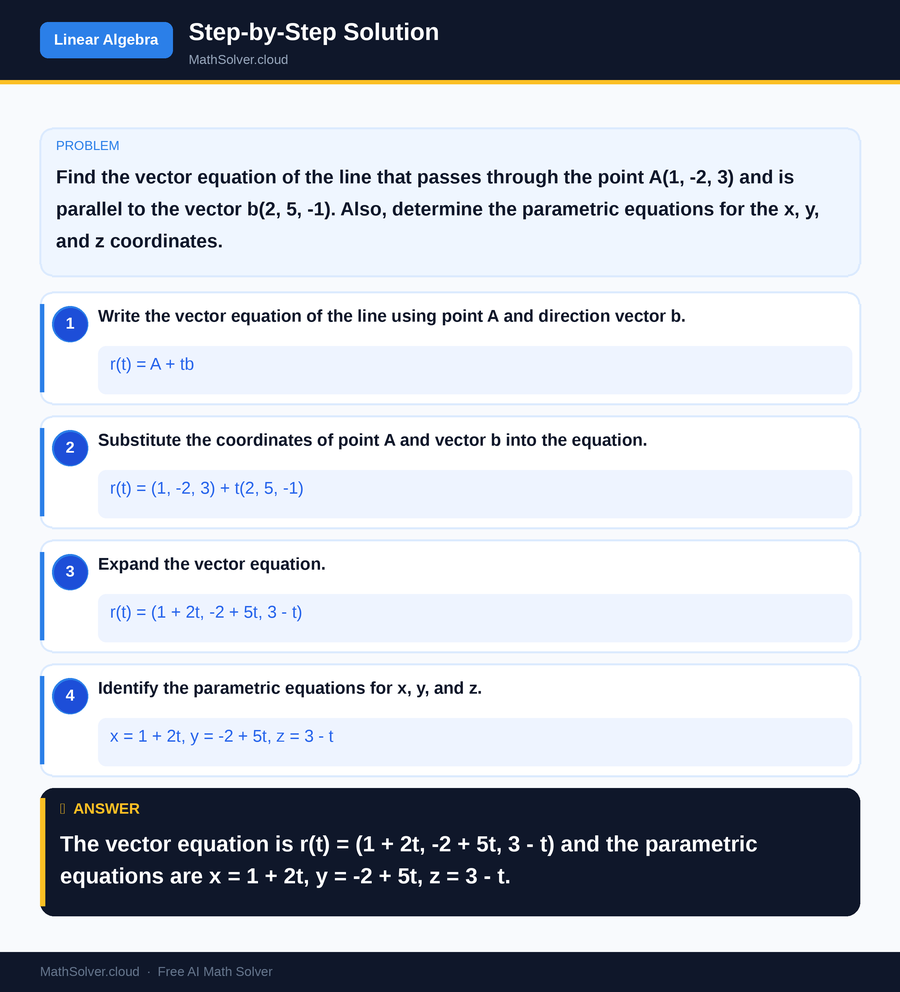
MathSolver Chrome extension solving this problem step-by-step
Common Mistakes to Avoid
One common error students make when dealing with the vector equation of a line is confusing the direction vector with a point on the line. It's crucial to remember that the direction vector indicates the line's orientation and does not represent an actual point on the line. Another mistake is neglecting to ensure the direction vector is not a zero vector, as this would not define a valid line.
Students may also struggle with parameterizing the line correctly. Misplacing terms or incorrectly simplifying the vector equation can lead to incorrect parametric equations. Always carefully verify each step, particularly when substituting and simplifying expressions, to avoid these pitfalls.
Real-World Applications
The vector equation of a line has numerous practical applications across various fields. In computer graphics, for instance, it is used to represent lines and edges in three-dimensional modeling. This allows for the creation of realistic simulations and animations where precise control over lines and angles is necessary.
In physics, the vector equation of a line is essential for describing motion paths of objects. Engineers use this concept to design and analyze structures, ensuring that beams and components align correctly according to specified directions. These examples highlight the utility of vector equations in bridging theoretical mathematics with real-world problem-solving.
Frequently Asked Questions
❓ What is the vector equation of a line?
❓ How do you find the vector equation of a line?
❓ How can AI help with the vector equation of a line?
❓ What are the parametric equations derived from a vector equation of a line?
❓ Where else can vector equations be useful?
🚀 Solve any math problem instantly
2,000+ students use MathSolver every day — join them for free
📥 Add to Chrome — It's Free