Understanding the Two Step Equations Calculator
📋 In this guide
A two step equations calculator is an invaluable tool for students who need help solving algebraic equations that require more than a single step to find the solution. Many students find these equations challenging because they involve multiple operations that must be performed in a specific order. The goal of this article is to provide a comprehensive understanding of how a two step equations calculator works and how it can assist students in mastering these types of equations. Along the way, we'll explore the key formulas, provide detailed examples, and highlight common mistakes to avoid.
Understanding two step equations is crucial for students as they advance in mathematics. These equations are often a stepping stone to more complex problems, and mastering them can build confidence and improve problem-solving skills. With a two step equations calculator, students can quickly verify their answers and understand the steps involved in reaching the solution. This article will guide you through the process of solving these equations, providing clear explanations and practical examples.
By the end of this article, you'll know how to effectively use a two step equations calculator, recognize common pitfalls, and see the real-world applications of these mathematical problems. Whether you're a student looking to improve your skills or a teacher seeking a resource for your classroom, this guide will provide the insights you need to tackle two step equations with confidence.
Step-by-Step: How to Solve Two Step Equations Calculator
Step 1: Understand the Equation
To solve a two step equation, it's essential first to thoroughly understand the equation itself. Identify the variable you need to solve for and determine the operations involved. For instance, in the equation 3x + 5 = 20, the variable is x, and the operations are addition and multiplication. Recognizing these components will guide you in selecting the correct inverse operations.
Step 2: Perform the Inverse of Addition or Subtraction
The first step in solving a two step equation is to eliminate the constant term on the side with the variable. This is typically done by performing the inverse operation of addition or subtraction. For the equation 3x + 5 = 20, subtract 5 from both sides to remove the constant term: 3x + 5 - 5 = 20 - 5, simplifying to 3x = 15.
Step 3: Perform the Inverse of Multiplication or Division
Once you have isolated the variable term, the next step is to perform the inverse operation of multiplication or division to solve for the variable. With the equation 3x = 15, divide both sides by 3 to isolate x: 3x/3 = 15/3, simplifying to x = 5. This step will give you the solution to the equation.
Step 4: Check Your Solution
It is always a good practice to check your solution by substituting the variable back into the original equation. Replace x with 5 in the equation 3x + 5 = 20 to verify: 3(5) + 5 = 20, which simplifies to 15 + 5 = 20. Since both sides of the equation are equal, your solution is correct. Using a two step equations calculator with steps can also help verify your solution.
🤖 Stuck on a math problem?
Take a screenshot and let our AI solve it step-by-step in seconds
⚡ Try MathSolver Free →Worked Examples
Example 1
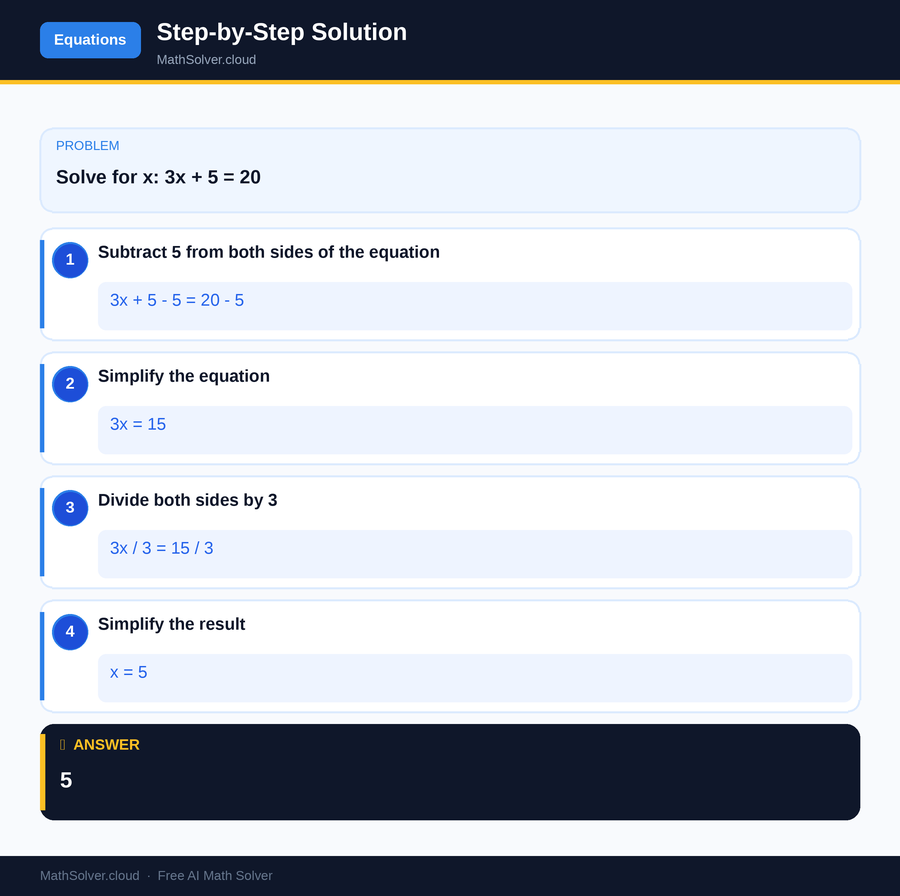
MathSolver Chrome extension solving this problem step-by-step
Example 2

MathSolver Chrome extension solving this problem step-by-step
Common Mistakes to Avoid
One common mistake students make is not performing the same operation on both sides of the equation. This can lead to incorrect solutions. Always remember that whatever operation you perform on one side, you must also perform on the other to maintain balance.
Another error is forgetting to check the solution by substituting it back into the original equation. This step is crucial because it verifies that your solution is correct. If the substituted values do not satisfy the original equation, recheck your steps to find any mistakes.
Real-World Applications
Two step equations calculators are not just academic tools; they have practical applications in various fields. For instance, they are often used in financial calculations, such as determining interest rates or loan payments, where two step equations help isolate and solve for unknown variables.
Another application is in physics, where equations are used to calculate speed, distance, or time. By setting up two step equations, students can solve real-world problems that involve multiple steps, such as determining the time it takes for an object to travel a certain distance given its speed.
Frequently Asked Questions
❓ What is a two step equations calculator?
❓ Why do students struggle with two step equations?
❓ How can AI help with two step equations calculator?
❓ What is the difference between one step and two step equations?
❓ Can I use a two step equations calculator for complex problems?
🚀 Solve any math problem instantly
2,000+ students use MathSolver every day — join them for free
📥 Add to Chrome — It's Free