Two Step Equations Worksheet: Mastering the Basics
📋 In this guide
A two step equations worksheet is an essential tool for students learning to solve equations that require exactly two operations to isolate the variable. These worksheets help students understand the process of breaking down complex problems into manageable steps, ultimately leading to a solution. Students often struggle with two step equations because they involve multiple steps, each requiring careful attention to detail. Through practice, learners will gain confidence in their ability to solve these equations, making them better prepared for more advanced mathematical concepts.
A common challenge with two step equations is the necessity to perform operations in a specific order. Students must first understand the basic principles of operations, such as the order of operations and inverse operations, before they can effectively tackle these problems. By working through a two step equations worksheet, students will learn to systematically approach the equations, applying the appropriate operations to isolate the variable.
In this article, we'll explore the key formula or definition of two step equations, provide a step-by-step guide for solving them, and work through some examples. Additionally, we'll discuss common mistakes to avoid, real-world applications of these equations, and answer frequently asked questions. By the end, students will have a solid understanding of how to approach a two step equations worksheet with confidence.
Step-by-Step: How to Solve Two Step Equations Worksheet
Step 1: Identify the Operations
The first step in solving a two step equation is to identify the operations involved. Look at the equation and determine which operations have been applied to the variable. Typically, you will see an equation that involves addition or subtraction, followed by multiplication or division. Understanding the sequence of operations is crucial for solving the equation correctly.
Step 2: Undo the Addition or Subtraction
Once you have identified the operations, the next step is to undo the addition or subtraction. This is done by performing the inverse operation on both sides of the equation. For example, if the equation is ax + b = c, you would subtract b from both sides to get ax = c - b. This step simplifies the equation, making it easier to isolate the variable.
Step 3: Undo the Multiplication or Division
After simplifying the equation by removing the addition or subtraction, the next step is to undo the multiplication or division. In the equation ax = c - b, divide both sides by a to isolate the variable x. This step completes the process of solving the equation, allowing you to find the value of the variable.
Step 4: Verify Your Solution
The final step is to verify your solution by plugging the value of the variable back into the original equation. This ensures that the solution is correct and that no errors were made during the solving process. If the left-hand side equals the right-hand side after substitution, you can be confident that your solution is accurate.
🤖 Stuck on a math problem?
Take a screenshot and let our AI solve it step-by-step in seconds
⚡ Try MathSolver Free →Worked Examples
Example 1
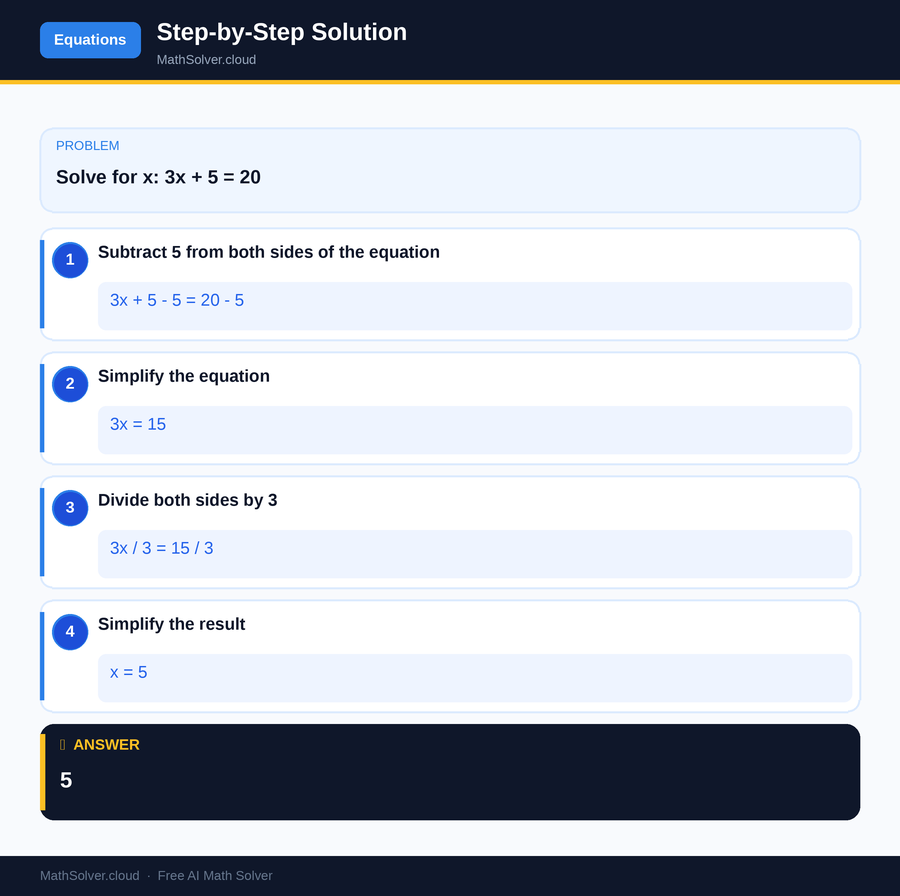
MathSolver Chrome extension solving this problem step-by-step
Example 2
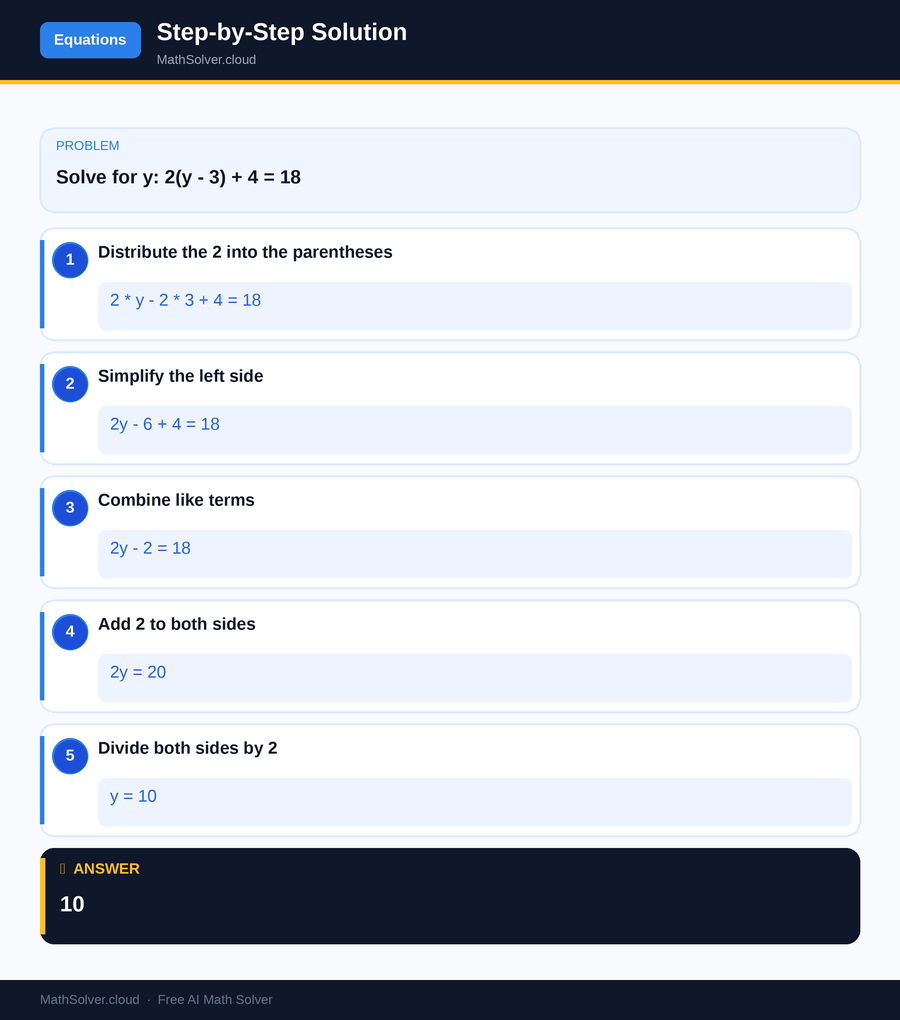
MathSolver Chrome extension solving this problem step-by-step
Common Mistakes to Avoid
One common mistake students make when solving two step equations is performing operations in the wrong order. It's crucial to first undo addition or subtraction before tackling multiplication or division. Skipping this order can lead to incorrect solutions. Another frequent error is neglecting to apply the inverse operation to both sides of the equation, which can disrupt the balance of the equation and result in inaccuracies.
Additionally, students may forget to verify their solutions by substituting the variable back into the original equation. This step is essential for ensuring that the solution is correct. By practicing with a two step equations worksheet, students can become more familiar with these common pitfalls and learn to avoid them in future problem-solving endeavors.
Real-World Applications
Two step equations are not just abstract mathematical concepts; they have practical applications in everyday life. For instance, they are used in financial calculations, such as determining interest rates or budgeting expenses. By setting up and solving a two step equation, individuals can calculate how much money they need to save each month to reach a financial goal.
In the field of engineering, two step equations are used to solve problems related to force and motion. Engineers often use these equations to calculate the necessary force to move an object a certain distance or to determine the speed of an object after a given time. Understanding how to solve two step equations is crucial for professionals in various fields who rely on mathematical modeling to make informed decisions.
Frequently Asked Questions
❓ What is a two step equations worksheet, and why is it helpful?
❓ Why do students struggle with solving two step equations?
❓ How can AI help with two step equations worksheet?
❓ What is the difference between one step and two step equations?
❓ How can I improve my skills in solving two step equations?
🚀 Solve any math problem instantly
2,000+ students use MathSolver every day — join them for free
📥 Add to Chrome — It's Free