Understanding Two Step Equations
📋 In this guide
Two step equations are a fundamental concept in algebra that often pose a challenge for students. In essence, these are equations that require two separate operations to isolate the variable and find its value. Despite their simplicity, many students find themselves struggling with two step equations because they involve multiple operations, which can be confusing if not approached systematically. The purpose of this article is to demystify two step equations by providing clear explanations and step-by-step guidance to help students understand and master this essential algebraic skill.
The challenge with two step equations often lies in the need to reverse the order of operations, which is a common stumbling block. Students who are used to following specific mathematical procedures in a forward manner may find it difficult to apply inverse operations. By breaking down the solution process into manageable steps, students can gain confidence and improve their problem-solving skills. This article will cover the key formula, a detailed step-by-step guide, worked examples, common mistakes to avoid, and real-world applications, providing a comprehensive understanding of two step equations.
By the end of this article, you will have a solid grasp of how to solve two step equations efficiently and accurately. Additionally, we'll explore resources such as the two step equations worksheet and two step equations calculator, which can be invaluable tools for practice and verification. Whether you're a student looking to improve your algebra skills or a teacher searching for effective teaching strategies, this guide aims to equip you with the knowledge and resources you need to succeed.
Step-by-Step: How to Solve Two Step Equations
Step 1: Identify the Operations
The first step in solving two step equations is to identify the operations involved. Look at the equation and determine what operations are being applied to the variable. Typically, you'll find that there is an addition or subtraction operation, followed by a multiplication or division operation. Understanding the order of operations in the equation is crucial because it dictates the steps you will take to isolate the variable.
Step 2: Undo Addition or Subtraction
Once you've identified the operations, your next step is to undo the addition or subtraction. This involves performing the inverse operation to both sides of the equation. For example, if the equation is 3x + 5 = 20, you would subtract 5 from both sides to begin isolating the variable. This step effectively simplifies the equation and brings you closer to solving for the variable.
Step 3: Undo Multiplication or Division
After addressing the addition or subtraction, the next step is to tackle the multiplication or division. Again, you'll use the inverse operation. Continuing with our example, you would divide both sides of the equation by 3 to solve for x. This step is crucial because it isolates the variable, allowing you to find its value. Make sure to perform the operation on both sides to maintain the equation's balance.
Step 4: Verify the Solution
The final step is to verify your solution. Substitute the value you found for the variable back into the original equation to ensure that both sides are equal. This verification step is essential for confirming that your solution is correct. If the equation holds true, you've successfully solved the two step equation. If not, revisit your calculations to identify any errors.
🤖 Stuck on a math problem?
Take a screenshot and let our AI solve it step-by-step in seconds
⚡ Try MathSolver Free →Worked Examples
Example 1
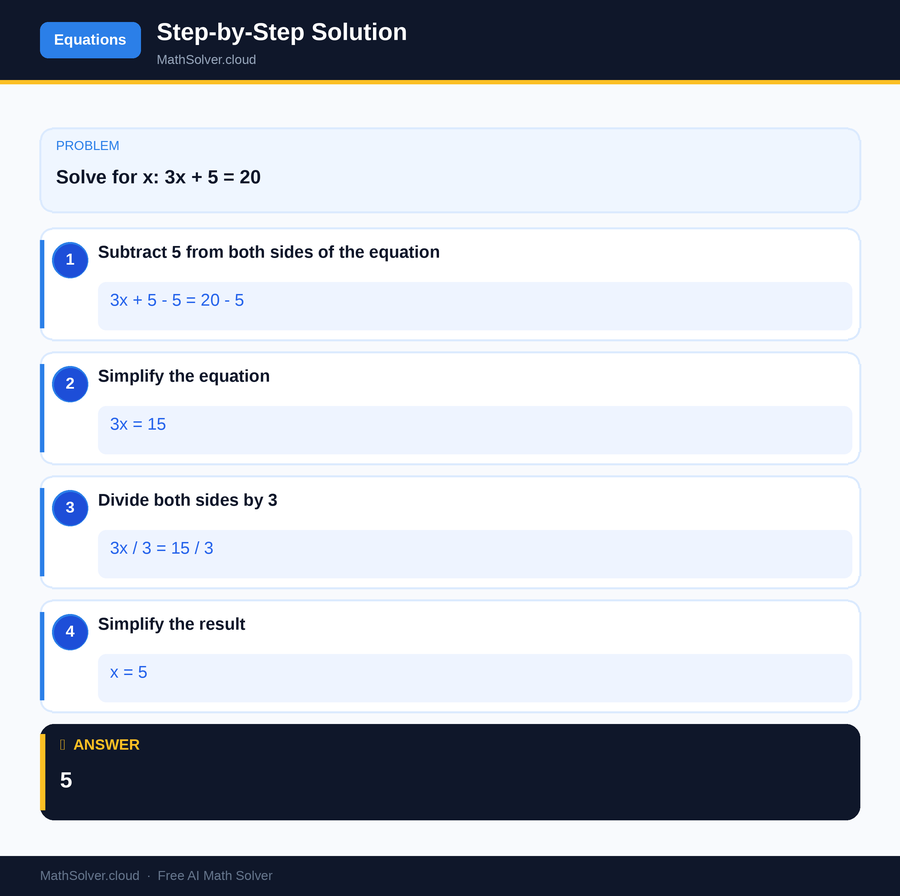
MathSolver Chrome extension solving this problem step-by-step
Example 2
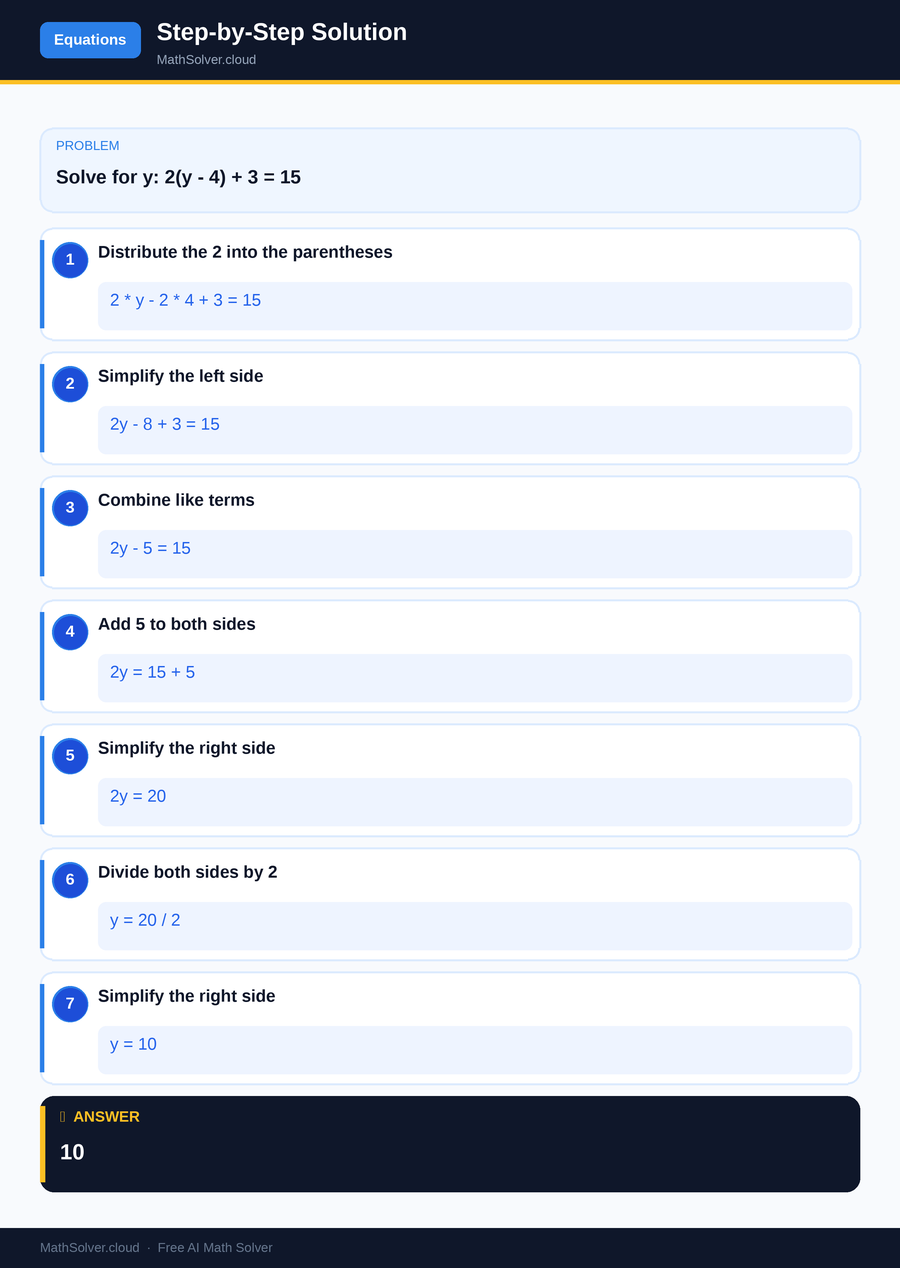
MathSolver Chrome extension solving this problem step-by-step
Common Mistakes to Avoid
One common mistake when solving two step equations is neglecting to perform the inverse operations on both sides of the equation. This can lead to incorrect solutions because the balance of the equation is disrupted. Always remember to apply the same operation to both sides to maintain equality. Another frequent error is reversing the order of operations, which can lead to incorrect simplification. Ensure that you first undo addition or subtraction before tackling multiplication or division.
Additionally, students often forget to verify their solutions, which is a crucial step in ensuring accuracy. Failing to check your work can result in overlooked errors and incorrect answers. By substituting the variable back into the original equation, you can confirm that your solution is correct, providing confidence in your problem-solving abilities.
Real-World Applications
Two step equations have practical applications in various real-life scenarios. For instance, they are often used in budgeting and finance to calculate expenses or savings goals. If you know your monthly income and expenses, you can use two step equations to determine how much you can save each month. This application is particularly useful for personal financial planning and management.
Another real-world use of two step equations is in cooking and recipe adjustments. When scaling a recipe up or down, you can use these equations to adjust ingredient quantities proportionally. This ensures that the final dish maintains the intended flavor and consistency, which is essential for successful culinary endeavors.
Frequently Asked Questions
❓ What are two step equations and why are they important?
❓ Why do students struggle with two step equations?
❓ How can AI help with two step equations?
❓ How do I use a two step equations worksheet effectively?
❓ What is the benefit of using a two step equations calculator?
🚀 Solve any math problem instantly
2,000+ students use MathSolver every day — join them for free
📥 Add to Chrome — It's Free