Mastering Step by Step Multi Step Equations
📋 In this guide
Step by step multi step equations are a crucial component of algebra that students often find challenging. These equations require multiple operations to isolate the variable and find its value. Unlike simpler one-step or two-step equations, multi-step equations can include variables on both sides, parentheses, and fraction coefficients, making them appear complex and intimidating. However, with a systematic approach and practice, solving these equations becomes much more manageable. By learning how to solve step by step multi step equations, students can improve their problem-solving skills, build a solid foundation in algebra, and gain the confidence needed to tackle more advanced mathematical concepts.
Many students struggle with multi-step equations because they involve multiple arithmetic operations and the need to apply the correct order of operations. Additionally, keeping track of positive and negative signs can be a source of confusion. Students might also face difficulties when dealing with equations that include fractions or decimals. Understanding the systematic approach to solving these equations can alleviate these challenges and help students efficiently find the correct solutions.
In this article, you will learn how to solve step by step multi step equations, including techniques to simplify and solve them effectively. We will explore key formulas, provide a step-by-step guide, and work through detailed examples. By the end, you will be equipped with the knowledge and skills to tackle multi-step equations with ease. Whether you're dealing with algebra equations, kinematic equations, or even differential equations, mastering this skill will be invaluable.
Step-by-Step: How to Solve Step By Step Multi Step Equations
Step 1: Simplify Both Sides of the Equation
The first step in solving a multi-step equation is to simplify both sides of the equation as much as possible. This may involve using the distributive property to eliminate parentheses and combining like terms. For example, if you have an equation like 3(x + 2) = 6 + 2x, you would distribute the 3 to get 3x + 6 = 6 + 2x. This step helps to clear complexity and sets up the equation for further simplification.
Step 2: Move Variables to One Side
Once both sides of the equation are simplified, the next step is to get all the variable terms on one side of the equation and the constant terms on the other. You can do this by adding or subtracting terms from both sides. Continuing with our example, you would subtract 2x from both sides to get 3x - 2x + 6 = 6. This simplifies to x + 6 = 6, moving all variable terms to one side of the equation.
Step 3: Isolate the Variable
After moving all variable terms to one side, the next step is to isolate the variable completely. You do this by applying inverse operations. In our ongoing example, you would subtract 6 from both sides to get x = 0. This step ensures that you have the variable by itself with a coefficient of 1, ready to find its value.
Step 4: Verify Your Solution
Finally, it's essential to verify your solution by substituting the value of the variable back into the original equation. This ensures that the solution is correct and that the original equation holds true. For x = 0 in our example, substituting back into the original equation 3(x + 2) = 6 + 2x confirms that both sides equal 6, verifying our solution.
🤖 Stuck on a math problem?
Take a screenshot and let our AI solve it step-by-step in seconds
⚡ Try MathSolver Free →Worked Examples
Example 1

MathSolver Chrome extension solving this problem step-by-step
Example 2
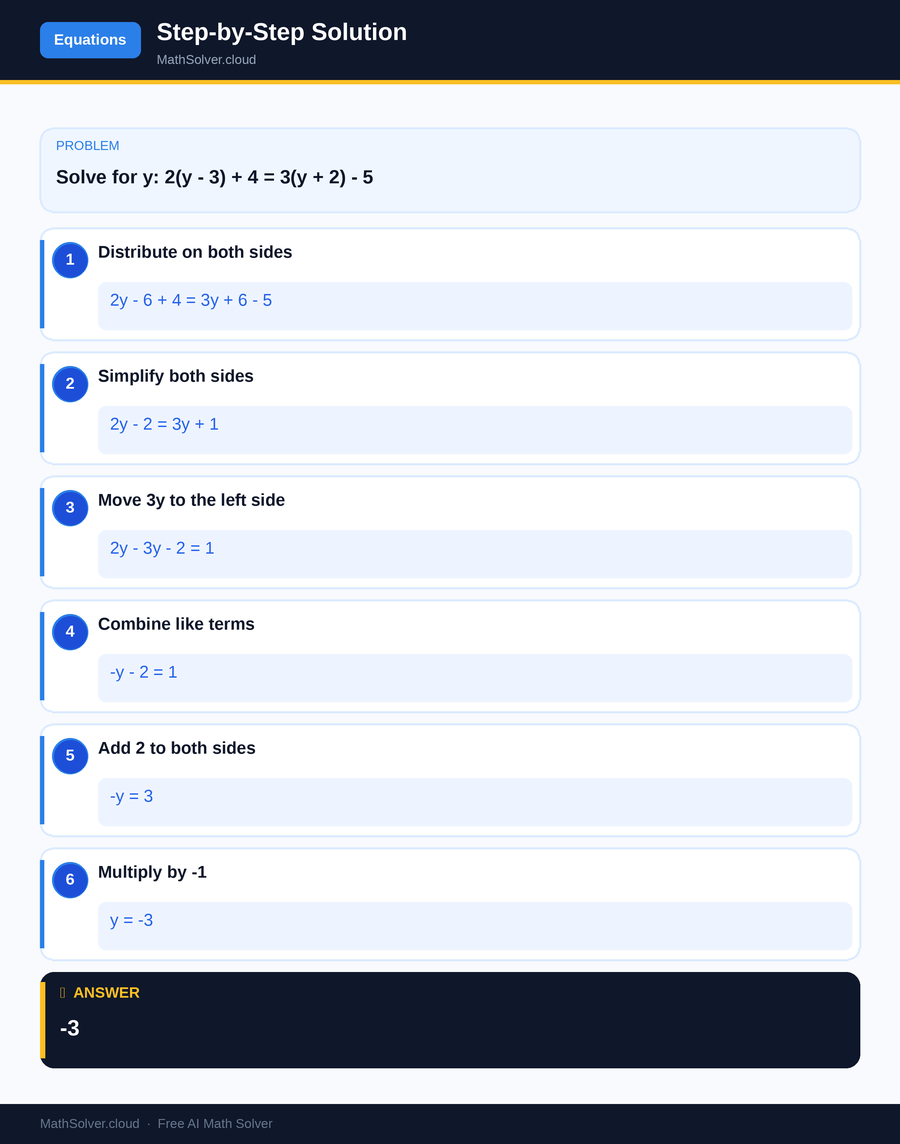
MathSolver Chrome extension solving this problem step-by-step
Common Mistakes to Avoid
One common mistake when solving step by step multi step equations is neglecting the order of operations. Students might incorrectly simplify expressions by not applying the distributive property first or failing to combine like terms before moving further. To avoid this, always simplify each side of the equation completely before moving variables or constants.
Another frequent error is mishandling negative signs, especially when moving terms from one side of the equation to the other. Students might forget to change the sign of a term when subtracting it from both sides, leading to incorrect solutions. To prevent this, carefully track each arithmetic operation and double-check your work to ensure all signs are correctly applied.
Real-World Applications
Step by step multi step equations are not just theoretical; they have practical applications in various fields. For instance, in physics, solving kinematic equations often involves multi-step approaches to find unknown variables such as velocity or time. Engineers also use these equations to calculate loads, stresses, and material properties in structural design.
In economics, multi-step equations can model and solve problems related to supply and demand, where multiple factors interact to determine equilibrium prices and quantities. By understanding how to solve these equations, professionals can make informed decisions and predictions in their respective fields.
Frequently Asked Questions
❓ What are step by step multi step equations?
❓ Why do students often struggle with multi step equations?
❓ How can AI help with step by step multi step equations?
❓ How are multi step equations different from linear equations?
❓ Where can I find more resources on solving equations?
🚀 Solve any math problem instantly
2,000+ students use MathSolver every day — join them for free
📥 Add to Chrome — It's Free