Mastering Multi Step Equations
📋 In this guide
Multi step equations are a fundamental part of algebra that often pose challenges for students. These equations, as the name implies, require more than one step to solve, involving a combination of operations such as addition, subtraction, multiplication, and division. Students often find themselves overwhelmed by the complexity and the sequential nature of the tasks required to isolate the variable. However, understanding the systematic approach to solving multi step equations can make this process much more manageable.
Often, the struggle with multi step equations arises from missing out on essential steps or misapplying algebraic rules. Unlike simpler equations that can be solved in one or two steps, multi step equations require careful attention to the order of operations and properties of equality. By mastering these concepts, students can enhance their algebraic thinking and develop a strong foundation for tackling more complex mathematical problems.
In this article, we will break down the process of solving multi step equations into easy-to-follow steps, offering clear explanations and examples. By the end of this guide, you will have a solid grasp of how to approach these equations, and you'll be equipped with strategies to avoid common pitfalls. We will also explore some real-world applications of multi step equations, showing how they are used beyond the classroom.
Step-by-Step: How to Solve Multi Step Equations
Step 1: Simplify Each Side of the Equation
The first step in solving a multi step equation is to simplify both sides as much as possible. This includes distributing any coefficients through parentheses and combining like terms. Simplification is crucial because it reduces the complexity of the equation and sets the stage for isolating the variable. For example, if you have an equation like 2(x + 3) = 14, you would first distribute the 2 to get 2x + 6 = 14.
Step 2: Move Variables to One Side
Once the equation is simplified, the next step is to get all the variable terms on one side of the equation. This often involves adding or subtracting terms from both sides. For instance, if you have variables on both sides, like in the equation 3x + 5 = x + 9, you'll want to subtract x from both sides to get 2x + 5 = 9. This step helps in setting up the equation such that the variable can be isolated.
Step 3: Isolate the Variable
With all variable terms on one side, the next task is to isolate the variable completely. This typically involves undoing any addition or subtraction first, followed by any multiplication or division. Continuing with our previous example, 2x + 5 = 9, you would subtract 5 from both sides to get 2x = 4, and then divide both sides by 2 to solve for x, giving x = 2.
Step 4: Check Your Solution
Finally, it's essential to verify your solution by plugging the value back into the original equation. This ensures that no mistakes were made during the solving process. If substituting the solution into the original equation yields a true statement, then the solution is correct. For instance, substituting x = 2 back into 3x + 5 = x + 9 would confirm the solution, as both sides of the equation would equal 11.
🤖 Stuck on a math problem?
Take a screenshot and let our AI solve it step-by-step in seconds
⚡ Try MathSolver Free →Worked Examples
Example 1

MathSolver Chrome extension solving this problem step-by-step
Example 2
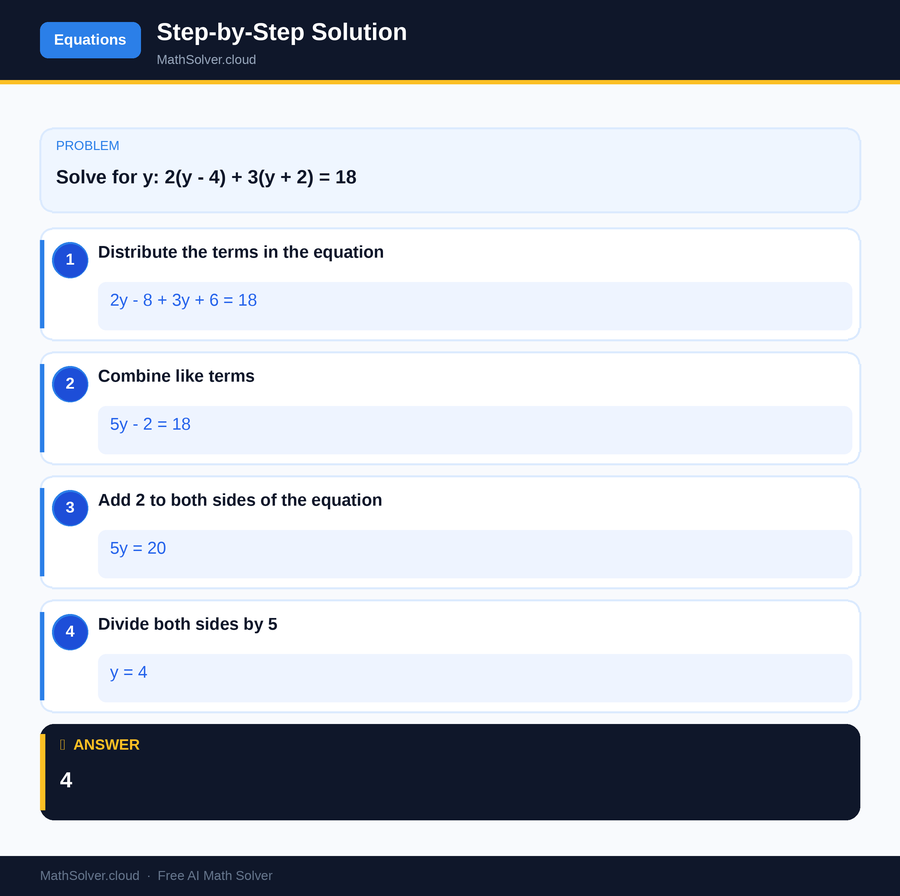
MathSolver Chrome extension solving this problem step-by-step
Common Mistakes to Avoid
One common mistake students make when solving multi step equations is neglecting to properly simplify each side of the equation before attempting to isolate the variable. Skipping this step can lead to errors in the subsequent steps, as it may cause misalignment in the equation's terms. Always remember to distribute and combine like terms first.
Another mistake is incorrectly applying the properties of equality, such as forgetting to perform the same operation on both sides of the equation. For instance, if you subtract a term from one side but not the other, the equation becomes unbalanced. To avoid this, consistently check that each step maintains the equation's balance by performing operations equally on both sides.
Real-World Applications
Multi step equations are not just academic exercises; they have practical applications in various fields. In finance, these equations are used to calculate interest rates, loan payments, and investment growth over time. For example, determining the monthly payment for a mortgage involves solving multi step equations with variables representing principal, interest rate, and time.
In engineering, multi step equations play a crucial role in planning and design. Engineers use these equations to calculate forces, stress, and other parameters that ensure structures are safe and efficient. Understanding how to manipulate and solve these equations is vital for making informed decisions in the design process.
Frequently Asked Questions
❓ What are multi step equations?
❓ Why do students struggle with solving multi step equations?
❓ How can AI help with multi step equations?
❓ What is the difference between two step and multi step equations?
❓ How can I practice solving multi step equations effectively?
🚀 Solve any math problem instantly
2,000+ students use MathSolver every day — join them for free
📥 Add to Chrome — It's Free