Mastering Step by Step Two Step Equations
📋 In this guide
Step by step two step equations are a fundamental concept in algebra that many students find challenging. These equations require understanding two main operations to isolate the variable and find its value. Students often struggle with step by step two step equations because they involve multiple steps and require a solid grasp of basic arithmetic operations and the order of operations. As you learn to solve these equations, you will develop essential skills that will help you tackle more complex algebra equations, including multi step equations and even kinematic equations.
In this guide, we will dive deep into the process of solving step by step two step equations. By breaking down each step clearly, you will gain the confidence and understanding needed to solve these equations independently. Whether you're a middle school student encountering algebra for the first time or a high school student brushing up on your skills, this guide will be your go-to resource. You'll discover that with practice, solving these equations will become an intuitive and straightforward process.
By the end of this article, you will not only be able to solve step by step two step equations but also understand their applications in real-world scenarios. We will provide clear explanations, practical examples, and tips on avoiding common mistakes. Additionally, we'll explore how tools like MathSolver's Chrome extension can assist you in mastering these equations. Let's get started on this mathematical journey!
Step-by-Step: How to Solve Step By Step Two Step Equations
Step 1: Simplify the Equation
The first step in solving step by step two step equations is to simplify the equation if necessary. This involves combining like terms and eliminating any parentheses by distributing any coefficients. This step ensures that the equation is in its simplest form before you begin solving for the variable. By simplifying the equation, you make it easier to identify the operations needed to isolate the variable.
Step 2: Undo Addition or Subtraction
Once the equation is simplified, the next step is to undo any addition or subtraction to begin isolating the variable. Look for any constant term added or subtracted from the variable term and perform the opposite operation on both sides of the equation. This step moves the constant term to the opposite side of the equation, bringing you closer to isolating the variable.
Step 3: Undo Multiplication or Division
After addressing addition or subtraction, the next step is to undo any multiplication or division involving the variable. This is done by performing the opposite operation on both sides of the equation. If the variable is multiplied by a coefficient, divide both sides by that coefficient. If the variable is divided, multiply both sides by the denominator. This step will completely isolate the variable, allowing you to find its value.
Step 4: Verify the Solution
The final step is to verify your solution by substituting the value of the variable back into the original equation. This ensures that the solution satisfies the equation. If both sides of the equation are equal after substitution, you have correctly solved the equation. Verifying your solution helps catch any arithmetic errors and confirms the accuracy of your answer.
🤖 Stuck on a math problem?
Take a screenshot and let our AI solve it step-by-step in seconds
⚡ Try MathSolver Free →Worked Examples
Example 1

MathSolver Chrome extension solving this problem step-by-step
Example 2
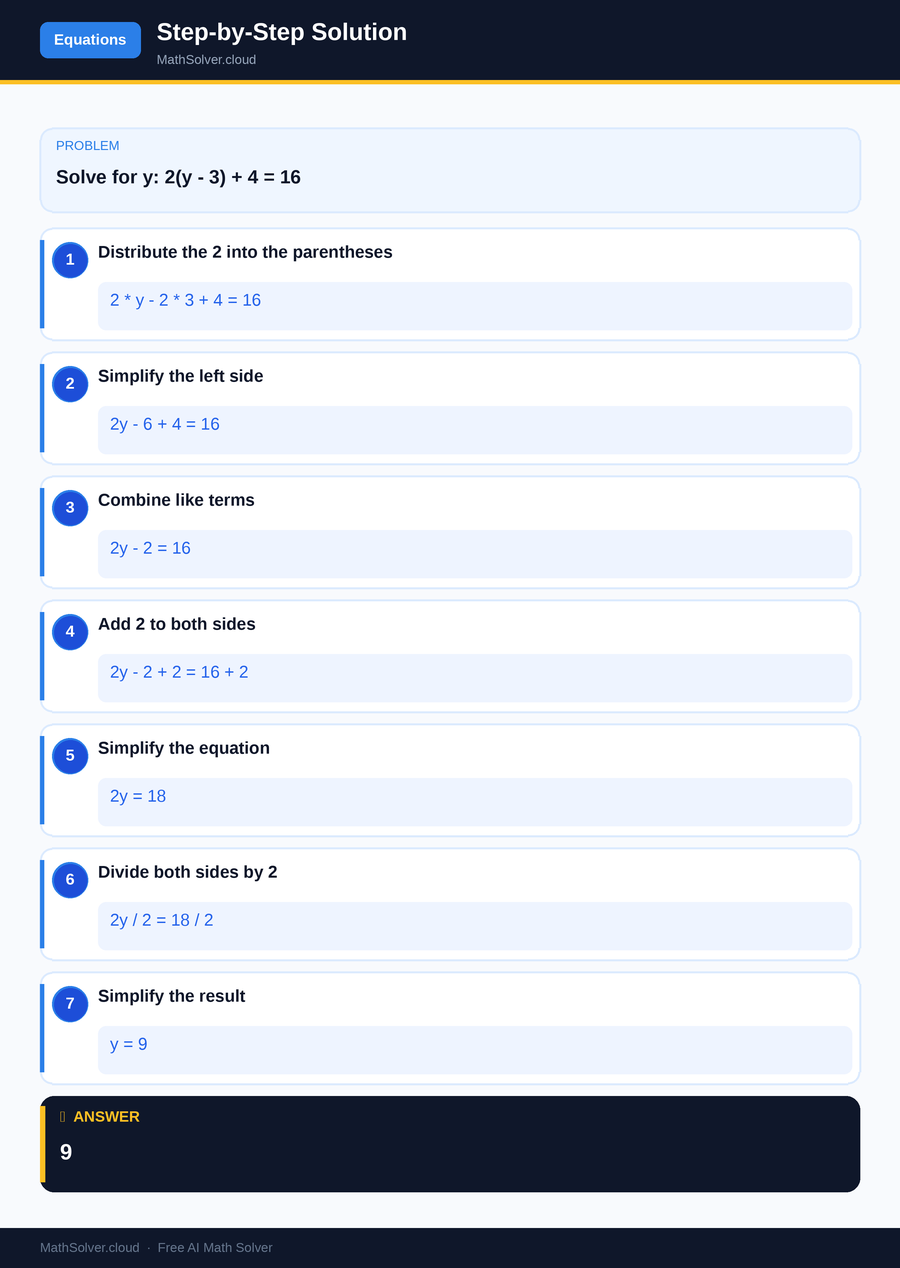
MathSolver Chrome extension solving this problem step-by-step
Common Mistakes to Avoid
One common mistake students make when solving step by step two step equations is neglecting to perform the same operation on both sides of the equation. This can lead to an incorrect solution because it disrupts the balance of the equation. Always remember to perform each step equally on both sides to maintain the equation's integrity.
Another frequent error is miscalculating basic arithmetic operations, such as addition, subtraction, multiplication, or division. Double-check your calculations at each step to avoid this pitfall. Slow down and ensure that each arithmetic operation is performed accurately to prevent small errors from leading to an incorrect final solution.
Real-World Applications
Step by step two step equations are not just academic exercises; they have practical applications in various fields. For example, in finance, these equations are used to calculate interest rates, loan payments, and investment growth. By understanding how to solve these equations, you can make informed financial decisions.
In physics, particularly in kinematics, two step equations help in calculating the motion of objects. Kinematic equations often involve solving for variables such as velocity, time, or distance. Mastery of step by step two step equations is essential for anyone pursuing a career in the sciences or engineering, where these calculations are frequently encountered.
Frequently Asked Questions
❓ How do step by step two step equations differ from multi step equations?
❓ Why do students find step by step two step equations challenging?
❓ How can AI help with step by step two step equations?
❓ What are some strategies for mastering step by step two step equations?
❓ How do step by step two step equations relate to linear equations?
🚀 Solve any math problem instantly
2,000+ students use MathSolver every day — join them for free
📥 Add to Chrome — It's Free