Mastering the Square Equation Solver
📋 In this guide
A square equation solver is an invaluable tool for students grappling with quadratic equations. These solvers are designed to simplify the process of finding the roots of quadratic equations, which are polynomial equations of the second degree. Many students find themselves struggling with these equations due to their complexity and the abstract thinking required to solve them. By the end of this article, you will understand how to effectively use a square equation solver, breaking down the problem-solving process into manageable steps.
Despite their importance in mathematics, quadratic equations can be intimidating. The quadratic formula, factoring, and completing the square are methods that often leave students puzzled. A square equation solver demystifies these processes, offering clear and systematic approaches to finding solutions. This article will guide you through the essential concepts and techniques, ensuring you gain both confidence and competence in solving these algebra equations.
Understanding quadratic equations and their solutions is crucial not only for academic success but also for real-world applications. Whether you are tackling kinematic equations in physics or optimizing a business problem, mastering the use of a square equation solver is a skill that will serve you well. Let's dive into the world of square equation solvers and explore how they can transform your approach to solving quadratic equations.
Step-by-Step: How to Solve Square Equation Solver
Step 1: Identify the Coefficients
The first step in using a square equation solver is to identify the coefficients a, b, and c from the quadratic equation ax^2 + bx + c = 0. These coefficients are essential for applying the quadratic formula. For example, in the equation x^2 - 6x + 8 = 0, the coefficients are a = 1, b = -6, and c = 8. Properly identifying these values is crucial for accurate calculations.
Step 2: Calculate the Discriminant
Next, calculate the discriminant using the formula b^2 - 4ac. The discriminant helps determine whether the roots are real or complex, and if real, whether they are distinct or repeated. For instance, if the discriminant is positive, there are two distinct real roots. If it is zero, there is one repeated real root. If negative, the roots are complex. This step is vital for understanding the nature of the solutions.
Step 3: Apply the Quadratic Formula
With the coefficients and discriminant in hand, apply the quadratic formula: x = (-b ± sqrt(b^2 - 4ac)) / (2a). Substitute the values of a, b, and c into the formula to find the roots. This step involves arithmetic operations and square root calculations, which can be simplified using a square equation solver. This solver automates the process, ensuring accuracy and saving time.
Step 4: Interpret the Results
After calculating the roots using the quadratic formula, interpret the results in the context of the problem you are solving. Consider whether the solutions are practical or theoretical, especially in real-world applications. Understanding the implications of the roots, whether they represent time, distance, or another variable, is the final step in solving quadratic equations effectively.
🤖 Stuck on a math problem?
Take a screenshot and let our AI solve it step-by-step in seconds
⚡ Try MathSolver Free →Worked Examples
Example 1
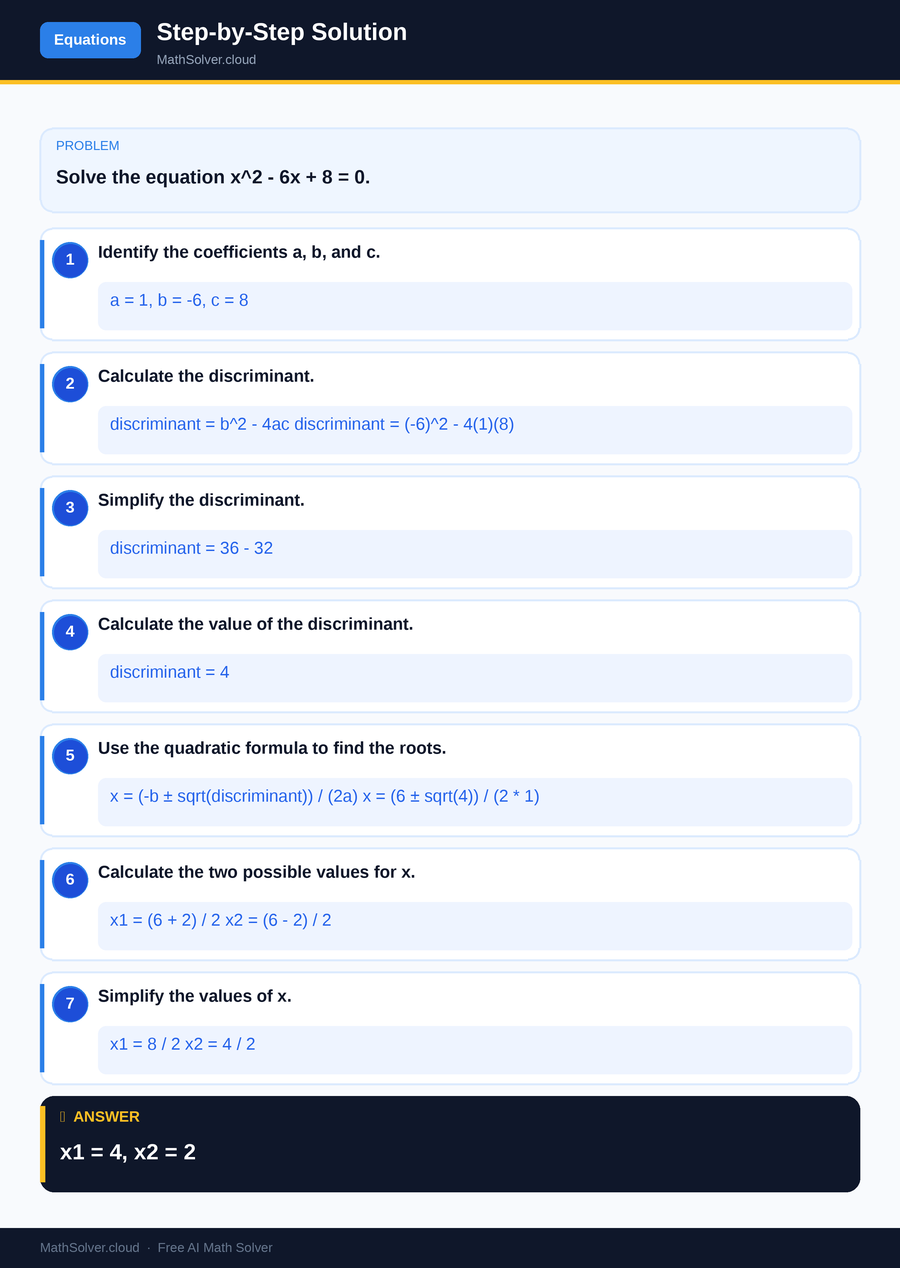
MathSolver Chrome extension solving this problem step-by-step
Example 2
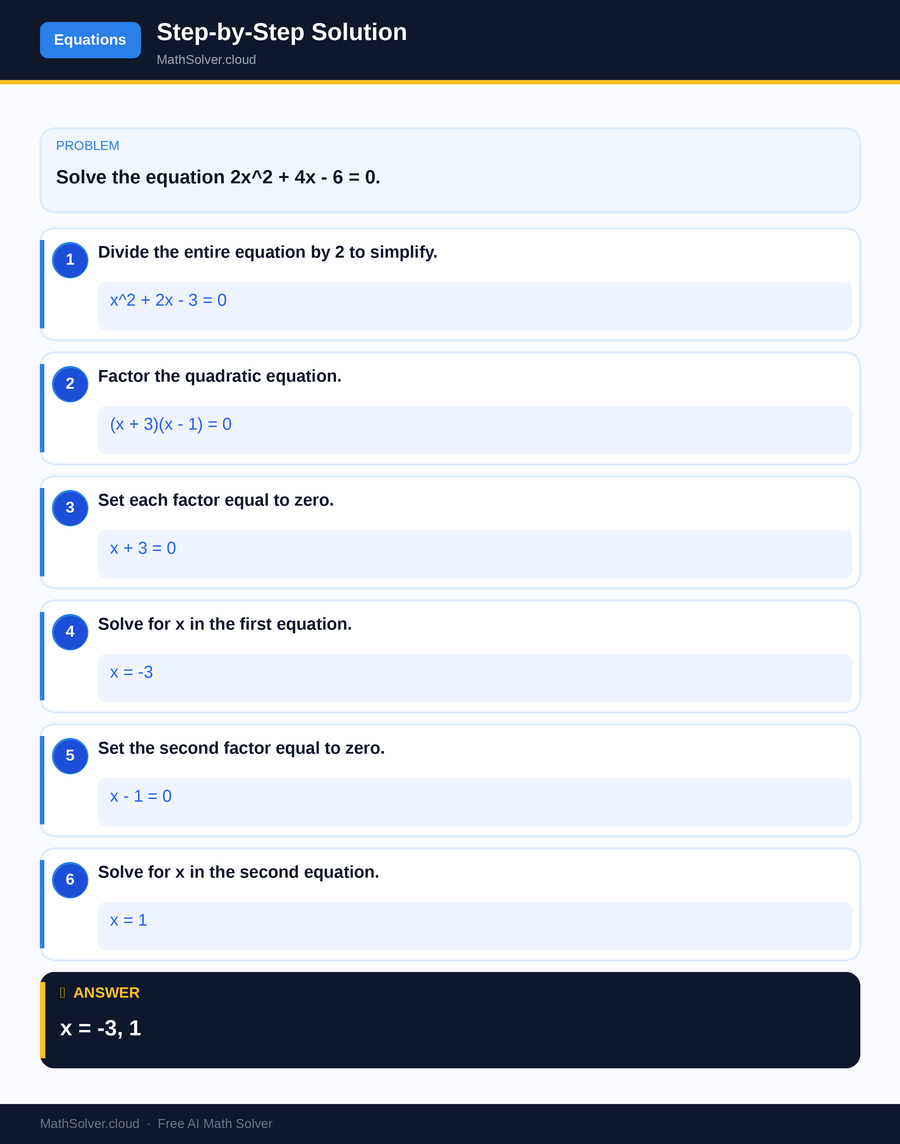
MathSolver Chrome extension solving this problem step-by-step
Common Mistakes to Avoid
One common mistake students make when using a square equation solver is misidentifying the coefficients a, b, and c. This error can lead to incorrect application of the quadratic formula and faulty solutions. Always double-check these values before proceeding with calculations. Additionally, forgetting to consider the discriminant's sign can result in misinterpretation of the root types.
Another frequent error involves arithmetic mistakes during the calculation of the discriminant and the application of the quadratic formula. To avoid this, take time to perform each step carefully and verify calculations. Utilizing tools like a math solver can help by providing automated, accurate solutions, allowing you to focus on understanding the process.
Real-World Applications
Square equation solvers are not only academic tools; they play a crucial role in various real-world scenarios. For example, in physics, they are used in kinematic equations to determine the time, velocity, or displacement of an object in motion. Understanding how to solve quadratic equations is essential for accurately predicting these physical phenomena.
In business, quadratic equations are often involved in optimization problems, such as maximizing profit or minimizing cost. Companies use these equations to model scenarios and make data-driven decisions. Mastery of a square equation solver enables professionals to navigate these complex problems with confidence and precision.
Frequently Asked Questions
❓ What is a square equation solver, and how does it work?
❓ Why do students struggle with quadratic equations?
❓ How can AI help with a square equation solver?
❓ What are some related topics to quadratic equations?
❓ How are quadratic equations used in engineering?
🚀 Solve any math problem instantly
2,000+ students use MathSolver every day — join them for free
📥 Add to Chrome — It's Free