Mastering the Spring Force Equation
📋 In this guide
The spring force equation is a fundamental concept in physics that describes how springs exert force. It is particularly important for students studying mechanics and oscillations. This equation can be confusing at first, as it involves understanding both the physical setup of a spring and the mathematical expressions that describe its behavior. Students often struggle with the spring force equation because it requires a grasp of several interconnected concepts, such as force, displacement, and the spring constant. In this article, you will learn the essentials of the spring force equation, how to apply it in various situations, and see it solved step-by-step with practical examples.
Understanding the spring force equation is crucial for students who are delving into topics like kinematics and dynamics. By mastering this equation, you can solve complex physics problems involving oscillations and harmonic motion. Many students find it challenging because it blends theoretical physics concepts with practical algebra equations. Our goal is to help you navigate these challenges with ease and confidence.
We'll break down the spring force equation into digestible parts, providing a detailed explanation of each component. By the end of this guide, you should feel comfortable applying the spring force equation to different problems and be able to identify and correct common errors. Let's dive into this fascinating topic and enhance your understanding of physics!
Step-by-Step: How to Solve Spring Force Equation
Step 1: Understand the Components of the Spring Force Equation
To effectively use the spring force equation, it's essential to understand its components. The force (F) is the push or pull exerted by the spring. The spring constant (k) is a measure of the stiffness of the spring; a higher value indicates a stiffer spring. Displacement (x) refers to the distance the spring is compressed or stretched from its natural length. Grasping these components is crucial for applying the equation accurately.
Step 2: Determine the Spring Constant
Determining the spring constant (k) is vital, as it varies between different springs. It is typically provided in problems, measured in Newtons per meter (N/m). If not given, you can experimentally determine it by dividing the force applied (in Newtons) by the displacement it causes (in meters). Knowing the spring constant allows you to compute the force for a given displacement, as it directly impacts the spring's behavior.
Step 3: Calculate the Displacement
Displacement (x) is the next key factor to calculate. It is the difference between the spring's stretched or compressed length and its natural or equilibrium length. Displacement can be positive (when stretched) or negative (when compressed). Always ensure your displacement measurement is accurate, as it significantly influences the calculated force using the spring force equation.
Step 4: Apply the Spring Force Equation
Once you have the spring constant and displacement, apply the spring force equation: F = -kx. Multiply the spring constant by the displacement, ensuring to include the negative sign to indicate direction. The resulting force is the magnitude of push or pull exerted by the spring. It's crucial to maintain consistent units (typically meters and Newtons) to ensure accuracy.
🤖 Stuck on a math problem?
Take a screenshot and let our AI solve it step-by-step in seconds
⚡ Try MathSolver Free →Worked Examples
Example 1
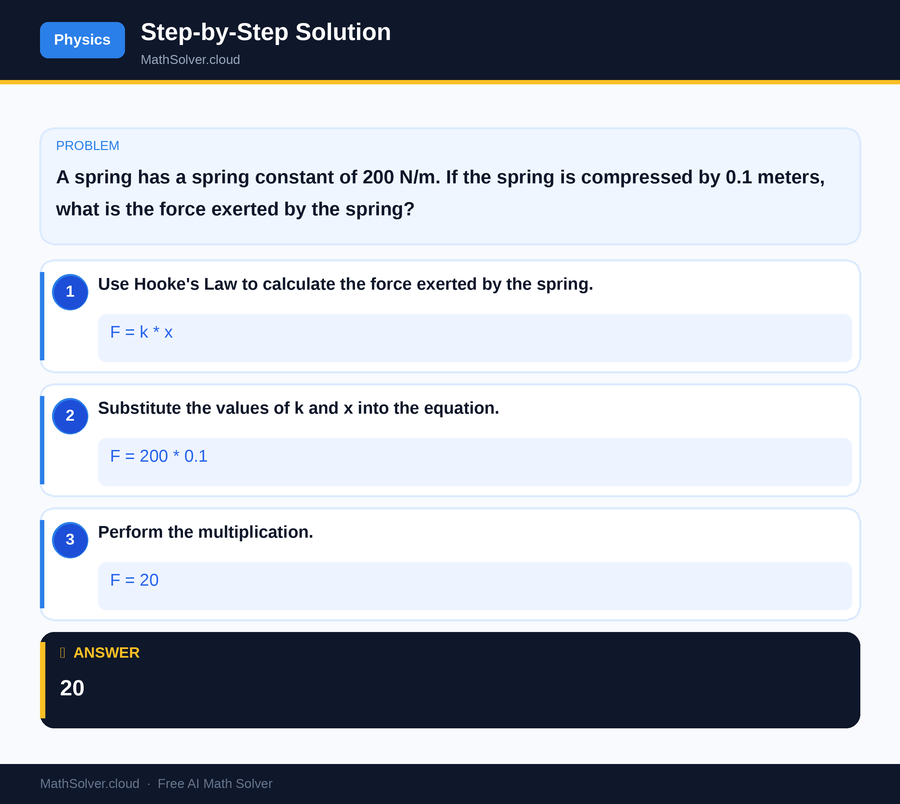
MathSolver Chrome extension solving this problem step-by-step
Example 2
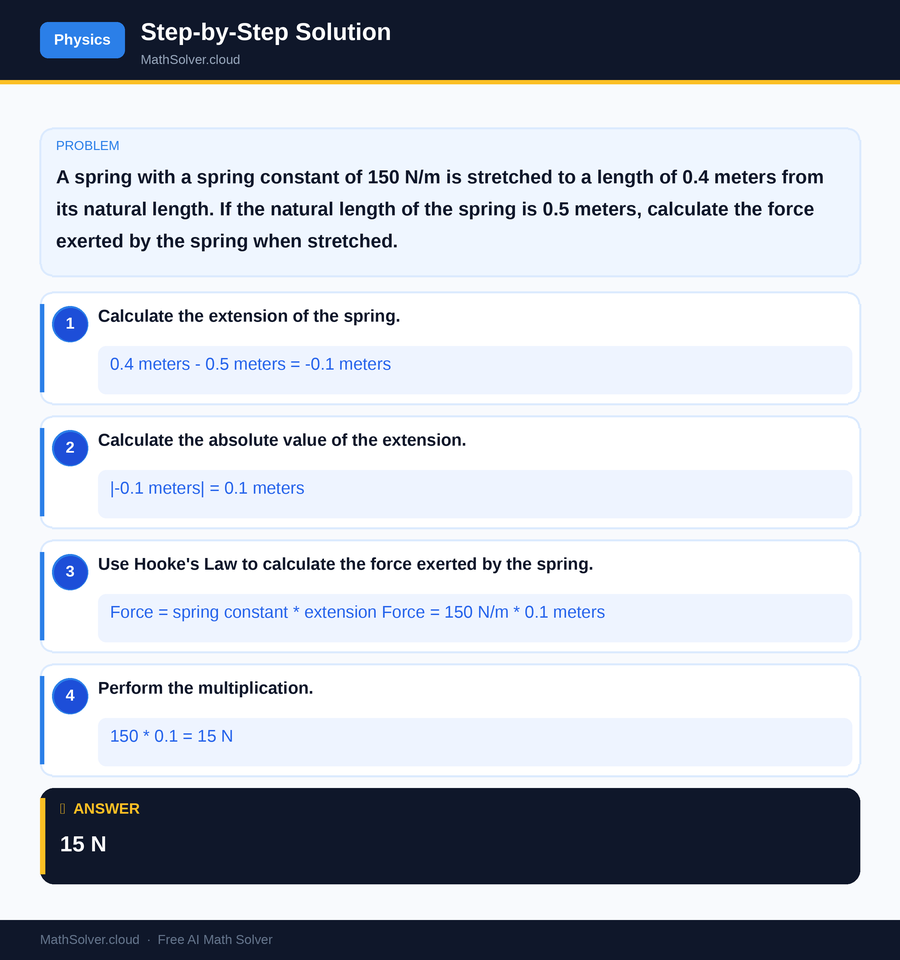
MathSolver Chrome extension solving this problem step-by-step
Common Mistakes to Avoid
One common mistake students make is neglecting the negative sign in the spring force equation. This sign is crucial as it indicates the direction of the force, opposite to the displacement. Always remember to include it, especially when determining the force's direction in a problem. Another frequent error is miscalculating displacement by confusing the stretched or compressed length with the natural length. Double-check these measurements to ensure accuracy.
Another pitfall is using inconsistent units, which can lead to incorrect results. Ensure that all measurements are in standard units, like meters for displacement and Newtons per meter for the spring constant. This consistency is critical for applying the spring force equation correctly and obtaining the right solution.
Real-World Applications
The spring force equation is not just theoretical; it has numerous practical applications. For instance, it's used in designing suspension systems in vehicles, where springs absorb shocks and maintain ride comfort. Understanding how springs work helps engineers design systems that ensure safety and performance in automobiles.
Springs are also crucial in various industrial applications, such as in the functioning of mechanical watches, where they store and release energy to keep time accurately. Additionally, springs are used in weighing scales and measuring devices, where precise force calculations are essential for accuracy. The spring force equation is fundamental in ensuring these devices function correctly.
Frequently Asked Questions
❓ What is the spring force equation used for in physics?
❓ Why do students find the spring force equation challenging?
❓ How can AI help with the spring force equation?
❓ How does the spring force equation relate to other physics equations?
❓ How is the spring force equation applied in engineering?
🚀 Solve any math problem instantly
2,000+ students use MathSolver every day — join them for free
📥 Add to Chrome — It's Free