A Comprehensive Guide to Solving Multi Step Equations
📋 In this guide
Solving multi step equations is a fundamental skill in algebra that requires students to perform a series of operations to find the value of an unknown variable. Unlike one or two-step equations, multi step equations involve multiple operations, including addition, subtraction, multiplication, and division, which can be distributed across both sides of the equation. This complexity often leaves students puzzled, as they need to keep track of numerous steps and apply their knowledge of mathematical principles consistently. However, mastering this concept is essential for progressing in math, as it lays the groundwork for more advanced topics.
Many students struggle with solving multi step equations due to the intricate nature of the problems. It requires a strong grasp of basic arithmetic, properties of equality, and the ability to manipulate equations while maintaining balance. Students may find it challenging to decide which operation to perform first or how to handle equations with variables on both sides. This article aims to demystify the process, offering a step-by-step guide to help you understand and solve these equations more effectively.
By the end of this article, you will learn how to systematically approach solving multi step equations with confidence. We will guide you through the essential steps, work through examples, and provide tips to avoid common pitfalls. Additionally, we will explore real-world applications of these equations and provide resources such as a solving multi step equations worksheet and reference to our complete Equation Solving guide to help reinforce your learning.
Step-by-Step: How to Solve Solving Multi Step Equations
Step 1: Simplify Each Side of the Equation
The first step in solving multi step equations is to simplify each side of the equation separately. This involves combining like terms and simplifying any expressions, such as distributing multiplication over addition. For example, if you have an equation like 2(x + 3) + 4 = 10, you would first distribute the 2 to get 2x + 6 + 4 = 10, and then combine like terms to get 2x + 10 = 10. Simplifying each side helps to clarify what operations need to be performed next.
Step 2: Move Variables to One Side
Once each side of the equation is simplified, the next step is to move all terms containing the variable to one side of the equation. This often involves using addition or subtraction to eliminate terms from one side. For instance, if you have 2x + 10 = x + 14, you would subtract x from both sides to get x + 10 = 14. This step is crucial for isolating the variable, which is the ultimate goal.
Step 3: Isolate the Variable
With variables on one side of the equation, the next step is to isolate the variable completely. This typically involves eliminating any constants on the variable's side by using inverse operations. Continuing from the previous example, x + 10 = 14, you would subtract 10 from both sides to get x = 4. This step leaves you with a simple equation where the variable is by itself, giving you the solution.
Step 4: Verify Your Solution
The final step in solving multi step equations is to verify your solution by substituting the value back into the original equation. This ensures that your solution is correct and that no mistakes were made during the process. For example, substituting x = 4 back into the original equation 2(x + 3) + 4 = 10, you get 2(4 + 3) + 4 = 10, which simplifies to 14 + 4 = 10, confirming that your solution is correct.
🤖 Stuck on a math problem?
Take a screenshot and let our AI solve it step-by-step in seconds
⚡ Try MathSolver Free →Worked Examples
Example 1

MathSolver Chrome extension solving this problem step-by-step
Example 2
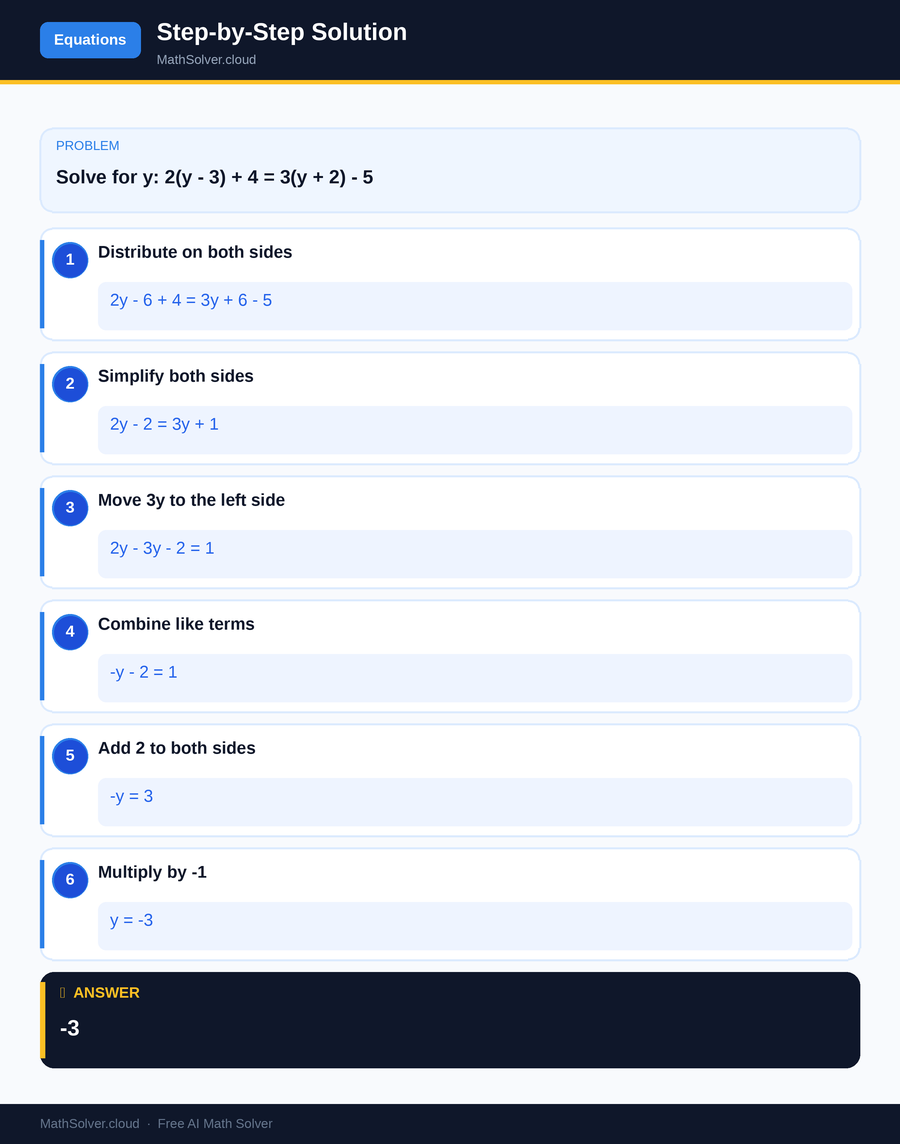
MathSolver Chrome extension solving this problem step-by-step
Common Mistakes to Avoid
One common mistake students make when solving multi step equations is not simplifying each side of the equation first. This oversight can lead to errors in combining like terms or distributing coefficients, resulting in incorrect solutions. To avoid this, always simplify both sides before attempting to move variables or constants.
Another frequent error is failing to perform the same operation on both sides of the equation. This is crucial to maintaining the balance of the equation. Remember, whatever operation you perform on one side must be done to the other. Carefully double-check each step to ensure that the operations are consistently applied, preventing any imbalance in the equation.
Real-World Applications
Solving multi step equations is not just a classroom exercise; it has practical applications in various fields. For example, in finance and economics, multi step equations are used to calculate interest rates, loan payments, and investment growth, helping individuals and businesses make informed decisions.
In engineering, multi step equations are essential for designing systems and structures. Engineers use these equations to calculate forces, stress, and other critical factors, ensuring that buildings and machines operate safely and efficiently. Understanding how to solve these equations can lead to solving real-world problems effectively.
Frequently Asked Questions
❓ What is the most efficient method for solving multi step equations?
❓ Why do I need to learn solving multi step equations?
❓ How can AI help with solving multi step equations?
❓ What's the difference between two step and multi step equations?
❓ Where can I find resources to practice solving multi step equations?
🚀 Solve any math problem instantly
2,000+ students use MathSolver every day — join them for free
📥 Add to Chrome — It's Free