Mastering the Art of Solving Equations
📋 In this guide
Solving equations is a fundamental skill in mathematics that involves finding the value of the unknown variable that makes the equation true. Many students find solving equations challenging due to the complexities of balancing variables and constants, as well as the variety of methods available for solution. In this article, we'll break down the process of solving equations into manageable steps, providing you with the tools and confidence needed to tackle these problems effectively.
As we delve into the intricacies of solving equations, you'll learn about different types of equations, including those with variables on both sides and multi-step equations. Understanding these concepts is crucial as they form the foundation for more advanced mathematical topics. By the end of this article, you'll be equipped to handle equations more efficiently and accurately, whether in a classroom setting or when encountering real-world applications.
Through practical examples and a step-by-step approach, we'll guide you in mastering the art of solving equations. You'll also discover how technological tools, like the MathSolver Chrome extension, can aid in simplifying the process. Whether you're preparing for a test or completing homework, this guide will serve as a valuable resource in your mathematical journey.
Step-by-Step: How to Solve Solving Equations
Step 1: Simplify Both Sides of the Equation
Begin by simplifying each side of the equation as much as possible. This may involve distributing terms, combining like terms, or simplifying fractions. For instance, if you have an equation like 2(x + 3) = 4x - 5, you would first distribute to get 2x + 6 = 4x - 5. Simplifying both sides makes it easier to see the structure of the equation and plan your next steps.
Step 2: Move Variables to One Side
The next step is to get all the variable terms on one side of the equation and all constant terms on the other. You can do this by adding or subtracting terms from both sides. Continuing with our example, you might subtract 2x from both sides to get 6 = 2x - 5. This step is crucial in solving equations with variables on both sides, as it helps isolate the variable.
Step 3: Isolate the Variable
Once the variables are on one side, focus on isolating the variable completely. This may require dividing or multiplying both sides by a number to solve for the variable. From the example, you would add 5 to both sides to get 11 = 2x, then divide both sides by 2 to solve for x, resulting in x = 11/2. This step requires careful calculation to ensure accuracy.
Step 4: Check Your Solution
Finally, substitute the solution back into the original equation to verify that it satisfies the equation. This is an essential step to confirm that no mistakes were made during the solving process. In our example, substituting x = 11/2 back into the original equation should yield a true statement, confirming the correctness of the solution.
🤖 Stuck on a math problem?
Take a screenshot and let our AI solve it step-by-step in seconds
⚡ Try MathSolver Free →Worked Examples
Example 1
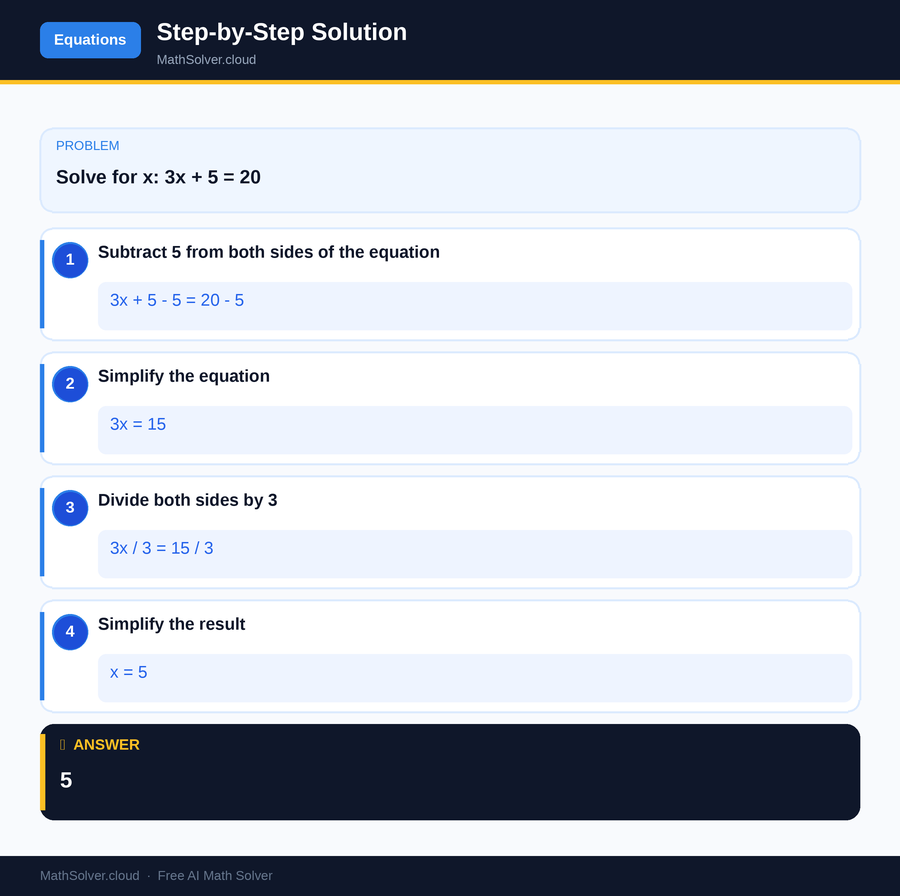
MathSolver Chrome extension solving this problem step-by-step
Example 2
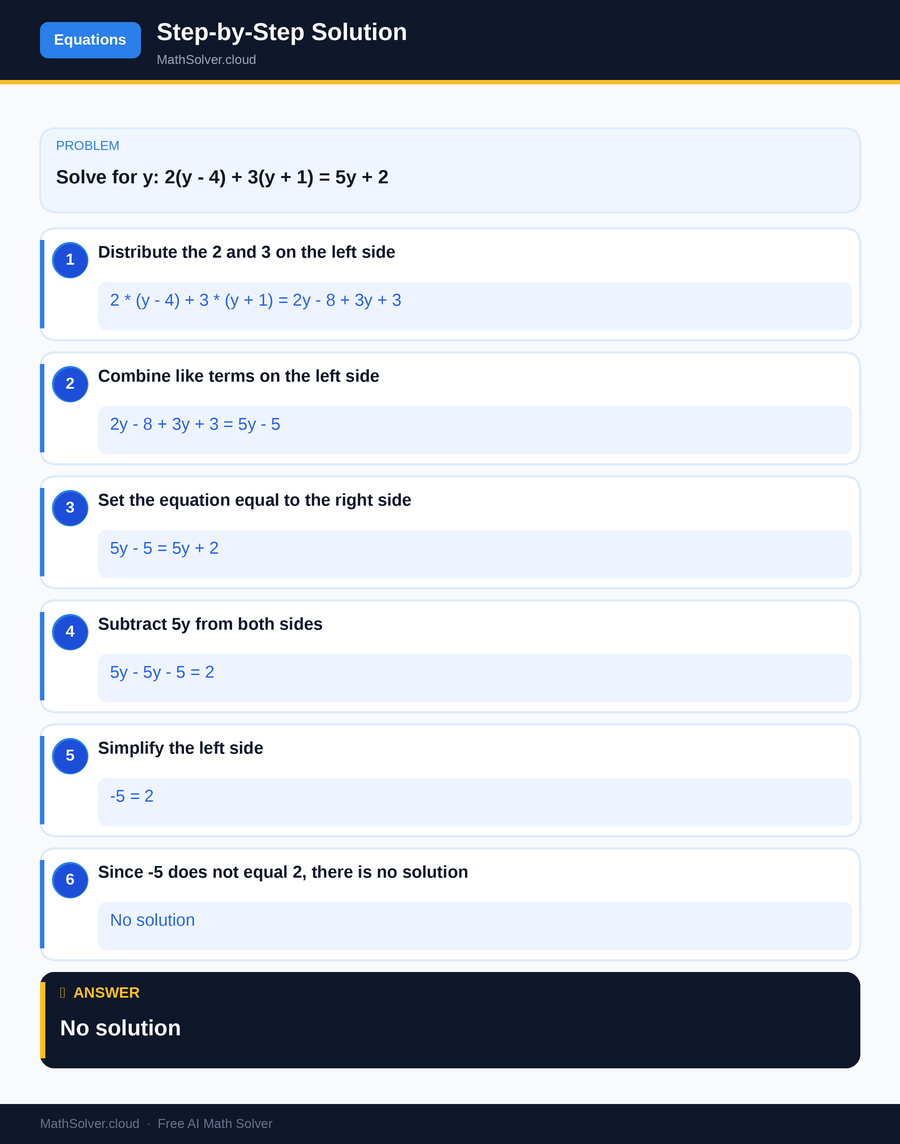
MathSolver Chrome extension solving this problem step-by-step
Common Mistakes to Avoid
One common mistake in solving equations is neglecting to perform the same operation on both sides. This error can lead to incorrect solutions and is often made when students rush through the steps. Always ensure that whatever operation is applied to one side of the equation is also applied to the other to maintain balance.
Another frequent error is mismanaging negative signs or distribution, particularly in multi-step equations. Students might forget to distribute a negative sign across a set of parentheses, leading to incorrect simplification. Careful attention to detail and double-checking each step can help prevent these mistakes.
Real-World Applications
Solving equations is not just an academic exercise; it plays a crucial role in various real-world scenarios. For instance, in finance, equations are used to calculate interest rates, loan payments, and investment returns. Understanding how to manipulate equations allows individuals to make informed financial decisions.
In engineering and physics, equations are fundamental in modeling and solving problems related to motion, forces, and energy. Engineers use equations to design structures and systems that are efficient and safe. By mastering the skill of solving equations, one can apply mathematical concepts to tackle complex real-world challenges.
Frequently Asked Questions
❓ What is the importance of solving equations in mathematics?
❓ How do I solve equations with variables on both sides?
❓ How can AI help with solving equations?
❓ What are two step equations, and how are they different from multi step equations?
❓ How can I practice solving equations effectively?
🚀 Solve any math problem instantly
2,000+ students use MathSolver every day — join them for free
📥 Add to Chrome — It's Free