Solving Equations with Variables on Both Sides
📋 In this guide
Solving equations with variables on both sides is a common challenge students face in algebra. This type of equation requires students to manipulate terms so that all variables are on one side of the equation and constants on the other. For many learners, this process can be confusing, especially if they're not comfortable with the operations involved. Understanding how to solve these equations is crucial, as it lays the foundation for more advanced math concepts and problem-solving techniques.
Students often struggle with solving equations with variables on both sides because it involves multiple steps and requires a solid grasp of algebraic principles. Mistakes can easily occur if one forgets to apply the same operations to both sides of the equation or mishandles negative signs. Mastering this skill improves logical thinking and prepares students for tackling more complex mathematical problems. Through this article, you'll learn the steps involved in solving these equations, common pitfalls to avoid, and how to apply these skills in real-world situations.
By the end of this guide, you'll be equipped with the knowledge to handle equations with variables on both sides confidently. We'll cover everything from key definitions and step-by-step guides to real-world applications and practice problems. Whether you're a student looking to improve your skills or a teacher seeking resources, this article will provide valuable insights and practical worksheets to enhance your learning experience.
Step-by-Step: How to Solve Solving Equations With Variables On Both Sides
Step 1: Simplify Each Side of the Equation
Begin by simplifying both sides of the equation separately. This means combining like terms and simplifying any arithmetic expressions. If there are parentheses, apply the distributive property to eliminate them. For example, in the equation 3x + 5 = 2(x + 3) + 1, you'd first distribute the 2 to get 3x + 5 = 2x + 6 + 1. Then, combine like terms to simplify further to 3x + 5 = 2x + 7.
Step 2: Get All Variable Terms on One Side
Next, choose a side to keep the variable terms and move all variable terms to that side. This usually involves adding or subtracting terms from both sides of the equation. Continuing with our example, subtract 2x from both sides to get 3x - 2x + 5 = 7, which simplifies to x + 5 = 7.
Step 3: Isolate the Variable
With the variable terms on one side, focus on isolating the variable. This often involves getting rid of any constants on the side with the variable. You can do this by adding or subtracting the constant from both sides. In our example, subtract 5 from both sides to isolate the variable: x + 5 - 5 = 7 - 5, resulting in x = 2.
Step 4: Verify Your Solution
To ensure the accuracy of your solution, substitute the value of the variable back into the original equation. This step checks if both sides of the equation are equal, confirming the solution's correctness. Substitute x = 2 back into the original equation: 3(2) + 5 = 2(2) + 7. Both sides equal 11, verifying that x = 2 is indeed correct.
🤖 Stuck on a math problem?
Take a screenshot and let our AI solve it step-by-step in seconds
⚡ Try MathSolver Free →Worked Examples
Example 1
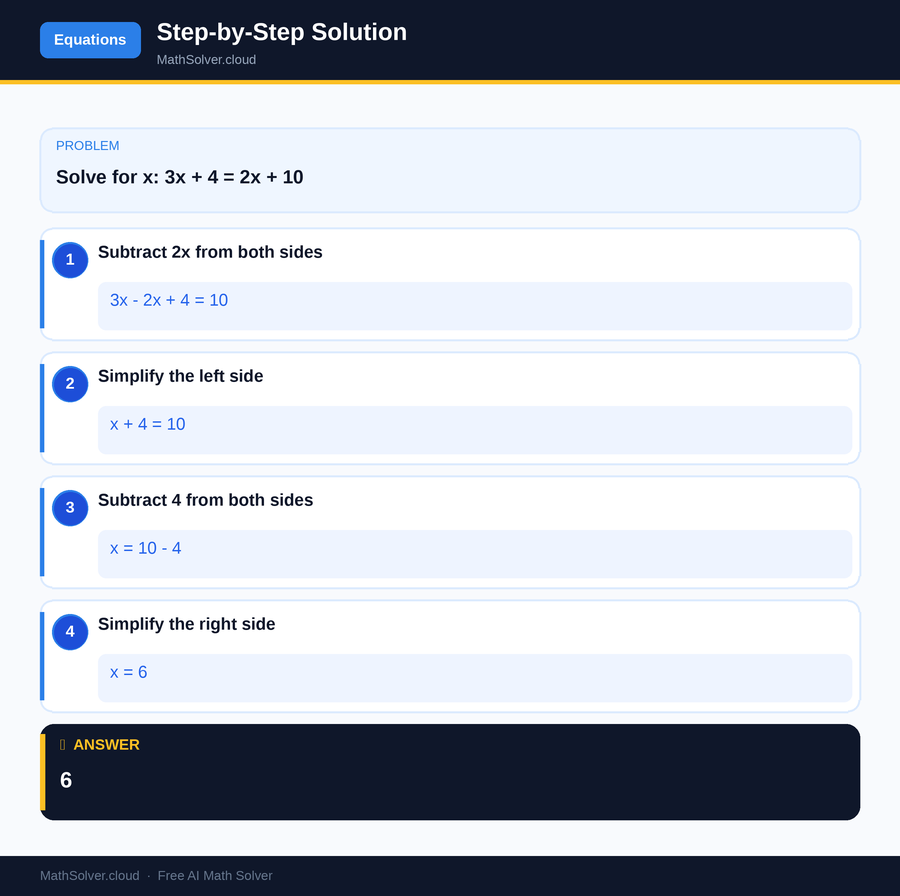
MathSolver Chrome extension solving this problem step-by-step
Example 2
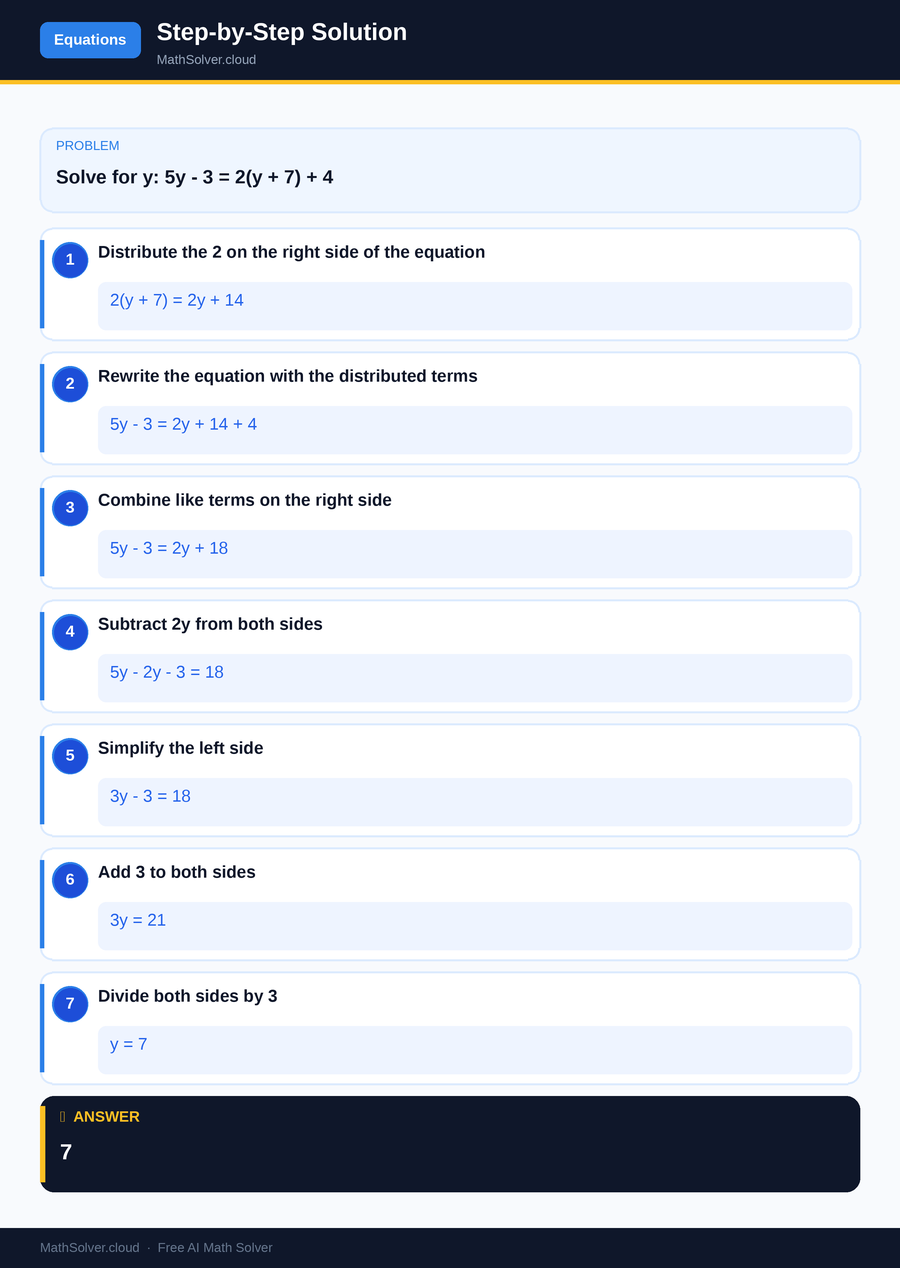
MathSolver Chrome extension solving this problem step-by-step
Common Mistakes to Avoid
One common mistake when solving equations with variables on both sides is neglecting to perform the same operation on both sides of the equation. This error can lead to incorrect solutions because it violates the principle of maintaining equality. To avoid this, always double-check that every step maintains balance by applying operations uniformly to both sides.
Another frequent error involves mishandling negative signs, especially when distributing or combining like terms. Students might forget to distribute a negative sign across terms inside parentheses, leading to incorrect simplifications. Carefully track signs throughout your work, and consider rechecking each step to ensure accuracy.
Real-World Applications
Solving equations with variables on both sides is not just an academic exercise; it has practical applications in various fields. For instance, in finance, these equations are used to calculate interest rates and loan repayments. By setting up equations with interest formulas on both sides, financial analysts can solve for unknown variables like interest rates or principal amounts.
In engineering, equations with variables on both sides are critical for designing systems and structures. Engineers use these equations to determine forces, loads, and stresses in materials, ensuring that structures are safe and efficient. This mathematical skill is essential for solving complex problems where multiple variables interact, impacting design and functionality.
Frequently Asked Questions
❓ What are some tips for solving equations with variables on both sides efficiently?
❓ Why do I keep getting the wrong answer when solving these equations?
❓ How can AI help with solving equations with variables on both sides?
❓ Can you solve equations with variables on both sides by guessing?
❓ Is there a practical way to practice these equations regularly?
🚀 Solve any math problem instantly
2,000+ students use MathSolver every day — join them for free
📥 Add to Chrome — It's Free