How to Solve the Given Exponential Equation
📋 In this guide
To solve the given exponential equation is a task that many students encounter during their math studies. An exponential equation is one in which the variable appears in the exponent, such as 2^x = 8. These equations can often seem daunting because they require a different approach than linear or quadratic equations. Understanding how to solve them is crucial, as they frequently appear in higher-level math courses and have numerous real-world applications. In this article, you'll learn how to solve the given exponential equation, breaking down the process into manageable steps.
One reason students struggle with solving exponential equations is that they often involve unfamiliar mathematical operations, such as logarithms. Unlike algebra equations, where you might simply solve for x in a straightforward manner, exponential equations require you to understand properties of exponents and logarithms. This can be confusing if these concepts haven't been mastered. Fortunately, with practice and the right guidance, anyone can become proficient in solving exponential equations.
This guide will walk you through the process of solving exponential equations, providing clear, step-by-step instructions, and worked examples to solidify your understanding. We'll also discuss common mistakes to avoid and explore some real-world applications where these skills are useful. By the end of this article, you'll be well-equipped to tackle any exponential equation confidently.
Step-by-Step: How to Solve Solve The Given Exponential Equation
Step 1: Identify the Equation Type
The first step in solving an exponential equation is to identify the form of the equation. Determine whether the equation can be rewritten such that both sides have the same base. For example, if you have 2^x = 16, recognize that 16 can be rewritten as 2^4. This transformation is crucial because it allows you to equate the exponents directly.
Step 2: Rewrite with a Common Base
If possible, rewrite both sides of the equation using the same base. This is essential because, as mentioned earlier, if a^b = a^c, then b must equal c. For instance, in the equation 3^(x-1) = 27, note that 27 can be expressed as 3^3. By rewriting the equation with a common base, you simplify the problem to comparing the exponents.
Step 3: Solve for the Exponent
Once you have the equation in the form a^b = a^c, the next step is to set the exponents equal to each other and solve for the unknown variable. This often involves straightforward algebraic manipulation. For example, if you have 2^x = 2^4, then x must equal 4. This step is typically the simplest part of solving the given exponential equation.
Step 4: Verify Your Solution
The final step is to verify your solution by substituting it back into the original equation. This ensures that the solution is correct and that no errors were made during the process. Verification is an important habit that helps catch mistakes and reinforces your understanding of the problem.
🤖 Stuck on a math problem?
Take a screenshot and let our AI solve it step-by-step in seconds
⚡ Try MathSolver Free →Worked Examples
Example 1
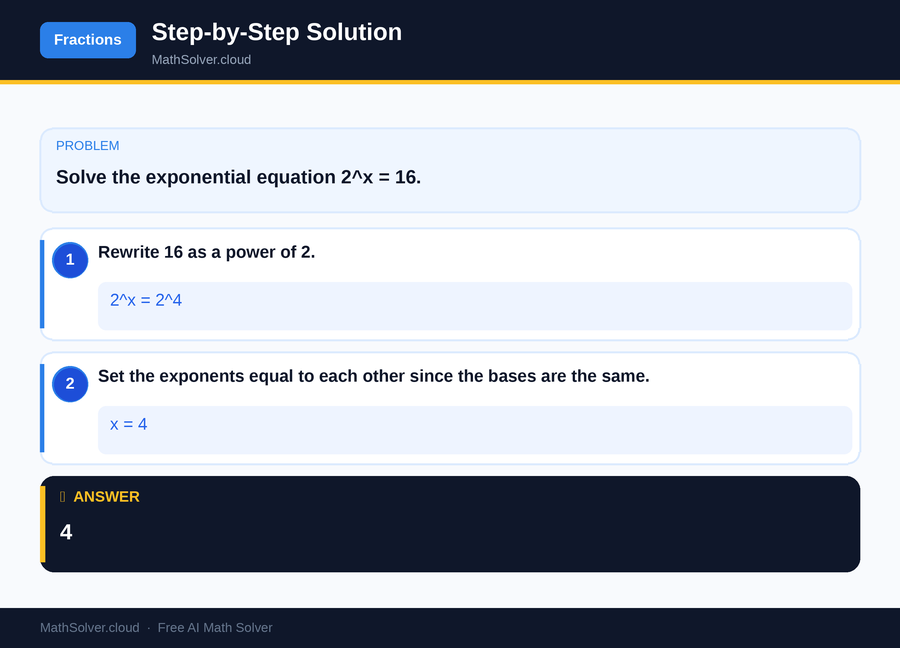
MathSolver Chrome extension solving this problem step-by-step
Example 2

MathSolver Chrome extension solving this problem step-by-step
Common Mistakes to Avoid
One common mistake when attempting to solve the given exponential equation is failing to recognize when to use common bases. Students often try to apply logarithms too early, which can complicate the problem unnecessarily. Always check if the numbers can be expressed with the same base first, as it often simplifies the solution process.
Another mistake students make is neglecting to check their solutions. After finding a potential solution, substituting it back into the original equation is critical to ensure accuracy. This step confirms that no arithmetic errors were made and reinforces the concept of verification, which is a fundamental part of solving any mathematical equation.
Real-World Applications
Exponential equations aren't just theoretical exercises; they have real-world applications across various fields. For example, in finance, exponential equations are used to calculate compound interest, which is essential for understanding investments and savings growth over time. These calculations help individuals and businesses make informed financial decisions.
In science, exponential equations are used to model population growth and radioactive decay. For instance, understanding how a population grows exponentially can help in planning resources and infrastructure. Similarly, in physics, exponential equations are crucial for solving kinematic equations that involve exponential decay, such as the discharge of a capacitor in an electrical circuit.
Frequently Asked Questions
❓ How do I solve the given exponential equation with different bases?
❓ Why do students find exponential equations difficult?
❓ How can AI help with solving the given exponential equation?
❓ What are some real-life examples of exponential equations?
❓ How do I know which method to use for solving exponential equations?
🚀 Solve any math problem instantly
2,000+ students use MathSolver every day — join them for free
📥 Add to Chrome — It's Free