Equation to Find 0.2 Percent Offset Yield Strength
📋 In this guide
The equation to find 0.2 percent offset yield strength is a vital tool in material science and engineering, helping to determine the point at which a material begins to deform permanently. Students often find this concept challenging due to its technical nature and the precision required in calculations. Understanding this equation is crucial for anyone working with materials that undergo stress and strain, such as metals and concrete.
In this article, you'll learn not only how to apply the equation to find 0.2 percent offset yield strength but also the underlying principles that make it a critical component in materials engineering. By breaking down each step of the process, we aim to make this concept more accessible and less intimidating. Students will gain clarity on the equation's application, common pitfalls, and its real-world uses.
The process of calculating the 0.2 percent offset yield strength involves understanding both the mathematical formula and the physical significance of yield strength in materials. With this guide, you will be equipped to tackle problems involving this equation confidently. By the end of this article, you should be proficient in applying the equation to find 0.2 percent offset yield strength, and have a deeper appreciation for its role in ensuring the safety and reliability of materials used in construction and manufacturing.
Step-by-Step: How to Solve Equation To Find 0.2 Percent Offset Yield Strength
Step 1: Understanding Yield Strength
Yield strength is the stress at which a material begins to deform plastically. Before reaching the yield point, a material will deform elastically and will return to its original shape when the applied stress is removed. Understanding yield strength is crucial because it defines the limit of elastic behavior and the onset of plastic deformation. In practical terms, this means knowing how much stress a material can withstand before it starts to change shape permanently. For engineers and designers, this is a fundamental property that helps ensure the structural integrity of materials used in buildings, bridges, and machinery.
Step 2: The Concept of Offset Yield Strength
Offset yield strength is a modification of the yield strength used for materials that do not have a clear yield point. By using a 0.2 percent offset, engineers can define a more precise point at which the material begins to deform plastically. This offset is crucial for materials like metals, where the yield point is not sharply defined. The 0.2 percent offset is a standard convention in engineering that provides consistency and reliability in material testing and analysis. It is used to ensure that comparisons between different materials are made on a consistent basis.
Step 3: Applying the Formula
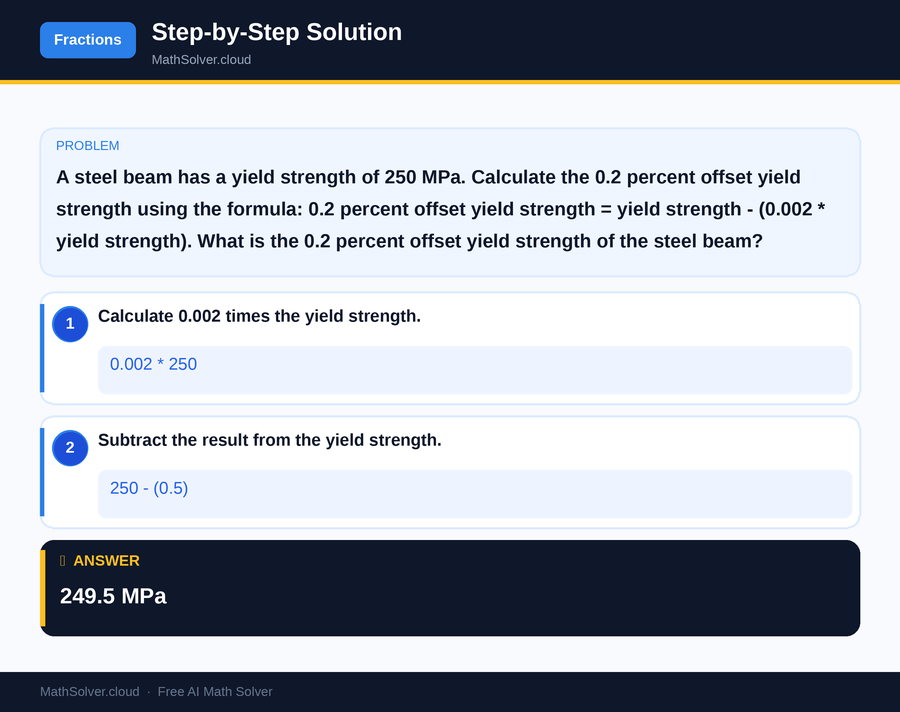
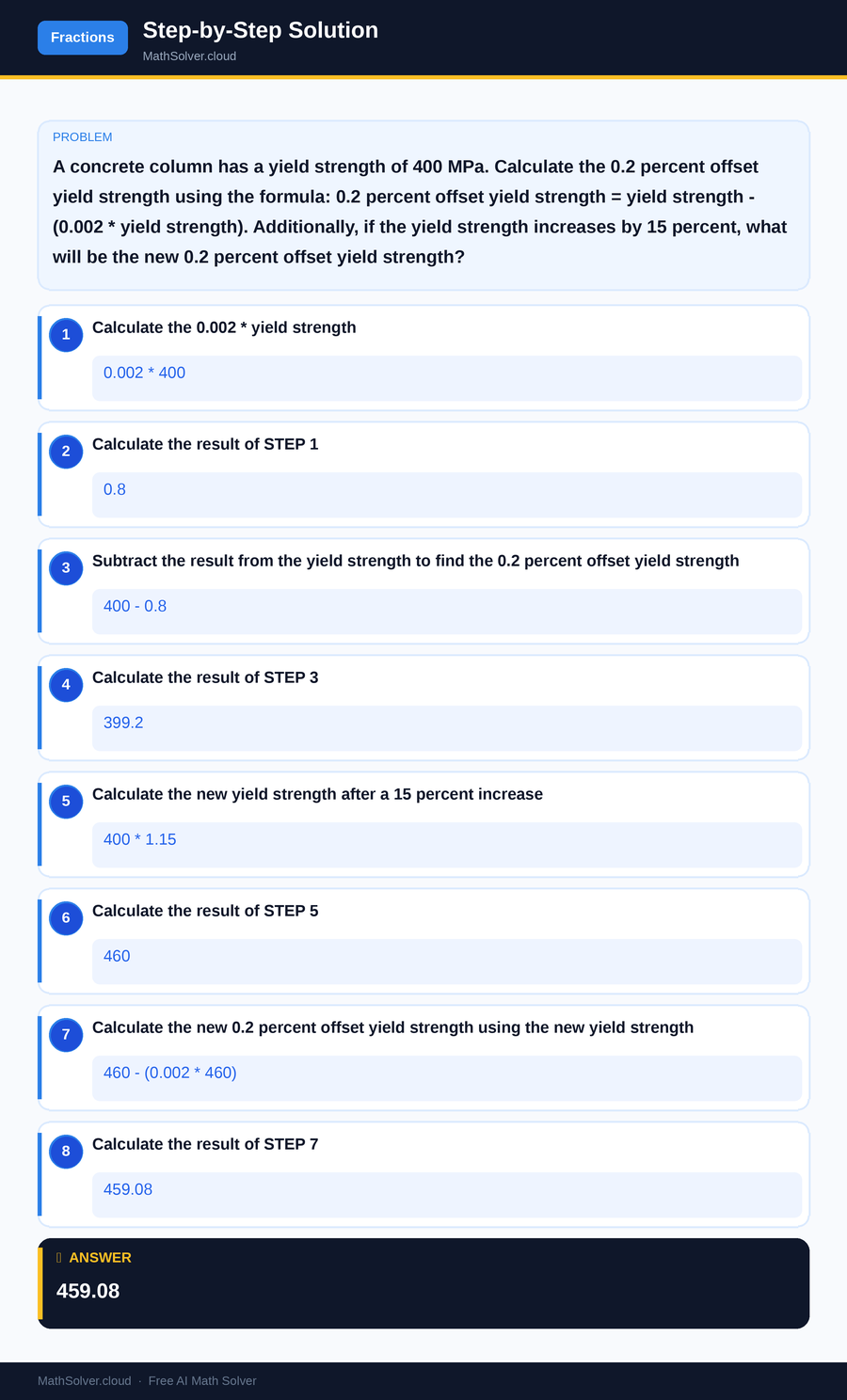
To apply the equation to find 0.2 percent offset yield strength, start by identifying the yield strength of the material in question. Then, multiply this yield strength by 0.002 (which represents the 0.2 percent offset). Subtract the resulting value from the original yield strength to find the offset yield strength. This calculated value represents a more conservative estimate of the material's yield point, ensuring that designs and structures are built with an adequate safety margin. Practically, this adjustment helps in designing components that are both safe and economical.
Step 4: Calculating with Precision
Precision is key when using the equation to find 0.2 percent offset yield strength. Ensure that all measurements and calculations are accurate, as even small errors can lead to significant differences in material performance. Double-check your calculations and consider using digital tools or software to enhance accuracy. It's also essential to be familiar with the units used in your calculations, typically megapascals (MPa) for stress values. Accurate calculations are vital in preventing material failures, which can have severe consequences in construction and manufacturing.
🤖 Stuck on a math problem?
Take a screenshot and let our AI solve it step-by-step in seconds
⚡ Try MathSolver Free →Worked Examples
Example 1
MathSolver Chrome extension solving this problem step-by-step
Example 2
MathSolver Chrome extension solving this problem step-by-step
Common Mistakes to Avoid
One common mistake when applying the equation to find 0.2 percent offset yield strength is miscalculating the offset value. Students often forget to convert percentages into decimals before multiplying. Remember, 0.2 percent is equivalent to 0.002. Another frequent error is neglecting to use the correct units, leading to incorrect results. Always ensure that your stress values are in consistent units, such as MPa.
Additionally, some students might overlook the importance of precision in their calculations. Rounding off numbers too early in the process can lead to inaccuracies. It's crucial to carry out calculations to an adequate number of decimal places and only round off the final result. Attention to detail is essential for obtaining accurate and reliable results.
Real-World Applications
The equation to find 0.2 percent offset yield strength is widely used in industries where material performance under stress is critical. For instance, in the construction industry, this equation helps engineers determine how much load a steel beam can support before it begins to deform permanently. This ensures buildings and bridges are safe and structurally sound.
In the automotive industry, understanding the offset yield strength of materials is crucial for designing components that can withstand high impacts and stresses, such as car frames and engine parts. Similarly, in aerospace engineering, materials must meet stringent yield strength criteria to ensure the safety and performance of aircraft under various operating conditions.
Frequently Asked Questions
❓ What is the equation to find 0.2 percent offset yield strength?
❓ Why is the 0.2 percent offset yield strength important in engineering?
❓ How can AI help with the equation to find 0.2 percent offset yield strength?
❓ What other equations are related to yield strength calculations?
❓ How is the 0.2 percent offset yield strength used in material selection?
🚀 Solve any math problem instantly
2,000+ students use MathSolver every day — join them for free
📥 Add to Chrome — It's Free