Homework Lesson 11 Equations for Proportional Relationships Answer Key
📋 In this guide
Homework lesson 11 equations for proportional relationships answer key is an essential topic in mathematics that helps students understand how two quantities relate to each other in a proportional manner. This lesson is crucial for building a foundational understanding of ratios and proportional reasoning, which are key concepts in many areas of math and science. Students often struggle with this lesson because it requires them to grasp the abstract concept of proportionality and apply it to different scenarios. However, mastering this lesson can open doors to understanding more complex mathematical ideas in the future.
In homework lesson 11, students will learn how to identify and solve equations that represent proportional relationships. These equations are vital for solving real-world problems where two variables change at a constant rate relative to each other. By understanding the answer key to this lesson, students will be able to confidently tackle problems involving proportions, whether in a classroom setting or in everyday life.
This article aims to demystify the topic of homework lesson 11 equations for proportional relationships answer key by providing a clear and comprehensive guide. We will cover the key formula, offer a step-by-step guide to solving these equations, present worked examples, and discuss common mistakes to avoid. Additionally, we will explore real-world applications and answer frequently asked questions to ensure a thorough understanding of this topic.
Step-by-Step: How to Solve Homework Lesson 11 Equations For Proportional Relationships Answer Key
Step 1: Identify the Variables
The first step in solving equations for proportional relationships is to identify the two variables involved. These variables represent the quantities that are changing in relation to each other. For example, in a problem involving distance and fuel consumption, the variables might be miles traveled and gallons of gas used. Identifying these variables helps set the stage for finding the constant of proportionality.
Step 2: Determine the Constant of Proportionality
Once you have identified the variables, the next step is to determine the constant of proportionality, k. This constant represents the rate at which one variable changes relative to the other. To find k, you can use the formula k = y/x, where y is the dependent variable and x is the independent variable. Calculating k gives you the key to setting up the proportional equation.
Step 3: Write the Proportional Equation
With the constant of proportionality known, you can now write the equation for the proportional relationship. This equation takes the form y = kx. Writing the equation allows you to express the relationship between the variables in a mathematical format, which can then be used to solve for unknown values.
Step 4: Solve for the Unknown
The final step is to use the proportional equation to solve for the unknown variable. Substitute the known values into the equation, and solve for the unknown. This process involves basic algebraic manipulation, such as multiplying or dividing both sides of the equation to isolate the unknown variable. Once solved, you will have the solution to the problem.
🤖 Stuck on a math problem?
Take a screenshot and let our AI solve it step-by-step in seconds
⚡ Try MathSolver Free →Worked Examples
Example 1
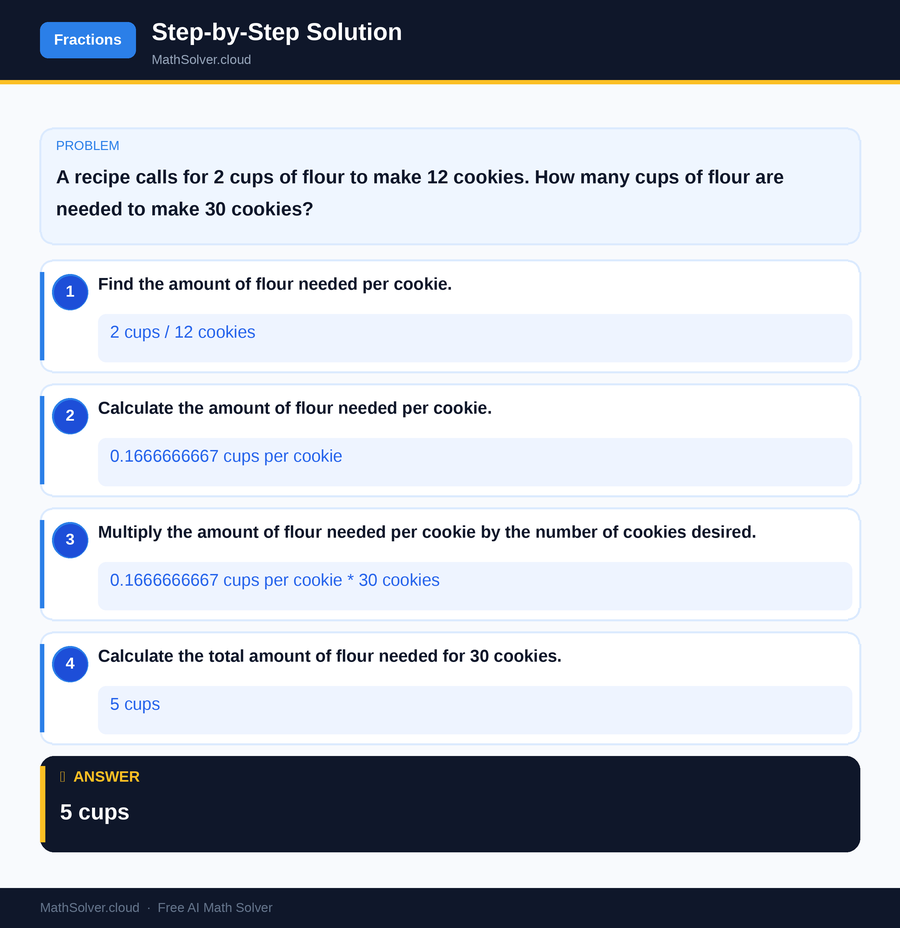
MathSolver Chrome extension solving this problem step-by-step
Example 2
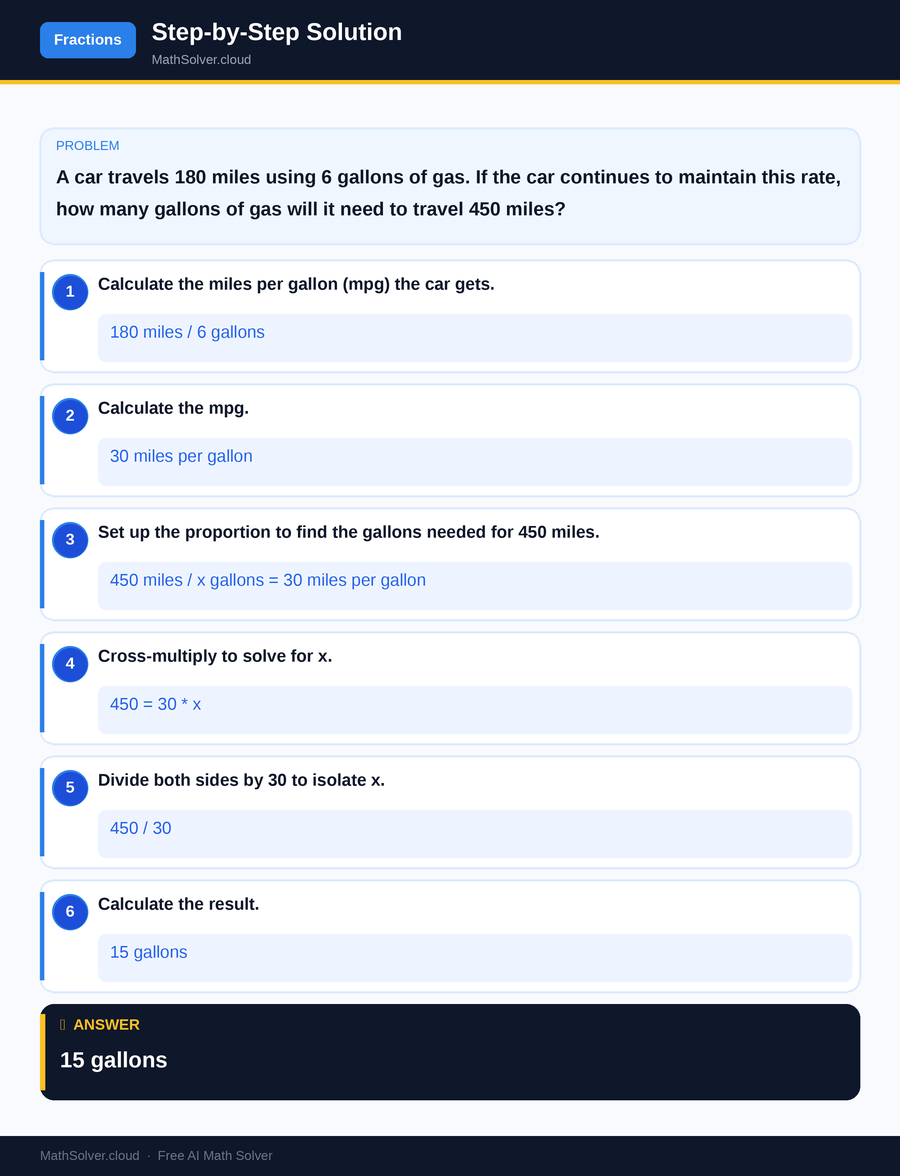
MathSolver Chrome extension solving this problem step-by-step
Common Mistakes to Avoid
One common mistake students make when working on homework lesson 11 equations for proportional relationships answer key is confusing the dependent and independent variables. It’s crucial to correctly identify which variable depends on the other to set up the equation accurately. Another frequent error is incorrectly calculating the constant of proportionality. Students should double-check their division to ensure that k is computed correctly.
Additionally, students sometimes forget to maintain the units of measurement consistent throughout the problem. Mixing units can lead to incorrect answers, so it's important to keep track of them from start to finish. By being mindful of these common pitfalls, students can improve their accuracy and confidence in solving proportional relationship problems.
Real-World Applications
The concepts covered in the homework lesson 11 equations for proportional relationships answer key have numerous real-world applications. For example, understanding proportional relationships is essential in cooking and baking, where ingredients must be scaled up or down based on serving sizes. Knowing how to calculate proportions ensures that recipes turn out as intended, regardless of the quantity being prepared.
Another practical application is in the field of engineering, where proportional relationships are used to design systems that operate efficiently under varying conditions. For instance, engineers might use these concepts to determine the flow rate of fluids in pipes or the load capacity of structures. By mastering proportional relationships, students can see the relevance of math in everyday life and professional contexts.
Frequently Asked Questions
❓ What is the homework lesson 11 equations for proportional relationships answer key?
❓ How do you determine the constant of proportionality in a problem?
❓ How can AI help with homework lesson 11 equations for proportional relationships answer key?
❓ Which equation represents the proportional relationship in the table?
❓ How can I apply proportional relationships in my daily life?
🚀 Solve any math problem instantly
2,000+ students use MathSolver every day — join them for free
📥 Add to Chrome — It's Free