Which Equation Represents the Proportional Relationship in the Table
📋 In this guide
Which equation represents the proportional relationship in the table? This question often perplexes students, but it is a central concept in understanding relationships between two quantities. Proportional relationships are everywhere in mathematics, from simple ratios to complex algebraic expressions. When students encounter tables of values, they often need to determine the equation that best describes the relationship between the variables. This task requires a solid grasp of proportional reasoning, which can be challenging if the underlying concepts are not clear.
Students frequently struggle with identifying proportional relationships because it involves interpreting numerical data and understanding how changes in one variable affect another. This can be confusing, especially when the table includes more than two points or when the relationship is not immediately obvious. Understanding which equation represents the proportional relationship in the table is crucial for solving many real-world problems, such as calculating rates, scaling recipes, or converting currencies.
In this article, we will delve into the process of identifying proportional relationships from tables. By the end, you'll be able to confidently determine which equation represents the proportional relationship in the table, using a step-by-step approach. We will cover key formulas, common mistakes, real-world applications, and provide worked examples to enhance your understanding.
Step-by-Step: How to Solve Which Equation Represents The Proportional Relationship In The Table
Step 1: Identify the Variables
First, examine the table to determine which quantities are the dependent variable (y) and the independent variable (x). Typically, the independent variable is the one that you control or change, while the dependent variable is the one that responds to changes in x. For example, if you have a table showing hours worked and money earned, hours worked would be x, and money earned would be y.
Step 2: Calculate the Constant of Proportionality
To find the constant of proportionality (k), select any pair of corresponding values from the table. Divide the dependent variable (y) by the independent variable (x) to find k. The result should be consistent across all pairs in the table to confirm a proportional relationship. If y/x = k for every pair, then the relationship is proportional, and k is the constant of proportionality.
Step 3: Write the Equation
Once you have identified the constant of proportionality, write the equation in the form y = kx. This equation represents the proportional relationship in the table. Substitute the value of k you calculated into the equation. This equation will allow you to predict the value of y for any given x within the range of data in the table.
Step 4: Verify the Equation
Finally, verify your equation by plugging in the x-values from the table into your equation to see if you get the corresponding y-values. If all the values from the table satisfy the equation, you can be confident that the equation correctly represents the proportional relationship. If not, re-evaluate your calculations for the constant of proportionality and check for any errors.
🤖 Stuck on a math problem?
Take a screenshot and let our AI solve it step-by-step in seconds
⚡ Try MathSolver Free →Worked Examples
Example 1
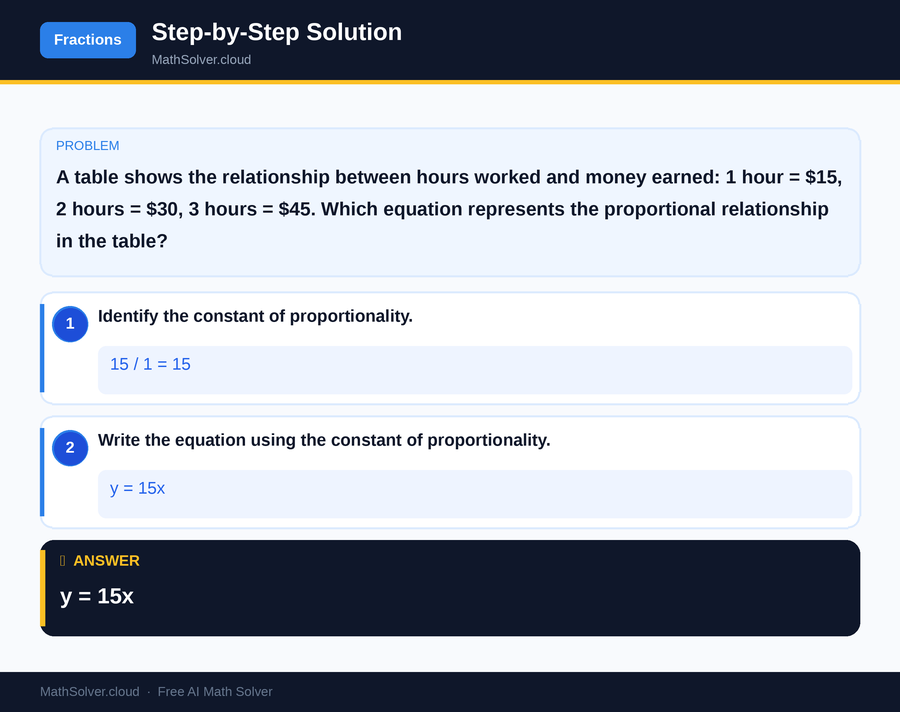
MathSolver Chrome extension solving this problem step-by-step
Example 2
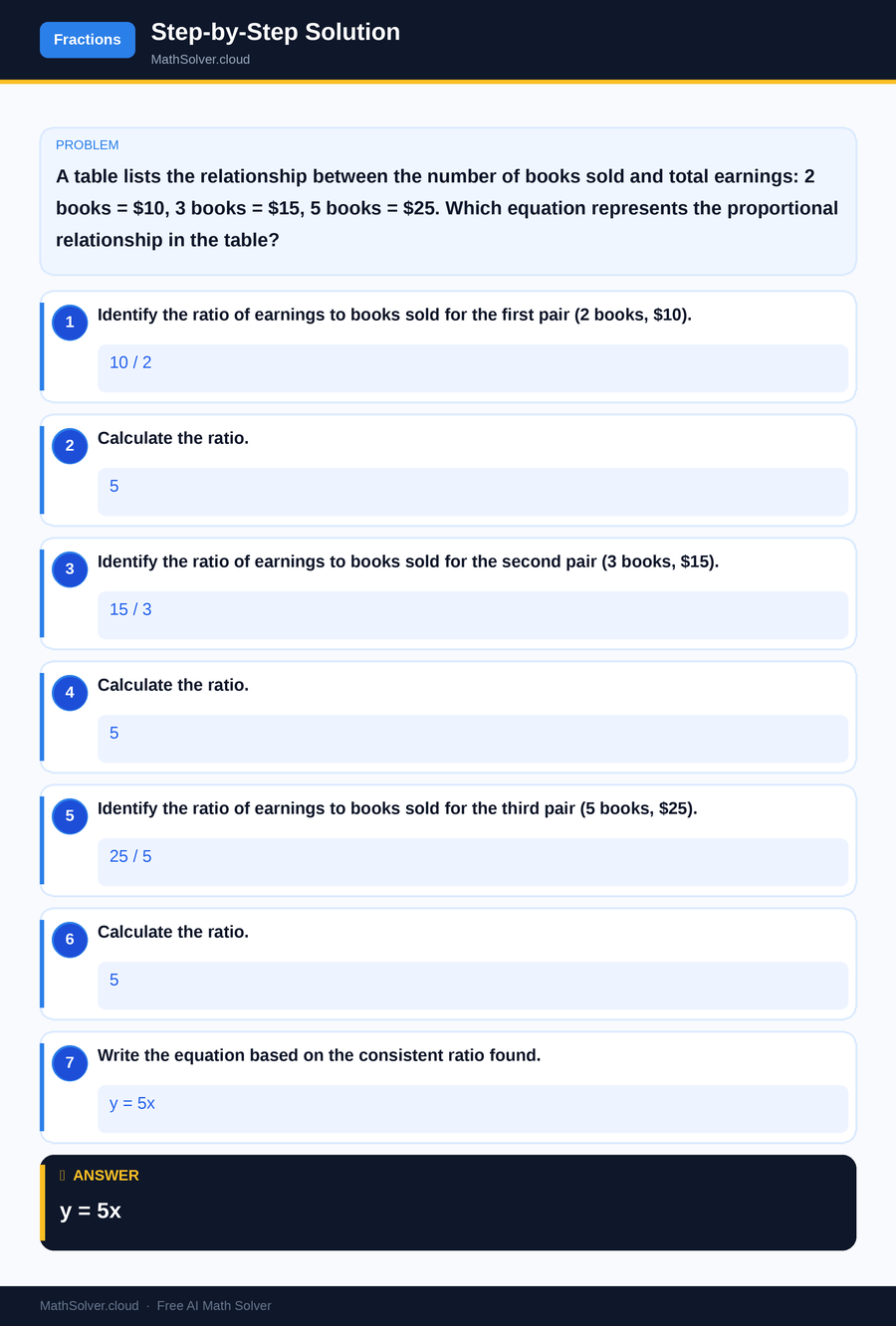
MathSolver Chrome extension solving this problem step-by-step
Common Mistakes to Avoid
One common mistake students make when determining which equation represents the proportional relationship in the table is neglecting to verify the consistency of the constant of proportionality across all data pairs. They might calculate k for one pair and assume it's correct without checking the rest. Always ensure that the ratio y/x is the same for all pairs.
Another error is misidentifying the variables, especially when the context is complex. Students might swap the independent and dependent variables, leading to incorrect conclusions. Always analyze the problem context to clearly distinguish which variable depends on the other.
Real-World Applications
Proportional relationships have numerous real-world applications. For instance, in cooking, recipes often involve proportional relationships. If a recipe calls for 2 cups of flour for every 1 cup of sugar, doubling the recipe requires doubling each ingredient proportionally. Understanding which equation represents the proportional relationship in the table helps you scale recipes correctly.
Another example is currency conversion. Suppose 1 USD is equivalent to 0.85 EUR. If you exchange USD for EUR, the relationship is proportional, and the conversion can be represented by an equation. Accurately determining the proportional relationship ensures precise conversions in finance and travel.
Frequently Asked Questions
❓ How do I determine which equation represents the proportional relationship in the table?
❓ What if the table values are not proportional?
❓ How can AI help with which equation represents the proportional relationship in the table?
❓ Can proportional relationships be negative?
❓ How does determining proportional relationships help in physics?
🚀 Solve any math problem instantly
2,000+ students use MathSolver every day — join them for free
📥 Add to Chrome — It's Free