Solving Exponential Equations
📋 In this guide
Solving exponential equations is a critical skill in mathematics that involves equations where variables appear as exponents. Many students find this topic challenging because it requires an understanding of both algebra and the properties of exponents. In this guide, you'll learn how to tackle these equations systematically, gaining the confidence and skills necessary to solve them efficiently. Whether you're preparing for an exam or simply looking to improve your math skills, understanding how to solve exponential equations is essential for your mathematical journey.
Exponential equations are prevalent in various branches of mathematics and science, such as calculus, physics, and finance. These equations often model real-world phenomena, such as population growth, radioactive decay, and interest calculations. By mastering the techniques for solving exponential equations, you will not only enhance your problem-solving abilities but also gain insights into how mathematical concepts apply to real-life situations.
As we delve into this topic, you'll learn key strategies for solving exponential equations, including isolating the variable, using logarithms, and recognizing patterns. By the end of this article, you will be equipped with the tools and confidence to tackle any exponential equation that comes your way. Let's embark on this mathematical journey together and demystify the process of solving exponential equations.
Step-by-Step: How to Solve Solving Exponential Equations
Step 1: Isolate the Exponential Expression
The first step in solving exponential equations is to isolate the exponential expression on one side of the equation. This involves manipulating the equation to get the term with the exponent by itself. For example, if you have an equation like 2^(3x) = 8, you would aim to have 2^(3x) alone on one side. This step often involves dividing or factoring out other terms that are not part of the exponential expression.
Step 2: Simplify the Equation
Once the exponential expression is isolated, the next step is to simplify the equation. This involves expressing both sides of the equation, if possible, with the same base. For example, if you have 2^x = 8, you can recognize that 8 is the same as 2^3. Simplifying the equation in this way allows you to set the exponents equal to each other, based on the property that if a^x = a^y, then x = y.
Step 3: Use Logarithms if Necessary
If the bases cannot be easily equated, you may need to use logarithms to solve the equation. Taking the logarithm of both sides of the equation is a powerful tool that allows you to bring the exponent down as a coefficient. For instance, if you have an equation like 5^x = 20, taking the logarithm base 10 (or natural logarithm) of both sides will enable you to solve for x by using the property log(a^b) = b*log(a).
Step 4: Solve for the Variable
The final step involves solving for the variable after simplifying the equation or using logarithms. This could involve basic algebraic manipulations such as dividing both sides by a coefficient or adding/subtracting terms to isolate the variable. Ensure that your solution satisfies the original equation by substituting it back into the equation for verification.
🤖 Stuck on a math problem?
Take a screenshot and let our AI solve it step-by-step in seconds
⚡ Try MathSolver Free →Worked Examples
Example 1
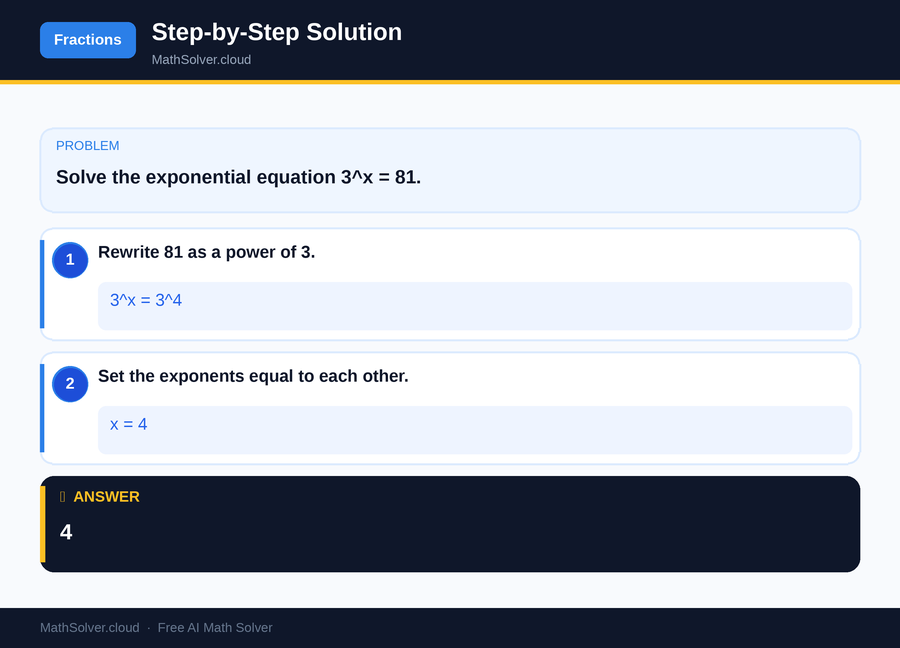
MathSolver Chrome extension solving this problem step-by-step
Example 2

MathSolver Chrome extension solving this problem step-by-step
Common Mistakes to Avoid
One common mistake when solving exponential equations is failing to properly handle the base. Students often try to equate exponents without ensuring the bases are the same, leading to incorrect solutions. Always verify that both sides of the equation have the same base or can be rewritten to have the same base before proceeding to equate exponents.
Another frequent error is misapplying logarithms. When taking the logarithm of both sides, students sometimes forget to apply the logarithm to the entire side of the equation or incorrectly distribute the logarithm across terms. To avoid this mistake, remember that the logarithm applies to the entire expression, and use parentheses to ensure clarity in your calculations.
Real-World Applications
Solving exponential equations has numerous applications in the real world. In finance, exponential equations are used to calculate compound interest, helping individuals and businesses understand how investments grow over time. For example, the formula for compound interest involves solving an exponential equation to determine the future value of an investment.
In the field of biology, exponential equations model population growth, where populations grow at a rate proportional to their current size. This understanding is crucial for predicting changes in population sizes and planning conservation efforts. Similarly, in physics, exponential equations describe radioactive decay, allowing scientists to determine the age of artifacts through carbon dating.
Frequently Asked Questions
❓ What is the best strategy for solving exponential equations when the bases are different?
❓ How do I know when to use logarithms in solving exponential equations?
❓ How can AI help with solving exponential equations?
❓ Can solving exponential equations help with understanding proportional relationships?
❓ What resources are available for practicing exponential equations and related topics?
🚀 Solve any math problem instantly
2,000+ students use MathSolver every day — join them for free
📥 Add to Chrome — It's Free