How to Solve Matrix Problems
📋 In this guide
To solve matrix problems involves understanding and manipulating arrays of numbers using specific mathematical rules. Many students struggle with this concept because matrices can appear complex and abstract, especially when first introduced. However, by breaking down the process into manageable steps, solving matrix problems can become a straightforward task. This article aims to demystify the process by providing clear explanations and step-by-step guidance. You'll also learn about the practical applications of matrices and how they are used in various fields.
Matrices are a fundamental component of linear algebra, a branch of mathematics with numerous applications in engineering, physics, computer science, and more. Understanding how to solve matrix equations is crucial for students in these disciplines. Unfortunately, the abstract nature of matrices can make them seem intimidating. By the end of this article, you will have a better grasp of matrix operations and the confidence to tackle matrix problems on your own.
Throughout this article, we'll explore essential concepts such as matrix multiplication, determinants, and inverse matrices. We'll also cover how to solve matrix equations, providing detailed examples to illustrate each step. Whether you're using a solve matrix calculator or your trusty TI-84 calculator, you'll discover practical tips and tricks to simplify the process. For those eager to master matrices, our complete Matrix & Linear Algebra guide offers additional resources and insights.
Step-by-Step: How to Solve Solve Matrix
Step 1: Understanding Matrices and Their Operations
Before you can solve matrix problems, it's essential to understand the basic operations that can be performed on matrices. These include addition, subtraction, and multiplication. Matrix addition and subtraction are straightforward, requiring that matrices be of the same dimension. Matrix multiplication, however, is more complex, involving the dot product of rows and columns. Familiarize yourself with these operations as they are foundational to solving matrix equations.
Step 2: Setting Up the Matrix Equation
The next step in learning how to solve matrix equations is setting up the matrix equation from the given system of linear equations. For instance, if you have a system of equations, you will need to express it in the form AX = B. Identify the coefficients of the variables and arrange them into the matrix A. Similarly, place the constants on the other side of the equation into the matrix B. This step is crucial as it forms the basis for solving the matrix.
Step 3: Finding the Inverse of a Matrix
To solve matrix equations, it's often necessary to find the inverse of the matrix A. The inverse of a matrix, denoted as A^(-1), is a matrix that, when multiplied with the original matrix A, results in the identity matrix. Not all matrices have inverses, and a matrix must be square (same number of rows and columns) to have an inverse. Use methods such as row reduction or the adjugate method to find the inverse. Alternatively, a matrix multiplication solver can assist in this process.
Step 4: Solving the Matrix Equation
Once you have the inverse of matrix A, multiply it by matrix B to find the matrix of variables X. This is the solution to the matrix equation. If you've set up the matrices correctly and found the inverse accurately, multiplying A^(-1) by B should yield the solution. Verify your solution by substituting the values back into the original equations to ensure they satisfy all conditions.
🤖 Stuck on a math problem?
Take a screenshot and let our AI solve it step-by-step in seconds
⚡ Try MathSolver Free →Worked Examples
Example 1
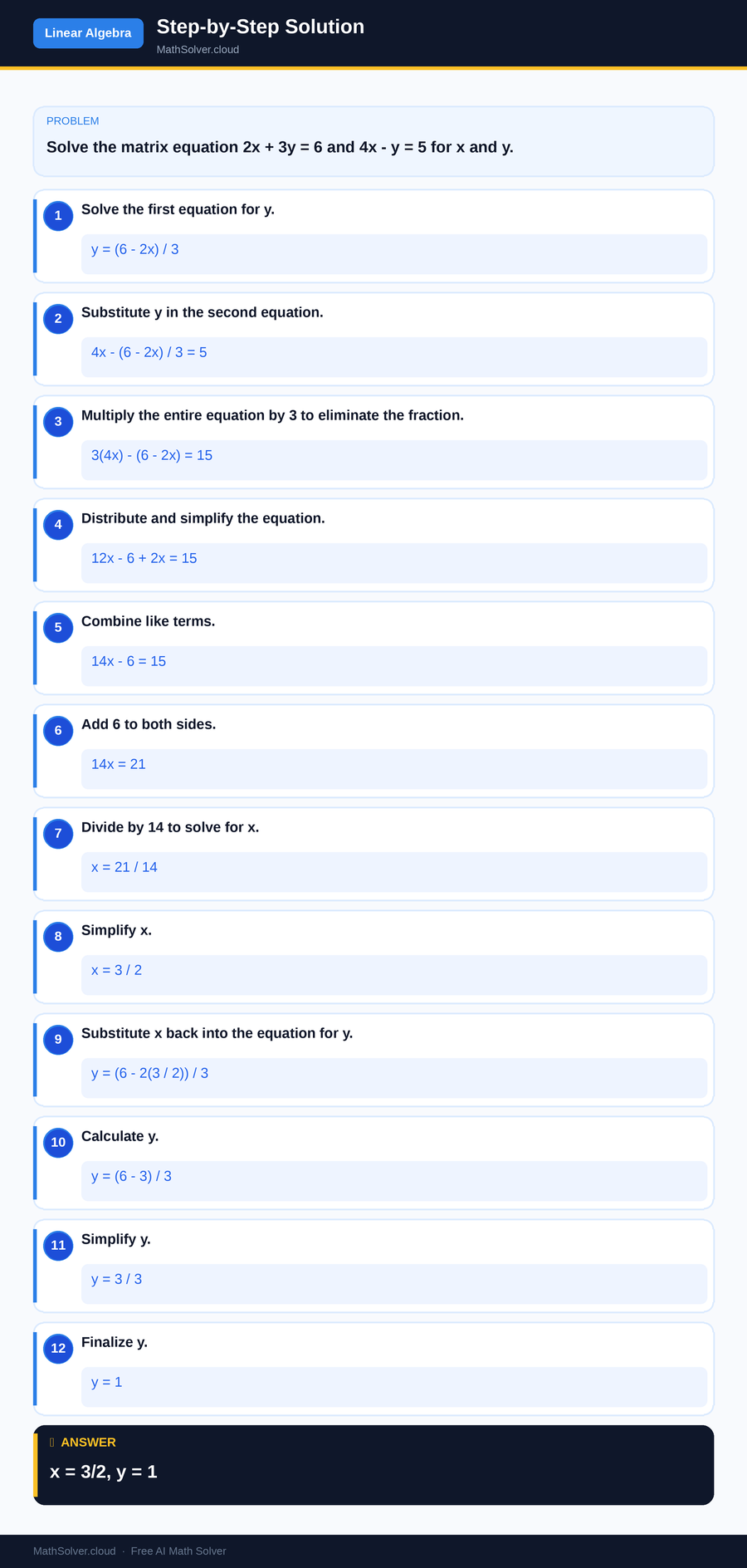
MathSolver Chrome extension solving this problem step-by-step
Example 2
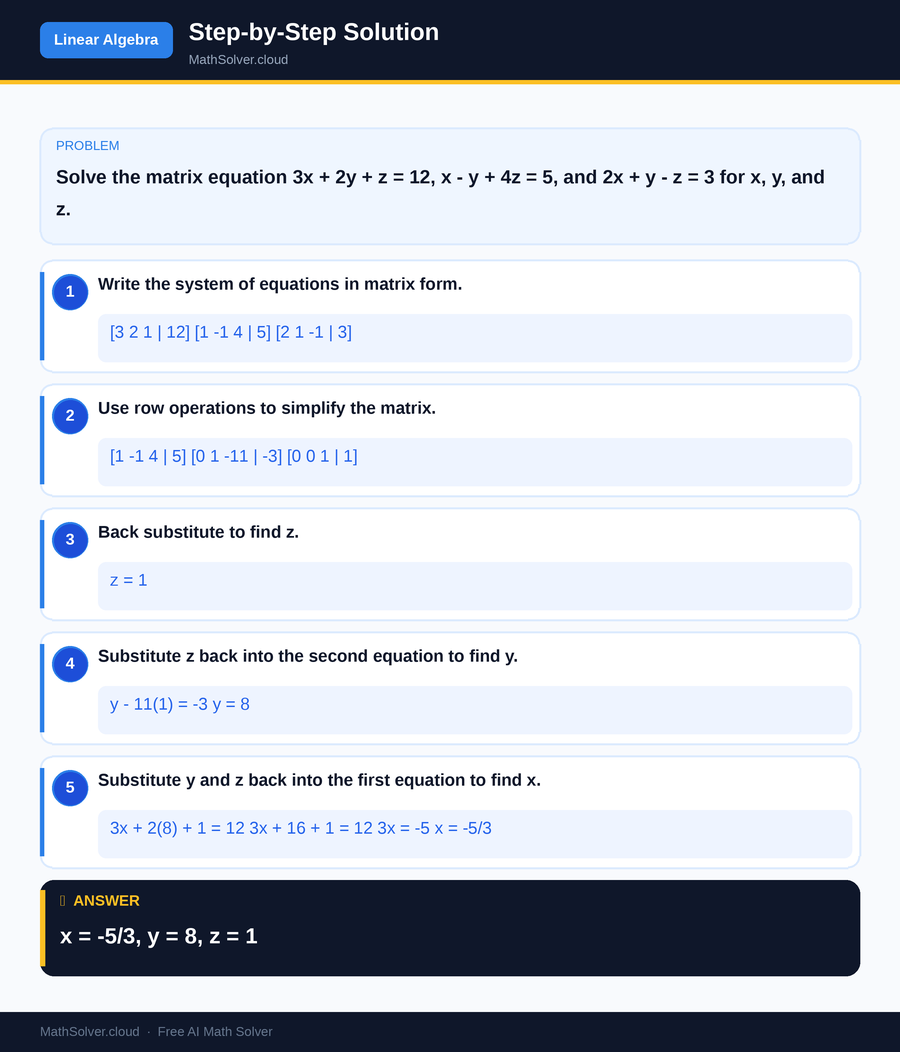
MathSolver Chrome extension solving this problem step-by-step
Common Mistakes to Avoid
One of the most common mistakes students make when they solve matrix problems is incorrectly setting up the matrices. It's crucial to ensure that the coefficients and constants are placed in the correct positions within their respective matrices. Another frequent error is neglecting to check if the matrix is invertible before attempting to find its inverse. A matrix with a determinant of zero does not have an inverse, and attempting to invert such a matrix will lead to incorrect results.
Students also often miscalculate the inverse of a matrix. When using methods like row reduction or the adjugate method, it's essential to follow each step meticulously. Double-check your calculations and ensure that each operation is performed accurately. Utilizing tools like a solve matrix calculator can help verify your results and build confidence in your solutions.
Real-World Applications
Matrices are used extensively in various real-world applications, making the ability to solve matrix problems highly valuable. In computer graphics, matrices are used to perform transformations such as scaling, rotation, and translation of objects. This is essential for rendering images and animations. Engineers use matrices to model and analyze systems in fields such as structural engineering and electrical circuits.
In data science, matrices are pivotal for managing and processing large datasets. They are used in algorithms for machine learning, particularly in operations involving unit vectors and matrix multiplication. Solving matrix equations is also critical in optimizing financial models and simulations. Understanding these applications can motivate students to master matrix algebra and appreciate its relevance in various disciplines.
Frequently Asked Questions
❓ What does it mean to solve matrix equations?
❓ How can I solve matrix problems on a TI-84 calculator?
❓ How can AI help with solving matrix equations?
❓ What is the role of determinants in solving matrices?
❓ Where can I find more resources to learn about matrices?
🚀 Solve any math problem instantly
2,000+ students use MathSolver every day — join them for free
📥 Add to Chrome — It's Free