How to Solve for a Matrix: A Comprehensive Guide
📋 In this guide
When we talk about learning how to solve for a matrix, we often dive into an area of mathematics that many students find daunting. Matrices can seem complex due to their multi-dimensional structure and the variety of operations that can be performed on them. However, understanding the fundamental techniques for solving matrix equations is crucial for advancing in mathematics, particularly in algebra and calculus. This article will guide you through the process of solving matrix equations, breaking down each step so that you can approach these problems with confidence.
Students often struggle with matrices because they require a different way of thinking compared to solving simple algebraic equations. Matrix operations involve not only understanding basic arithmetic but also comprehending concepts like matrix multiplication, determinants, and inverses. These operations can appear abstract at first, but with practice and clear guidance, they become much more approachable.
Throughout this article, you will learn the key steps to solve for a matrix effectively. We will cover essential formulas, provide step-by-step guides, and solve example problems. Whether you're using a solve for a matrix calculator or a traditional approach, this guide will help demystify matrices for you. By the end, you’ll have a solid foundation for tackling matrix problems, and you might even find them enjoyable to solve!
Step-by-Step: How to Solve Solve For A Matrix
Step 1: Understand the Problem
The first step in solving for a matrix is to thoroughly understand the problem you're dealing with. Identify the matrices involved and determine what operation you need to perform to isolate the unknown matrix. This might involve addition, subtraction, multiplication, or finding an inverse. Carefully analyze the equation and take note of the dimensions of each matrix; this is crucial because matrices must be compatible in terms of size for certain operations, such as multiplication.
Step 2: Perform Matrix Operations
Once you have a clear understanding of the problem, the next step is to perform the necessary matrix operations. This could involve adding or subtracting matrices to both sides of an equation, or multiplying both sides by a matrix. It's important to remember that matrix multiplication is not commutative, meaning that AB does not necessarily equal BA. Always follow the order of operations as dictated by the equation.
Step 3: Find the Inverse
If the problem requires you to solve an equation involving a product of matrices, you might need to find the inverse of a matrix. Not all matrices have inverses, so first check if the matrix is invertible by calculating its determinant. If the determinant is zero, the matrix does not have an inverse. If it is non-zero, use the formula for finding an inverse, which involves the adjugate and the determinant of the matrix.
Step 4: Solve for the Unknown Matrix
After performing the necessary operations and calculating any inverses, you can solve for the unknown matrix. Substitute the known values back into the equation and simplify to find the solution. Check your work by plugging the solution back into the original equation to ensure it satisfies the conditions given in the problem.
🤖 Stuck on a math problem?
Take a screenshot and let our AI solve it step-by-step in seconds
⚡ Try MathSolver Free →Worked Examples
Example 1
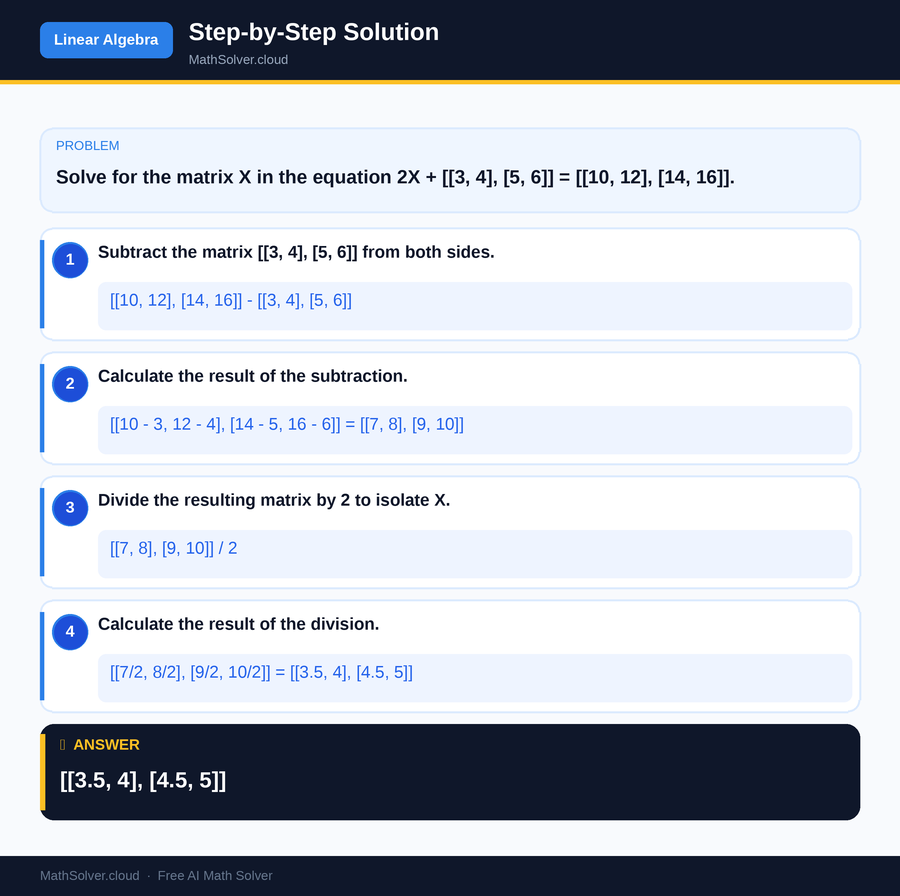
MathSolver Chrome extension solving this problem step-by-step
Example 2
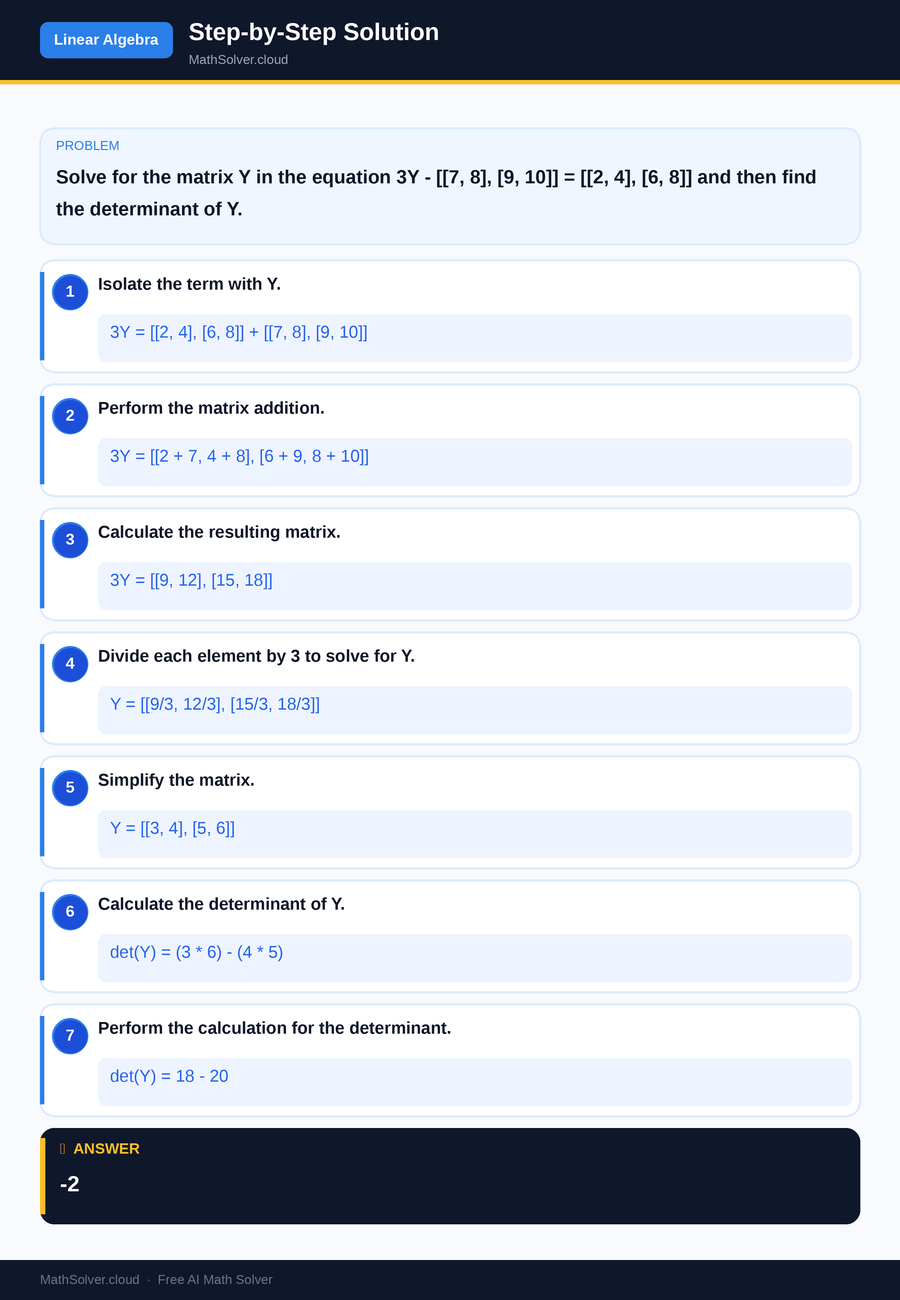
MathSolver Chrome extension solving this problem step-by-step
Common Mistakes to Avoid
One common mistake when solving for a matrix is not checking the dimensions of matrices before performing operations. Ensure that matrices are compatible for addition, subtraction, or multiplication. Another frequent error is neglecting the non-commutative nature of matrix multiplication, leading to incorrect results. Always follow the prescribed order of operations and double-check your work for accuracy.
Additionally, students sometimes overlook the requirement for a matrix to be invertible before attempting to use its inverse in calculations. Always calculate the determinant to confirm invertibility. If the determinant is zero, explore alternative methods to solve the equation, as the matrix cannot be inverted.
Real-World Applications
Matrices are used extensively in various fields, making the ability to solve for a matrix a valuable skill. In computer graphics, matrices are used to perform transformations such as rotations and scaling on images and models, allowing for complex animations and simulations. Engineers use matrices in structural analysis to determine forces and stresses within structures, ensuring safety and stability.
In economics, matrices represent data in input-output models, helping to analyze and predict economic outcomes. Additionally, matrices are foundational in machine learning algorithms, which rely on matrix operations for processing large datasets and training models. Understanding how to solve for a matrix is essential for leveraging these applications in real-world scenarios.
Frequently Asked Questions
❓ How do you solve for a matrix in a linear equation?
❓ Why do I need to find the inverse of a matrix?
❓ How can AI help with solve for a matrix problems?
❓ What happens if a matrix is not invertible?
❓ Can I use a solve for a matrix calculator for my homework?
🚀 Solve any math problem instantly
2,000+ students use MathSolver every day — join them for free
📥 Add to Chrome — It's Free