Master the Art of Solving Equations
📋 In this guide
Solve equation is a fundamental concept in mathematics that often poses a challenge for students. It involves finding the value(s) of the variable(s) that make an equation true. Whether it’s a simple two-step equation or a more complex multi-step equation, understanding how to solve equations is crucial for success in math. Many students struggle with this topic because it requires a blend of arithmetic skills, logical thinking, and a strong grasp of mathematical principles. In this article, you'll learn the key strategies and steps required to solve equations effectively.
Equations are the backbone of mathematics, and learning how to solve them opens doors to understanding more advanced topics, such as algebra, calculus, and beyond. Students often find it daunting to keep track of different terms and operations, especially when dealing with equations that have variables on both sides. This guide aims to demystify the process and provide you with a clear pathway to mastering the art of solving equations.
By the end of this article, you will gain confidence in your ability to solve equations, including those with variables on both sides. We’ll explore different methods, provide detailed examples, and discuss common pitfalls. Whether you're a beginner or looking to refine your skills, this guide will equip you with the tools you need to tackle equations with ease.
Step-by-Step: How to Solve Solve Equation
Step 1: Identify the Type of Equation
The first step in solving an equation is to identify what type of equation you are dealing with. Is it a simple equation with one variable, or does it have multiple steps or variables on both sides? Recognizing the equation type will guide you in choosing the most efficient method to solve it. For instance, two-step equations require you to perform two operations to isolate the variable, while multi-step equations might need you to simplify both sides or distribute terms.
Step 2: Simplify Each Side of the Equation
Before attempting to solve the equation, it’s important to simplify both sides as much as possible. This might involve combining like terms, distributing multiplication over addition, or reducing fractions. Simplifying the equation ensures that you are working with the simplest form, making it easier to solve. For example, in the equation "2(x + 3) = 14", you would start by distributing the 2 to get "2x + 6 = 14".
Step 3: Isolate the Variable
Once the equation is simplified, your next step is to isolate the variable on one side of the equation. This process often involves using inverse operations to move terms from one side of the equation to the other. For instance, if you have an equation like "x + 5 = 12", you would subtract 5 from both sides to get "x = 7". The goal is to have the variable by itself on one side of the equation.
Step 4: Check Your Solution
After isolating the variable and finding a solution, it’s crucial to check your work. Substitute the solution back into the original equation to verify that it satisfies the equation. This step helps catch any mistakes and ensures that your solution is correct. For example, if you solved "x + 5 = 12" and found x = 7, plug 7 back into the equation to verify: "7 + 5 = 12", which is true.
🤖 Stuck on a math problem?
Take a screenshot and let our AI solve it step-by-step in seconds
⚡ Try MathSolver Free →Worked Examples
Example 1
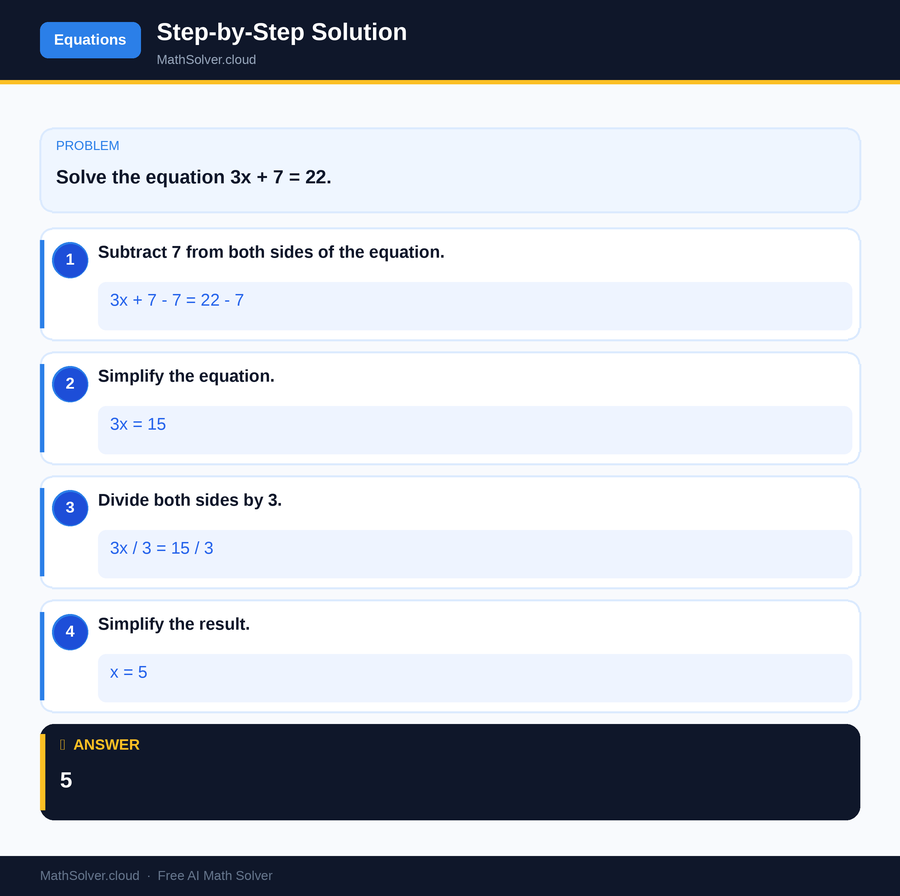
MathSolver Chrome extension solving this problem step-by-step
Example 2
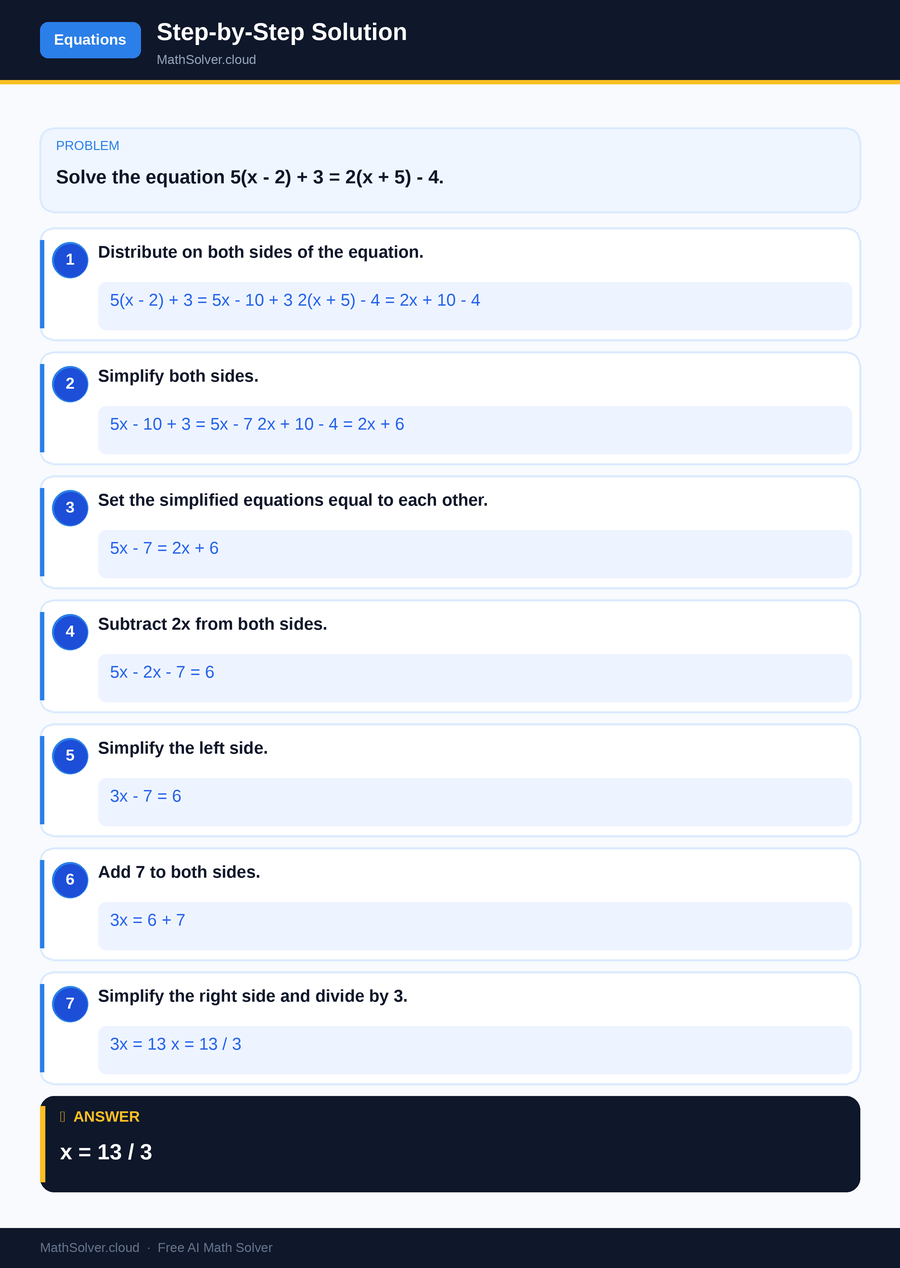
MathSolver Chrome extension solving this problem step-by-step
Common Mistakes to Avoid
One common mistake students make when solving equations is neglecting to perform the same operation on both sides of the equation. This can lead to incorrect solutions because it disrupts the balance of the equation. Always remember that whatever you do to one side of the equation, you must do to the other to maintain equality.
Another frequent error is mismanaging negative signs or distributing incorrectly. This often results in sign errors, which can completely change the solution. To avoid this, pay close attention to the signs and double-check each step of your solution process for accuracy.
Real-World Applications
Solving equations is not just an academic exercise; it's a valuable skill used in various real-world scenarios. For example, in finance, equations are used to calculate interest rates, loan payments, and investment returns. Understanding how to solve these equations can help individuals make informed financial decisions.
In engineering, solving equations is essential for designing and analyzing structures, electrical circuits, and systems. Engineers often use complex equations to determine forces, stresses, and other critical parameters. Mastery of solving equations is crucial for ensuring safety and efficiency in engineering projects.
Frequently Asked Questions
❓ What is the best way to solve equation problems?
❓ Why do students find it difficult to solve equations with variables on both sides?
❓ How can AI help with solving equations?
❓ What is the difference between two-step and multi-step equations?
❓ How can I practice solving equations effectively?
🚀 Solve any math problem instantly
2,000+ students use MathSolver every day — join them for free
📥 Add to Chrome — It's Free