Mastering the Solve Equation Calculator
📋 In this guide
A solve equation calculator is a powerful tool designed to assist students and learners in solving mathematical equations efficiently. Whether you're grappling with algebraic expressions or complex polynomials, these calculators can provide instant solutions, making them an indispensable resource for students worldwide. Many students struggle with equations because they often involve multiple steps, variables, and operations that can be confusing without a clear strategy. By using a solve equation calculator, students can not only find the correct answers but also understand the steps involved, leading to a deeper grasp of the concepts.
One of the primary challenges students face is the ability to follow the logical sequence of operations required to solve equations correctly. This is particularly true for more complex equations, such as quadratic equations, which necessitate the use of the quadratic formula. Fortunately, a solve equation calculator can guide students through these processes, breaking down each step into manageable parts. By doing so, students can learn to solve equations independently and build their confidence in mathematics.
In this article, you will learn how to utilize a solve equation calculator effectively, explore the steps involved in solving different types of equations, and understand common pitfalls to avoid. We will also provide practical examples and discuss the real-world applications of these calculators. By the end, you'll be equipped with the knowledge to tackle equations like a pro!
Step-by-Step: How to Solve Solve Equation Calculator
Step 1: Identify the Type of Equation
The first step in using a solve equation calculator is to identify the type of equation you are dealing with. Equations can be classified into different types, such as linear equations, quadratic equations, and polynomial equations. For example, a linear equation is typically in the form ax + b = 0, whereas a quadratic equation is in the form ax^2 + bx + c = 0. Knowing the type of equation will help you determine the appropriate method or formula needed to solve it.
Step 2: Input the Equation
Once you have identified the type of equation, the next step is to input the equation into the solve equation calculator. This usually involves entering the coefficients and constants from the equation. For example, if you have a quadratic equation like 2x^2 - 5x + 3 = 0, you would input the values for a, b, and c into the calculator. Make sure to double-check your inputs to avoid any errors that could lead to incorrect solutions.
Step 3: Follow the Solution Steps
After inputting the equation, the solve equation calculator will provide a step-by-step solution. This is one of the most valuable features of the calculator, as it allows you to see the logical progression of solving the equation. Pay close attention to each step, such as isolating variables, simplifying expressions, and applying formulas. Understanding these steps will help you learn how to solve similar equations manually in the future.
Step 4: Verify the Solution
The final step is to verify the solution provided by the solve equation calculator. You can do this by plugging the solution back into the original equation to see if it satisfies the equation. If it does, then the solution is correct. If not, recheck the steps to identify any potential errors. Verifying the solution ensures that you have understood the process and can confidently apply it to other problems.
🤖 Stuck on a math problem?
Take a screenshot and let our AI solve it step-by-step in seconds
⚡ Try MathSolver Free →Worked Examples
Example 1

MathSolver Chrome extension solving this problem step-by-step
Example 2
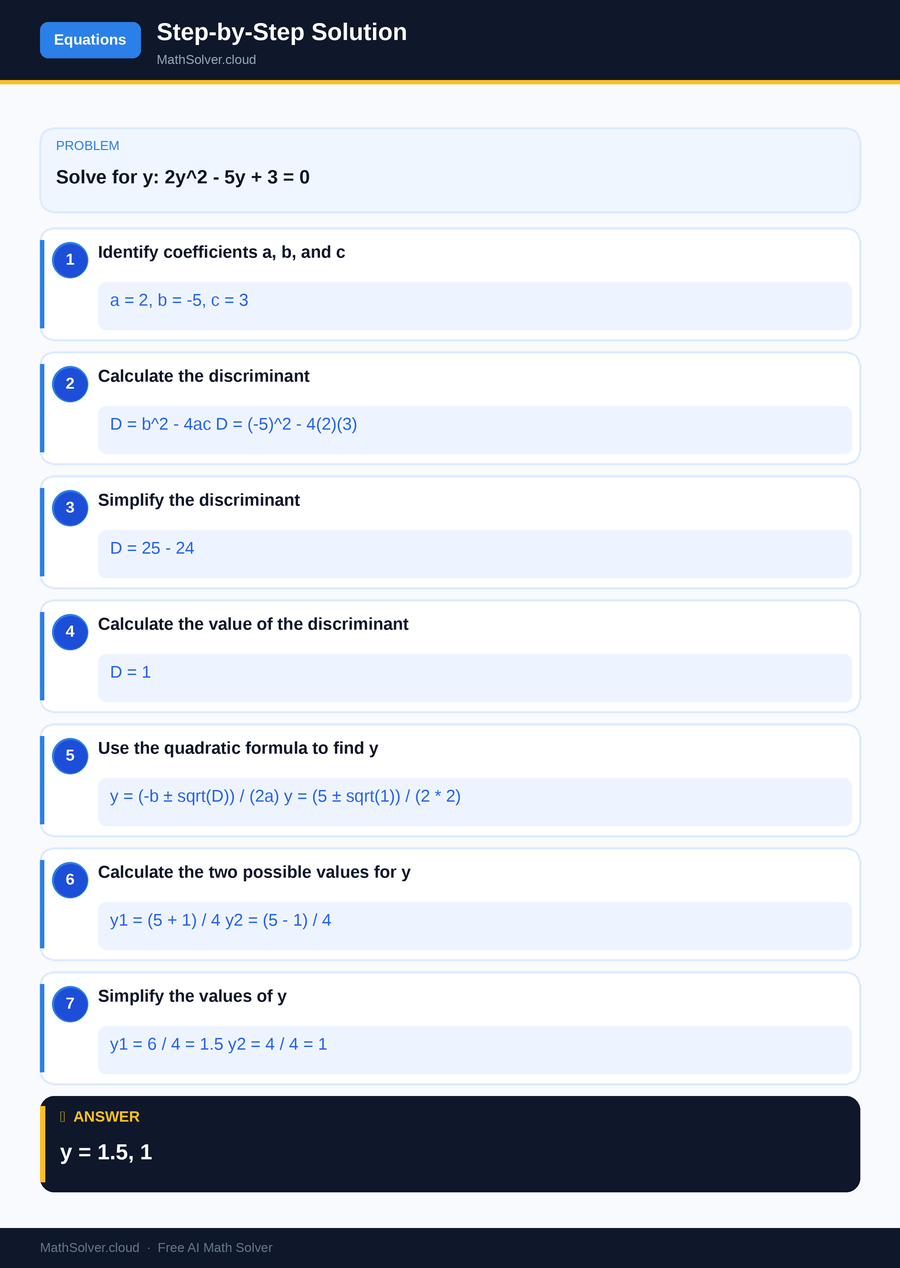
MathSolver Chrome extension solving this problem step-by-step
Common Mistakes to Avoid
One common mistake when using a solve equation calculator is entering incorrect coefficients or constants. This can lead to erroneous results, so it's crucial to double-check your inputs before proceeding. Another frequent error is misunderstanding the solution steps provided by the calculator. It's important to take your time to follow each step carefully and ensure you understand the logic behind them.
Additionally, students often forget to verify their solutions. This step is vital as it confirms the accuracy of the solution. Always substitute your answer back into the original equation to see if it holds true. By avoiding these mistakes, you can make the most out of your solve equation calculator experience.
Real-World Applications
Solve equation calculators have numerous real-world applications beyond academic settings. For instance, engineers frequently use them to solve complex equations related to structural analysis and design. This ensures that buildings and bridges are structurally sound and safe for use.
In the field of finance, solve equation calculators are used to model economic scenarios and forecast financial outcomes. By solving equations that represent various financial variables, analysts can make informed decisions and develop strategies for investment and budgeting. The versatility of these calculators makes them invaluable tools in many professional domains.
Frequently Asked Questions
❓ What is a solve equation calculator and how does it work?
❓ Why do students struggle with solving equations?
❓ How can AI help with solve equation calculator?
❓ What are two-step and multi-step equations, and how do they differ?
❓ How can I practice solving equations effectively?
🚀 Solve any math problem instantly
2,000+ students use MathSolver every day — join them for free
📥 Add to Chrome — It's Free