Mastering the Quad Equation Solver
📋 In this guide
The quad equation solver is an invaluable tool for students grappling with quadratic equations. These equations, which take the standard form ax^2 + bx + c = 0, often present a challenge due to their complexity. Students frequently encounter difficulties when trying to factorize or apply the quadratic formula, leading to frustration and confusion. By learning how to effectively use a quad equation solver, students can gain confidence in tackling these algebraic challenges and improve their problem-solving skills.
Quadratic equations pop up in various branches of mathematics and have applications in fields ranging from physics to biology. However, many students struggle with identifying the correct approach to solve them. They might mix up steps, miscalculate numbers, or forget which method to use altogether. This article aims to simplify the process by walking you through quad equation solvers, helping you understand the underlying principles and how to apply them effectively.
By the end of this guide, you'll have a solid understanding of how to use a quad equation solver to tackle quadratic equations with ease. You'll also learn about common mistakes to avoid, real-world applications of these equations, and how technology like the MathSolver Chrome extension can aid your learning process. Whether you're a student needing a refresher or someone looking to deepen your understanding of algebra equations, this article has something for you.
Step-by-Step: How to Solve Quad Equation Solver
Step 1: Identify the Coefficients
Before using a quad equation solver, it's crucial to identify the coefficients a, b, and c in the quadratic equation. These coefficients are the numerical values that multiply the variable terms. For example, in the equation 2x^2 - 4x - 6 = 0, the coefficients are a = 2, b = -4, and c = -6. Clearly identifying these values is the first critical step in using the quadratic formula effectively.
Step 2: Calculate the Discriminant
Once you have your coefficients, the next step is to calculate the discriminant, which is the expression under the square root in the quadratic formula: b^2 - 4ac. The discriminant helps determine the number and type of solutions. A positive discriminant indicates two real solutions, zero means one real solution, and a negative discriminant suggests two complex solutions. This step is crucial for understanding the nature of the roots you'll be solving for.
Step 3: Apply the Quadratic Formula
With the discriminant in hand, you can now apply the quadratic formula: x = (-b ± sqrt(b^2 - 4ac)) / (2a). Substitute the values of a, b, and c into the formula and solve for x. Remember to consider both the positive and negative square roots when calculating your solutions. This step is where the magic happens, as you'll find the roots of the quadratic equation.
Step 4: Verify Your Solutions
The final step is to verify your solutions by substituting them back into the original equation to ensure they satisfy it. This verification process is essential to ensure accuracy and build your confidence. If your solutions are correct, substituting them into the equation should yield zero. If not, revisit your calculations to check for any errors.
🤖 Stuck on a math problem?
Take a screenshot and let our AI solve it step-by-step in seconds
⚡ Try MathSolver Free →Worked Examples
Example 1
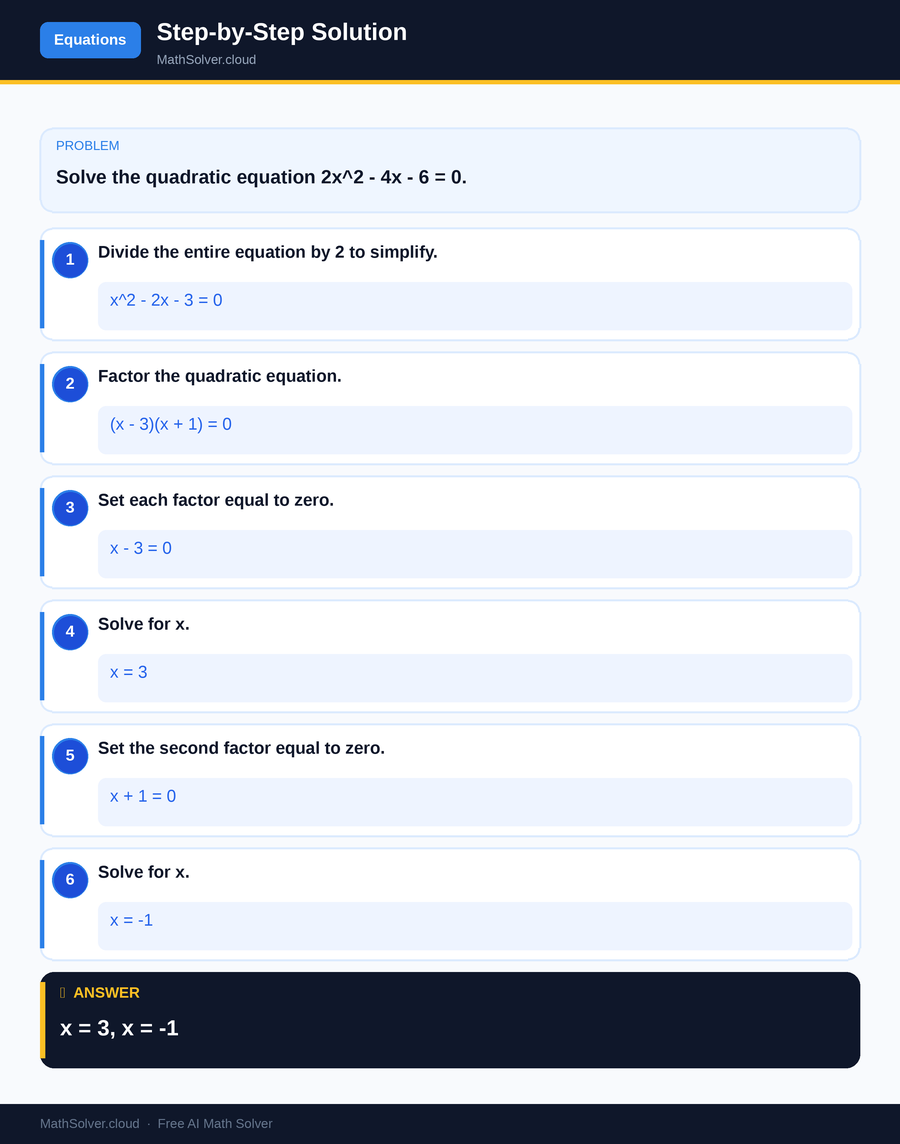
MathSolver Chrome extension solving this problem step-by-step
Example 2
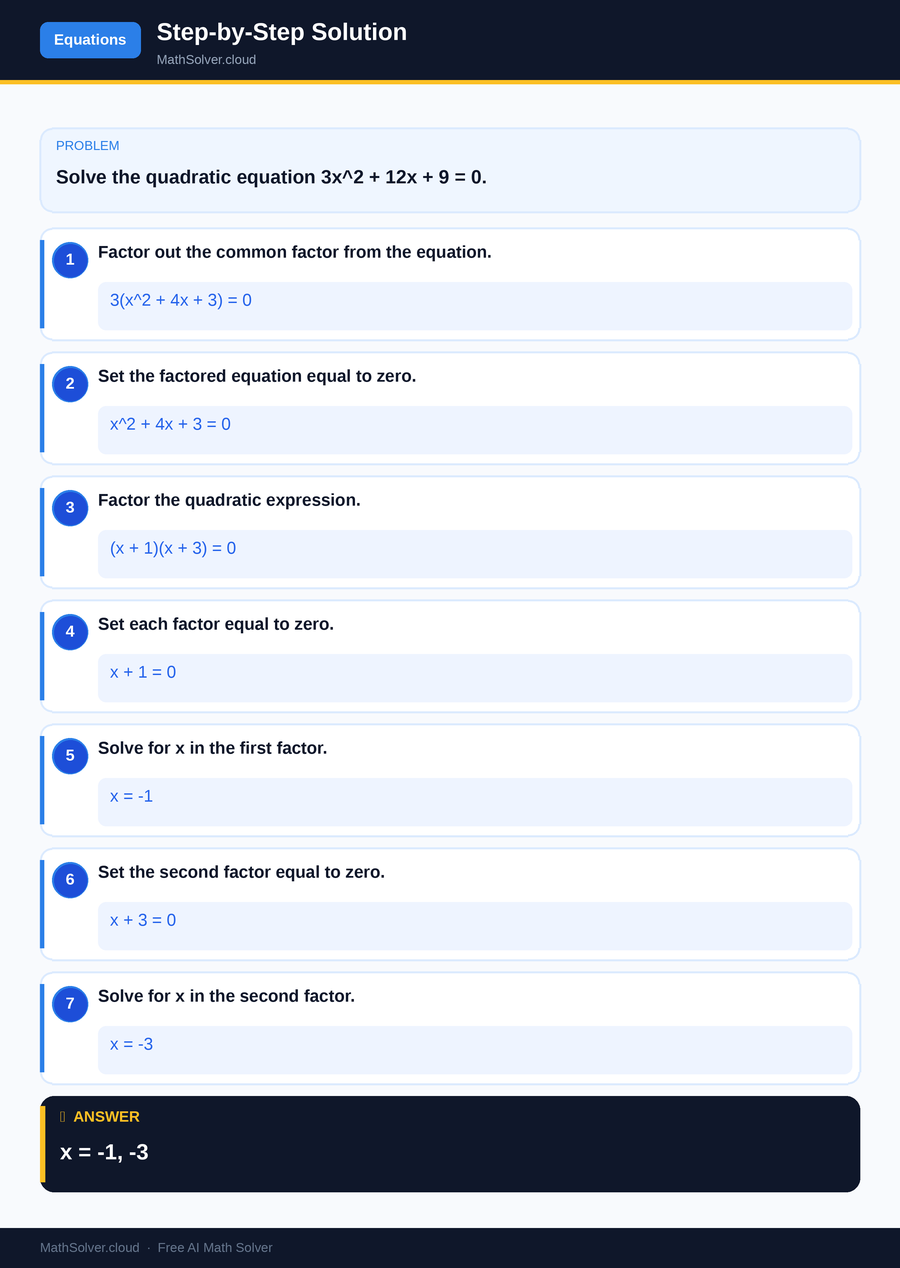
MathSolver Chrome extension solving this problem step-by-step
Common Mistakes to Avoid
One common mistake students often make is incorrectly calculating the discriminant. Misplacing a negative sign or miscalculating the value can lead to incorrect roots. Always double-check your arithmetic when calculating the discriminant to avoid this error.
Another frequent error is forgetting to consider both the positive and negative square roots when applying the quadratic formula. This oversight can result in missing one of the solutions. Make sure to solve for both x = (-b + sqrt(b^2 - 4ac)) / (2a) and x = (-b - sqrt(b^2 - 4ac)) / (2a) to find all possible solutions.
Real-World Applications
Quadratic equations and their solutions are not just confined to textbooks; they have real-world applications too. In physics, they are often used in kinematic equations to describe the motion of objects under constant acceleration. For example, the equation for the displacement of an object can be a quadratic equation involving time.
In biology, quadratic equations may be used to model population growth or the photosynthesis equation. These applications show how understanding quadratic equations is crucial for solving complex problems in various scientific fields.
Frequently Asked Questions
❓ What is a quad equation solver, and how does it work?
❓ Why do students struggle with quadratic equations?
❓ How can AI help with quad equation solver problems?
❓ Can quadratic equations have no real solutions?
❓ How do quadratic equations relate to other algebraic equations?
🚀 Solve any math problem instantly
2,000+ students use MathSolver every day — join them for free
📥 Add to Chrome — It's Free