Demystifying the Pythagorean Theorem Equation
📋 In this guide
The Pythagorean theorem equation is a fundamental concept in geometry, particularly in the study of right triangles. It provides a simple relationship between the lengths of the sides of a right triangle, allowing us to calculate the length of one side if the lengths of the other two are known. Despite its apparent simplicity, many students struggle with applying the Pythagorean theorem equation correctly. This struggle often stems from confusion about the components of a right triangle and the proper application of the formula. In this article, we will demystify the Pythagorean theorem equation, providing you with a clear understanding and practical steps to solve problems involving this essential mathematical principle.
By the end of this guide, you will be equipped with the knowledge to tackle any problem involving the Pythagorean theorem equation. We will start with a clear definition of the formula and proceed with a step-by-step guide to solving problems. You will also see worked examples that demonstrate how to apply the theorem in various scenarios. Additionally, we will discuss common mistakes to avoid and explore real-world applications of the Pythagorean theorem equation. Our goal is to make this topic as accessible and intuitive as possible, so you feel confident in your geometry lessons.
As we delve into the specifics, you will also learn how tools like the Pythagorean theorem equation solver can simplify your calculations, especially when tackling more complex problems. Whether you are a student looking to ace your geometry exams or simply curious about the practical uses of this theorem, this comprehensive guide will serve as a valuable resource. Remember, mathematics is not just about numbers; it's about solving real-world problems and enhancing your problem-solving skills.
Step-by-Step: How to Solve Pythagorean Theorem Equation
Step 1: Identify the Right Triangle Components
The first step in using the Pythagorean theorem equation is to correctly identify the components of the right triangle you are working with. A right triangle consists of two legs and one hypotenuse. The legs are the sides that form the right angle, and the hypotenuse is the side opposite the right angle, which is also the longest side. Ensuring you have correctly identified these parts is crucial, as mixing up the legs with the hypotenuse will lead to incorrect calculations. Take a moment to label each side of the triangle with the corresponding variables: 'a', 'b', and 'c'.
Step 2: Set Up the Equation
Once you have identified the components of your triangle, set up the Pythagorean theorem equation using the formula 'a^2 + b^2 = c^2'. Assign the known lengths of the sides to their respective variables. If you are given the lengths of both legs, they will be your 'a' and 'b'. If the hypotenuse length is provided, it will be your 'c'. This step is crucial for organizing your information and ensuring that you substitute the correct values into the equation.
Step 3: Solve for the Unknown Side
With the equation set up, the next step is to solve for the unknown side of the triangle. If you are solving for the hypotenuse, rearrange the equation to solve for 'c' by taking the square root of the sum of the squares of the legs: c = sqrt(a^2 + b^2). Conversely, if you are solving for one of the legs, rearrange the equation to solve for 'a' or 'b' by taking the square root of the difference between the square of the hypotenuse and the square of the known leg: a = sqrt(c^2 - b^2) or b = sqrt(c^2 - a^2). Perform the calculations carefully to avoid errors.
Step 4: Verify Your Solution
The final step is to verify your solution to ensure its accuracy. Double-check your calculations and ensure that the values used in the equation are correct. If possible, re-calculate the values using a pythagorean theorem equation solver to confirm accuracy. Verifying your solution is essential to ensure that you have not made any arithmetic mistakes and that your final answer makes sense in the context of the problem.
🤖 Stuck on a math problem?
Take a screenshot and let our AI solve it step-by-step in seconds
⚡ Try MathSolver Free →Worked Examples
Example 1
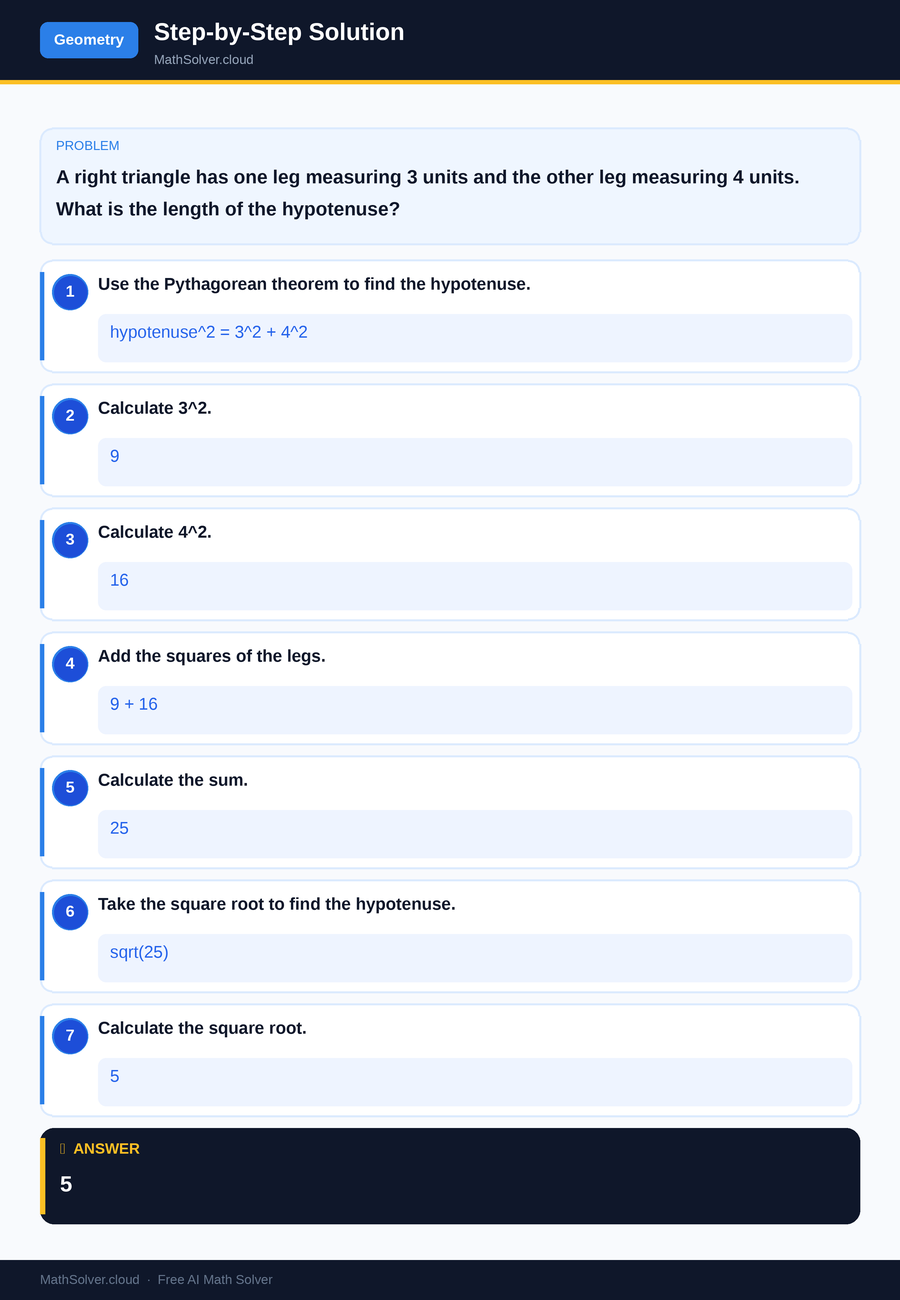
MathSolver Chrome extension solving this problem step-by-step
Example 2
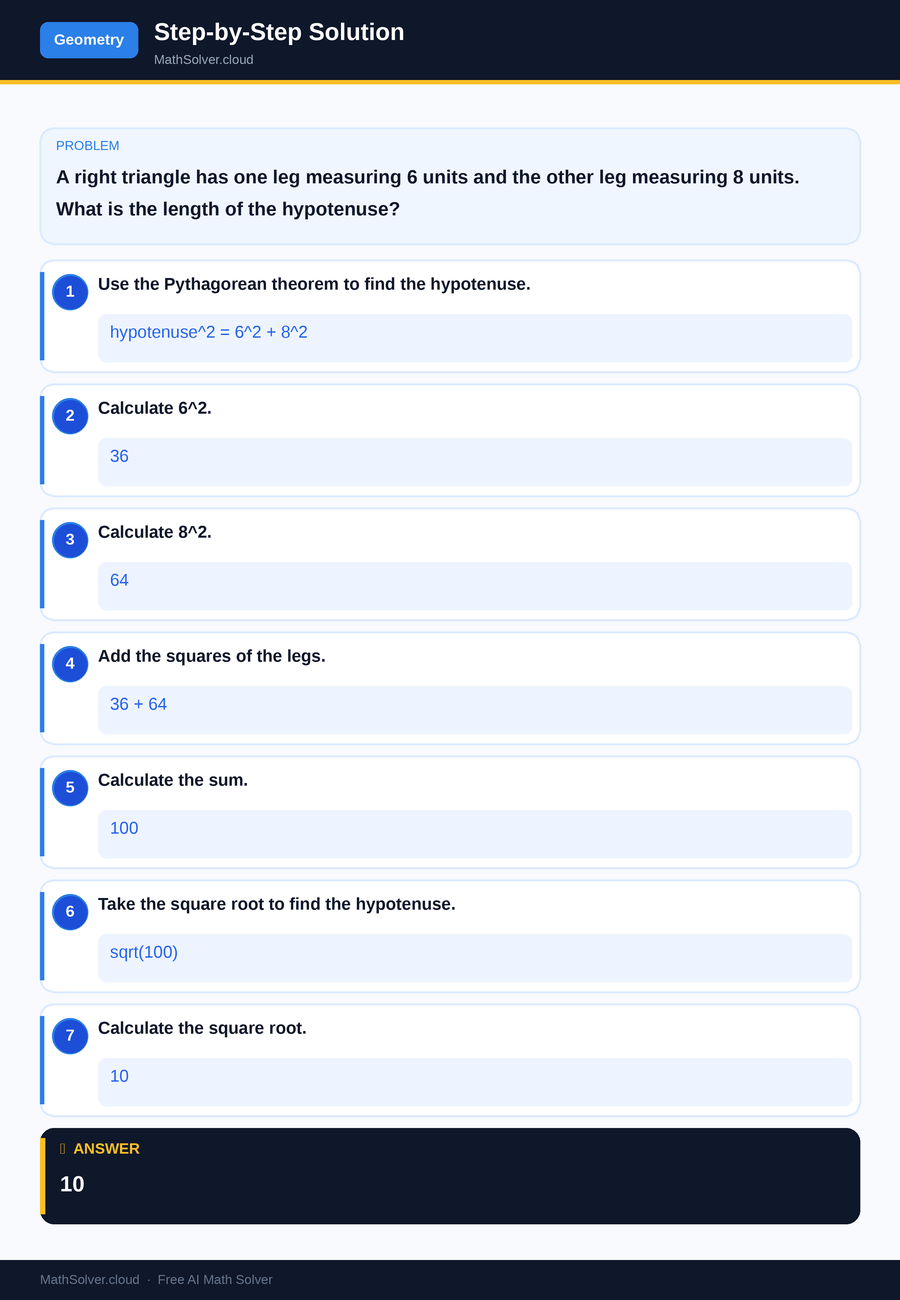
MathSolver Chrome extension solving this problem step-by-step
Common Mistakes to Avoid
One common mistake students make when working with the Pythagorean theorem equation is confusing the hypotenuse with one of the legs. Remember, the hypotenuse is always the longest side and lies opposite the right angle. Misidentifying the sides leads to incorrect substitutions in the equation and erroneous results. To avoid this, always double-check which side is the hypotenuse before beginning your calculations.
Another frequent error is neglecting to square the sides before adding or subtracting them. The equation requires you to square the values of 'a' and 'b' (or 'c' if solving for a leg) before performing any further operations. Failing to do this will result in incorrect calculations. To avoid this mistake, carefully follow each step of the formula and perform calculations methodically.
Real-World Applications
The Pythagorean theorem equation is not just confined to academic exercises; it has numerous real-world applications. For instance, it is used in construction and engineering to ensure structures are built with precise right angles. When installing roof trusses, builders use the theorem to calculate the proper length of materials needed.
Another practical application is in navigation and map-making. The theorem helps in calculating the shortest distance between two points, which is particularly useful in air and sea travel. By understanding how to apply the Pythagorean theorem equation in these contexts, you can appreciate its value beyond the classroom.
Frequently Asked Questions
❓ What is the Pythagorean theorem equation?
❓ Why do students find the Pythagorean theorem equation challenging?
❓ How can AI help with the Pythagorean theorem equation?
❓ How does the Pythagorean theorem relate to geometry lessons?
❓ Can the Pythagorean theorem be used in gaming, like Geometry Dash?
🚀 Solve any math problem instantly
2,000+ students use MathSolver every day — join them for free
📥 Add to Chrome — It's Free