Mastering Geometry Lessons
📋 In this guide
Geometry lessons serve as a foundational component of mathematics education, focusing on the study of shapes, sizes, relative positions, and properties of space. Students often find geometry lessons challenging due to the abstract nature of the concepts and the necessity to visualize and manipulate spatial information. These lessons encompass a wide range of topics, from basic shapes and angles to more advanced concepts like congruence, similarity, and geometric proofs.
Understanding geometry is crucial because it develops spatial reasoning and problem-solving skills. Students may struggle with geometry lessons because they require a different approach compared to arithmetic or algebra. Instead of straightforward numerical calculations, students need to engage in critical thinking and visualization, which can be daunting without proper guidance. Moreover, geometry often involves applying multiple concepts simultaneously, which can be overwhelming.
Through geometry lessons, students gain the ability to calculate areas, perimeters, and volumes, understand the properties of various geometric figures, and develop reasoning skills that are applicable beyond the classroom. By mastering these concepts, students can improve their overall mathematical proficiency and prepare for more advanced studies in mathematics and related fields.
Step-by-Step: How to Solve Geometry Lessons
Step 1: Understanding Basic Shapes and Properties
The first step in mastering geometry lessons is familiarizing yourself with basic shapes and their properties. Start by recognizing and naming shapes like triangles, rectangles, circles, and polygons. Each shape has specific properties, such as the number of sides and angles. Understanding these properties is crucial as they form the foundation for more complex topics. For instance, knowing that a rectangle has four right angles and opposite sides of equal length helps in solving problems related to this shape. Practice identifying shapes in everyday objects to reinforce your understanding.
Step 2: Learning to Calculate Areas and Perimeters
Once you are comfortable with basic shapes, the next step is learning how to calculate areas and perimeters. The area measures the space within a shape, while the perimeter is the total length around it. Begin with simple formulas like the area of a rectangle (length x width) and the perimeter of a rectangle (2 x (length + width)). Progress to more complex shapes, such as triangles and circles, using formulas like 1/2 x base x height for the area of a triangle and 2 x pi x radius for the circumference of a circle. Practice these calculations with different dimensions to strengthen your skills.
Step 3: Understanding Angles and Their Properties
Angles are a fundamental aspect of geometry lessons, and understanding them is vital for solving many geometric problems. Begin by learning the different types of angles—acute, right, obtuse, and straight—and their properties. Recognize that angles are measured in degrees, with a right angle being 90 degrees. Use a protractor to measure angles accurately. Additionally, learn about complementary and supplementary angles, which are pairs of angles that add up to 90 degrees and 180 degrees, respectively. Mastering angles will help you understand more complex geometric concepts, such as parallel lines and polygons.
Step 4: Applying Geometric Theorems and Proofs
The final step in geometry lessons involves applying geometric theorems and constructing proofs. Theorems are statements that have been proven based on previously established statements, such as axioms and postulates. Familiarize yourself with key theorems like the Pythagorean Theorem, which relates the sides of a right triangle: a^2 + b^2 = c^2, where c is the hypotenuse. Practice constructing logical arguments to prove geometric statements, a critical skill in geometry. Start with simple proofs and gradually tackle more complex ones as you gain confidence.
🤖 Stuck on a math problem?
Take a screenshot and let our AI solve it step-by-step in seconds
⚡ Try MathSolver Free →Worked Examples
Example 1
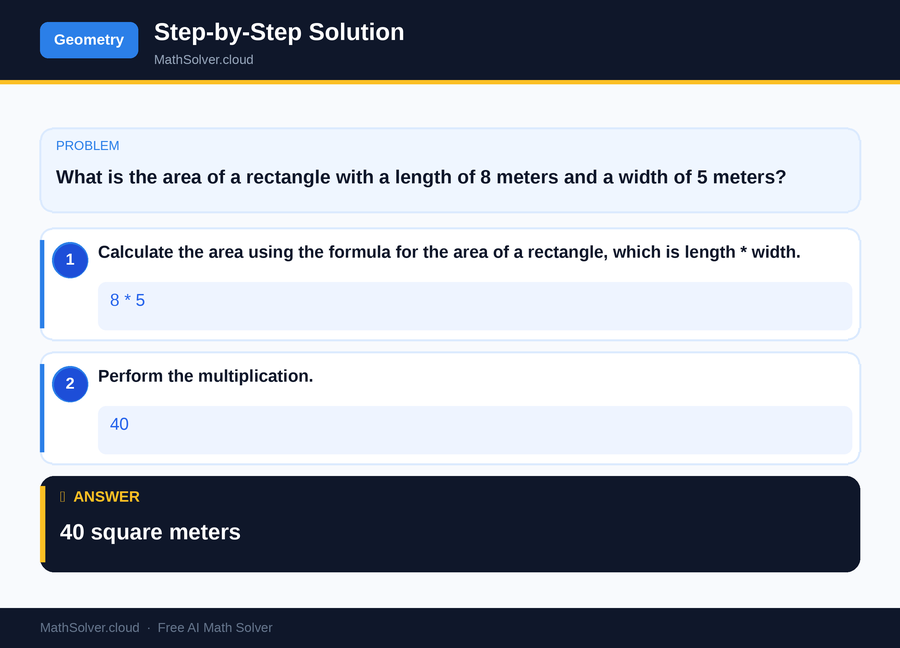
MathSolver Chrome extension solving this problem step-by-step
Example 2
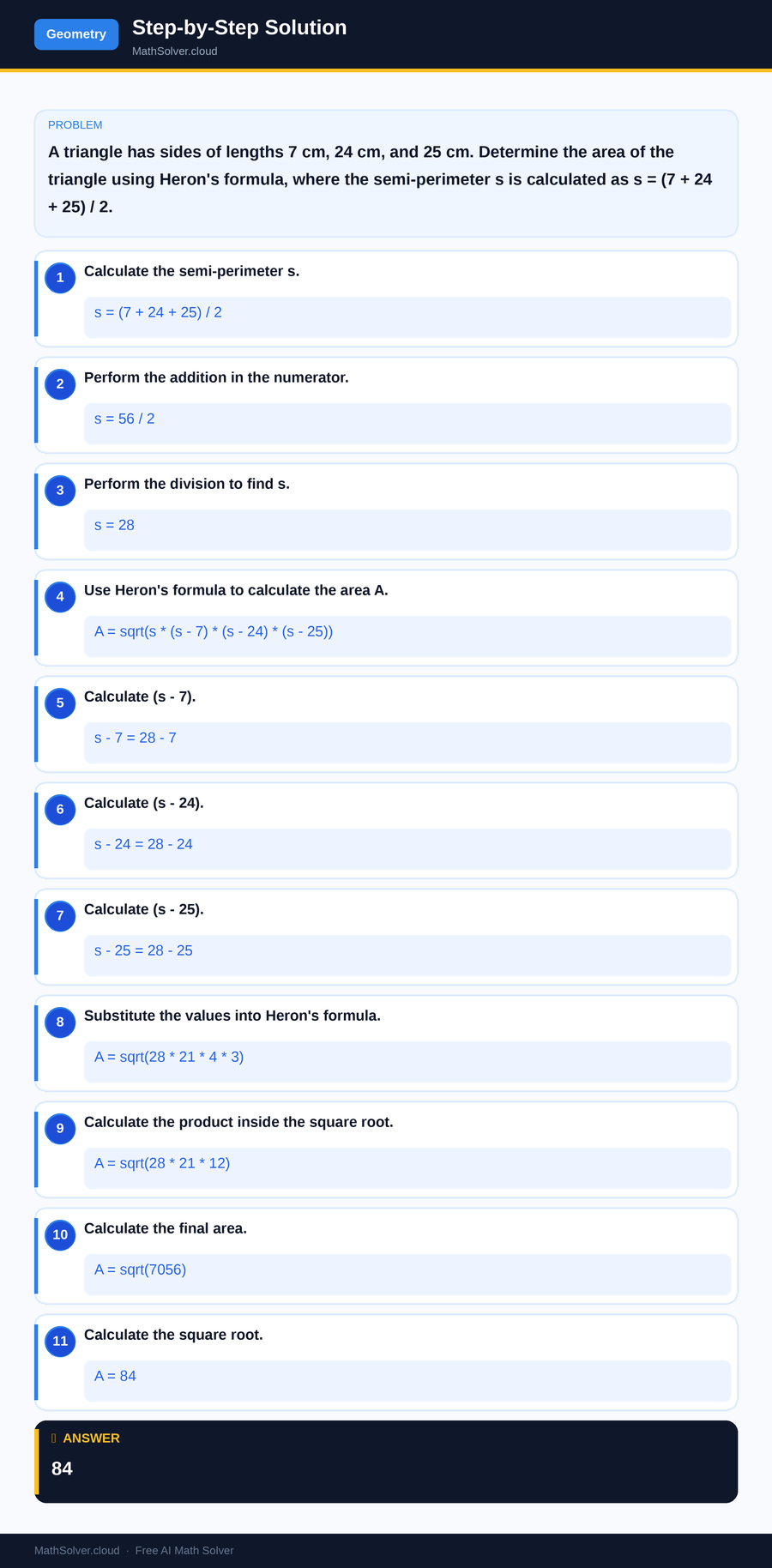
MathSolver Chrome extension solving this problem step-by-step
Common Mistakes to Avoid
A common mistake in geometry lessons is misapplying formulas. Students often confuse area and perimeter formulas or incorrectly substitute values. To avoid this, always double-check which formula you need for a given problem and carefully insert the correct values. Writing out the formulas and steps clearly can help prevent errors.
Another frequent error is neglecting units of measurement. In geometry, it is vital to use consistent units and include them in your final answer. For instance, if you calculate an area in square meters, ensure that all dimensions are in meters before performing calculations. Paying attention to units helps avoid confusion and ensures accurate results.
Real-World Applications
Geometry lessons have numerous real-world applications that are both practical and fascinating. Architects and engineers use geometry to design buildings and structures, ensuring they are safe and aesthetically pleasing. By understanding geometric principles, they can calculate dimensions and angles to create functional spaces.
In addition to construction, geometry plays a crucial role in fields like computer graphics and animation. Artists and game designers use geometric concepts to create realistic visuals and animations. Geometry helps them manipulate shapes and create lifelike environments, making it an essential tool in the digital world.
Frequently Asked Questions
❓ What are geometry lessons?
❓ Why do students struggle with geometry lessons?
❓ How can AI help with geometry lessons?
❓ What is the importance of learning geometry?
❓ How is geometry used in everyday life?
🚀 Solve any math problem instantly
2,000+ students use MathSolver every day — join them for free
📥 Add to Chrome — It's Free