Mastering Geometry Dash Spam
📋 In this guide
Geometry dash spam can be a tricky concept for students to grasp, often leading to confusion and errors in problem-solving. At its core, geometry dash spam refers to the rapid series of geometric calculations or concepts that students encounter without a clear understanding or strategy to tackle them effectively. This type of challenge often leaves students feeling overwhelmed, as they are required to navigate a series of problems quickly and efficiently, much like the fast-paced game it is named after. By understanding geometry dash spam, students can gain confidence in their ability to solve geometric problems with ease and accuracy.
Many students struggle with geometry dash spam due to the complexity and variety of problems they may face, ranging from calculating areas and perimeters to understanding geometric proofs and theorems. The lack of a systematic approach can lead to errors and a lack of confidence in their mathematical abilities. This article will serve as a comprehensive guide, providing students with the tools and strategies needed to tackle geometry dash spam head-on.
By the end of this article, you will have a clear understanding of geometry dash spam, including the key formulas and definitions involved. We will walk through step-by-step guides and worked examples, highlight common mistakes to avoid, and explore real-world applications. Additionally, we’ll provide answers to frequently asked questions to ensure you have a well-rounded grasp of the topic. With this knowledge, you’ll be able to approach geometry problems with confidence and precision.
Step-by-Step: How to Solve Geometry Dash Spam
Step 1: Understand the Problem
The first step in tackling geometry dash spam is to thoroughly read and understand the problem. Identify what is being asked and what information is provided. For example, if you need to find the area of a rectangle, ensure you know the length and width or any other relevant dimensions. Clarifying what you are solving for will help you apply the correct formulas and methods.
Step 2: Identify and Apply the Proper Formula
Once you understand the problem, identify which geometric formula is relevant. For a rectangle, you might need to calculate the perimeter and area using P = 2(l + w) and A = l * w, respectively. Ensure you have all necessary measurements and substitute them into the formula. This step is crucial as applying the wrong formula can lead to incorrect results.
Step 3: Solve Step-by-Step
With the correct formula identified, perform the calculations step-by-step. Break down each calculation into smaller parts if needed. For example, when calculating the perimeter of a rectangle, first add the length and width, then multiply by 2. Writing down each step can help avoid mistakes and ensure accuracy in your solution.
Step 4: Double-Check Your Work
After solving the problem, take a moment to review each step and ensure the calculations are correct. Verify that the final answer makes sense given the context of the problem. Double-checking your work can help catch any errors and solidify your understanding of the problem-solving process.
🤖 Stuck on a math problem?
Take a screenshot and let our AI solve it step-by-step in seconds
⚡ Try MathSolver Free →Worked Examples
Example 1
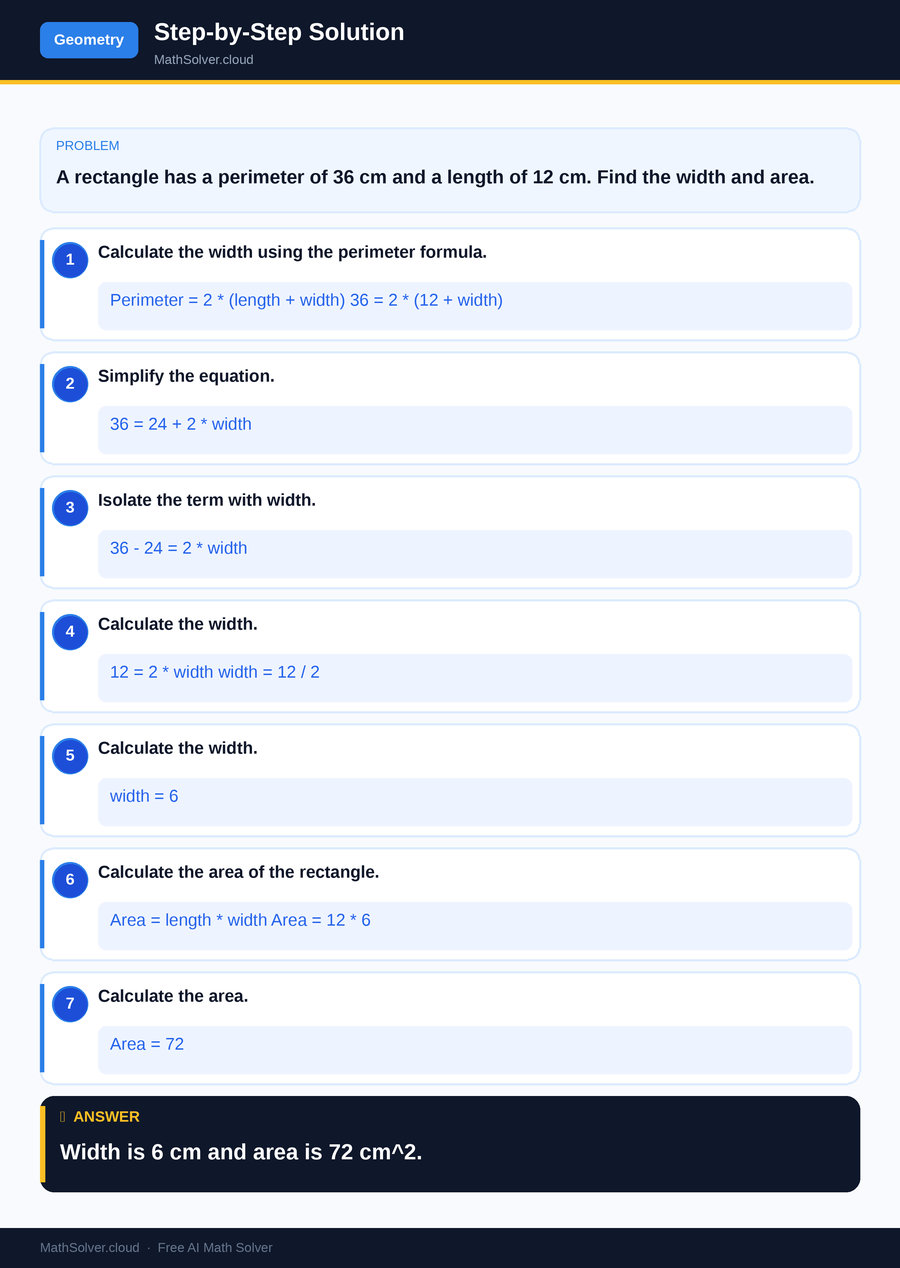
MathSolver Chrome extension solving this problem step-by-step
Example 2

MathSolver Chrome extension solving this problem step-by-step
Common Mistakes to Avoid
One common mistake students make when dealing with geometry dash spam is misapplying formulas. For example, using the formula for the area of a rectangle when calculating the area of a triangle can lead to incorrect results. Always ensure you are using the correct formula for the shape and problem at hand.
Another frequent error is in the arithmetic calculations, such as not squaring a term or incorrectly simplifying fractions. It is crucial to perform calculations carefully and methodically. Double-checking each step can help catch these errors and ensure accuracy in your solutions.
Real-World Applications
Geometry dash spam isn't just a classroom exercise; it has real-world applications in various fields. For instance, architects and engineers frequently use geometric calculations to design buildings and structures, ensuring they are both functional and aesthetically pleasing. Understanding geometry helps them calculate areas, volumes, and structural loads accurately.
In the world of design, graphic designers use geometry to create visually appealing layouts and designs. Knowledge of geometric principles allows them to balance elements and create harmony within their designs. Thus, mastering geometry dash spam can open up numerous career opportunities and enhance problem-solving skills in practical scenarios.
Frequently Asked Questions
❓ What is geometry dash spam?
❓ How can I improve my skills in solving geometry dash spam?
❓ How can AI help with geometry dash spam?
❓ Why is it important to understand geometry dash spam?
❓ How does geometry dash spam relate to geometry lessons?
🚀 Solve any math problem instantly
2,000+ students use MathSolver every day — join them for free
📥 Add to Chrome — It's Free