Mastering Geometry Dash Wave: A Comprehensive Guide
📋 In this guide
Geometry Dash Wave is an intriguing concept within the popular Geometry Dash game, where players navigate through a series of obstacles using a wave-form character. This feature can be quite challenging for many students, as it requires a keen understanding of both spatial awareness and precise timing. The Geometry Dash Wave mode demands players to control their wave character through levels filled with complex geometric patterns and obstacles, mimicking the challenges found in real-life geometry problems.
Students often struggle with Geometry Dash Wave because it combines elements of geometry with fast-paced, reflex-based gameplay. Understanding the geometric principles behind the game can significantly improve a player's ability to navigate through the levels. This article will guide you through the essential concepts needed to master Geometry Dash Wave, providing a comprehensive understanding of the geometric principles involved.
By delving into the mathematics behind Geometry Dash Wave, you'll learn how to apply geometric formulas, recognize patterns, and improve your strategic thinking. Our exploration of this topic will include key formulas, step-by-step guides, worked examples, and real-world applications. Whether you're a student looking to enhance your math skills or a player aiming to master the game, this article will offer valuable insights to help you succeed.
Step-by-Step: How to Solve Geometry Dash Wave
Step 1: Understanding Geometry Dash Wave's Basic Mechanics
To master Geometry Dash Wave, first familiarize yourself with the basic mechanics. The wave character moves in a sinusoidal pattern, which means it follows a wavelike path. This pattern is essential for navigating through the levels, as understanding the movement helps in predicting the trajectory and timing your actions. The wave moves at a constant speed, and the player can control its direction by tapping or holding the screen. This control mechanism mimics real-world concepts of sine waves in mathematics, where the wave's peak and trough determine its movement.
Step 2: Recognizing Geometric Patterns
Next, focus on recognizing geometric patterns within the game. The levels in Geometry Dash Wave are designed with various geometric shapes, such as triangles, squares, and trapezoids. These shapes often serve as obstacles or pathways that the wave character must navigate through. Understanding the properties of these shapes, such as angles and side lengths, can provide strategic advantages. For example, knowing that the sum of the angles in a triangle is 180 degrees can help predict the movement path within triangular obstacles.
Step 3: Applying Geometric Formulas
Once you are comfortable with recognizing patterns, apply geometric formulas to solve problems within the game. This involves calculating angles, distances, and identifying parallels and perpendiculars. Use formulas like the sum of interior angles of polygons or the Pythagorean theorem to determine distances between points. Applying these formulas can help you make more informed decisions about when to jump or change direction, ensuring smoother navigation through complex levels.
Step 4: Strategic Problem Solving
Finally, employ strategic problem-solving skills to tackle challenging levels. This involves combining your knowledge of geometric patterns and formulas with quick reflexes and timing. Analyze each level to identify potential traps and safe zones, and plan your route accordingly. Practice makes perfect, so keep experimenting with different strategies and learn from any mistakes to improve your performance. Remember, mastering Geometry Dash Wave requires both mathematical understanding and gameplay skills.
🤖 Stuck on a math problem?
Take a screenshot and let our AI solve it step-by-step in seconds
⚡ Try MathSolver Free →Worked Examples
Example 1
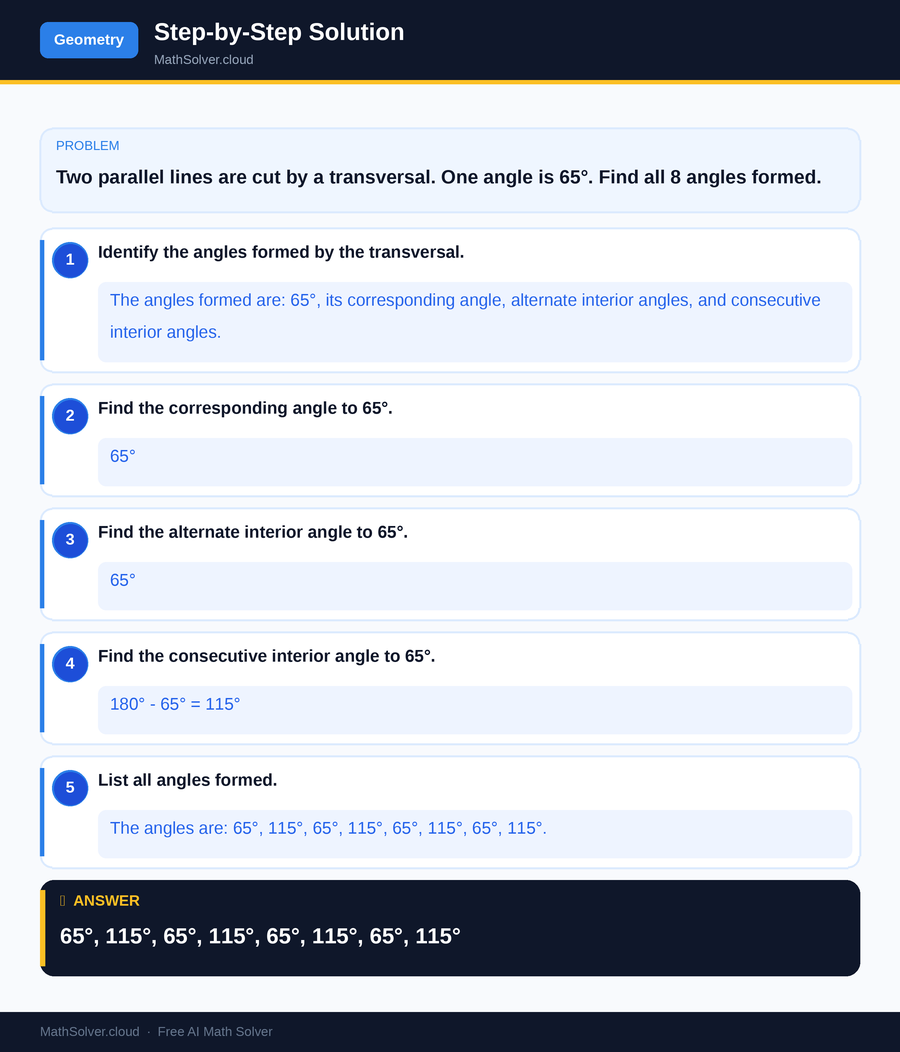
MathSolver Chrome extension solving this problem step-by-step
Example 2
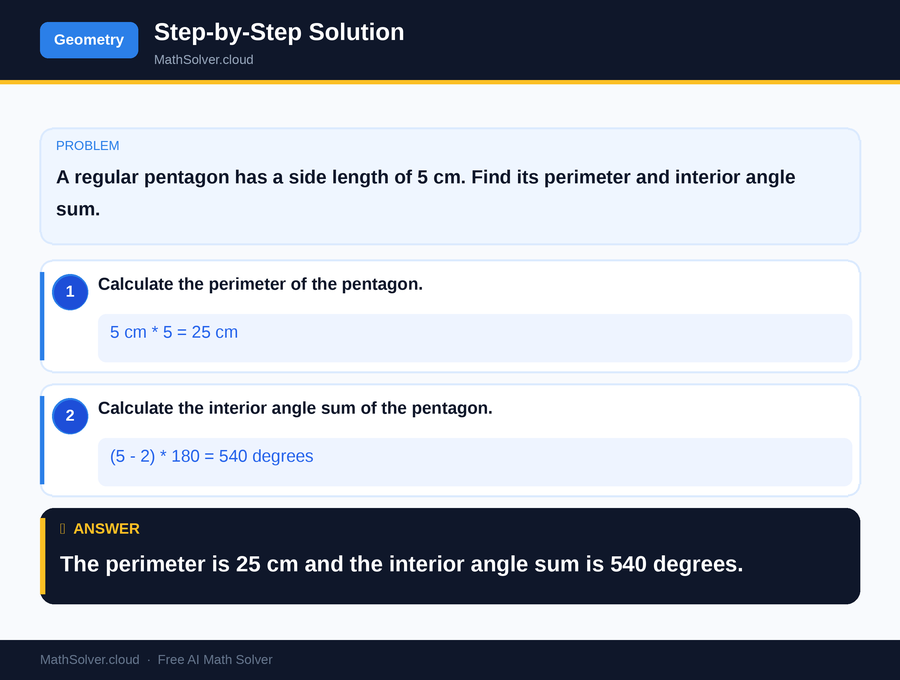
MathSolver Chrome extension solving this problem step-by-step
Common Mistakes to Avoid
One common mistake students make with Geometry Dash Wave is misunderstanding the properties of parallel lines and angles. Many assume that all angles are equal, without considering the relationships between them. To avoid this, remember that corresponding angles are equal, and the sum of angles on a straight line is 180 degrees. Another frequent error is neglecting to apply geometric formulas correctly, which can lead to incorrect calculations of distances and angles. Practice using these formulas in various contexts to build confidence and accuracy.
Another pitfall is failing to recognize geometric patterns during gameplay. Players often become overwhelmed by the fast pace and miss critical details in the level design. To prevent this, take time to analyze the layout of each level before playing. Look for repeating patterns and shapes, and use them to guide your movements. By focusing on these details, you'll improve your ability to navigate through challenging sections of the game.
Real-World Applications
Geometry Dash Wave isn't just a game; it has real-world applications that extend to various fields. For instance, the concept of wave patterns is crucial in physics, particularly in the study of light and sound waves. Understanding these patterns can help in designing better acoustic environments or developing new optical technologies. Moreover, the spatial awareness required in the game is similar to that needed in architecture and engineering, where precise measurements and calculations are vital for constructing stable structures.
Additionally, the skills developed through mastering Geometry Dash Wave can be applied in problem-solving scenarios across different disciplines. The ability to recognize patterns, apply mathematical formulas, and think strategically is beneficial in fields such as computer science, data analysis, and even financial modeling. By honing these skills, students can enhance their critical thinking and analytical abilities, which are essential in both academic and professional settings.
Frequently Asked Questions
❓ What is Geometry Dash Wave, and how does it work?
❓ Why do students struggle with Geometry Dash Wave?
❓ How can AI help with Geometry Dash Wave?
❓ How is Geometry Dash Wave related to real-world geometry lessons?
❓ How can players improve their skills in Geometry Dash Wave?
🚀 Solve any math problem instantly
2,000+ students use MathSolver every day — join them for free
📥 Add to Chrome — It's Free