Comprehensive Guide to Pythagorean Theorem Equation Solver
📋 In this guide
A pythagorean theorem equation solver is an invaluable tool for students tackling geometry problems involving right triangles. The Pythagorean Theorem is a fundamental principle in geometry, used to calculate the length of a side in a right triangle when the lengths of the other two sides are known. Despite its apparent simplicity, many students struggle with applying the theorem correctly, often due to missteps in mathematical operations or misinterpretation of the problem's requirements. In this article, we’ll explore what a pythagorean theorem equation solver is and how it can help students overcome these challenges.
Using a pythagorean theorem equation solver, students can quickly verify their solutions and gain insight into the problem-solving process. This is particularly helpful for those who find themselves making repeated errors or are not confident in their manual calculations. By using these solvers, students can ensure they understand the theorem's application and build a stronger foundation in geometry.
Throughout this guide, you will learn exactly how to use the pythagorean theorem equation solver, the common pitfalls to avoid, and the real-world applications of this mathematical principle. Whether you're a beginner just learning about the theorem or need a refresher, this article will provide a comprehensive understanding of how to effectively utilize the Pythagorean Theorem in your studies.
Step-by-Step: How to Solve Pythagorean Theorem Equation Solver
Step 1: Identify the Known Values
The first step in using a pythagorean theorem equation solver is to accurately identify the known values in your problem. Determine which two sides of the right triangle you know the lengths of. These values are essential for inputting into the theorem. If you know both legs, you'll be solving for the hypotenuse. If you know one leg and the hypotenuse, you'll be solving for the other leg. Clearly identifying these values lays the groundwork for the subsequent calculations.
Step 2: Plug the Values into the Formula
Once you've identified the known values, plug them into the Pythagorean Theorem formula: a^2 + b^2 = c^2. If you are solving for the hypotenuse, substitute your known values for 'a' and 'b'. Conversely, if you are solving for one of the legs, substitute the hypotenuse value for 'c' and the known leg for either 'a' or 'b'. This step requires careful attention to detail to ensure that you input the correct values in the right places.
Step 3: Perform the Calculations
With the values plugged into the formula, the next step is to perform the necessary calculations. Begin by squaring the known values and then either add or subtract these results as dictated by your equation setup. If calculating the hypotenuse, sum the squares of the legs; if calculating a leg, subtract the square of the known leg from the square of the hypotenuse. This step is crucial as miscalculations here can lead to errors in your final answer.
Step 4: Solve for the Unknown Length
The final step involves solving for the unknown length by taking the square root of the result from the previous calculation. This step will yield the length of the unknown side, completing your solution. Ensure your final answer makes sense in the context of the problem—double-check your arithmetic and logical reasoning if something seems off. Once confident, use a pythagorean theorem equation solver to cross-verify your solution for added assurance.
🤖 Stuck on a math problem?
Take a screenshot and let our AI solve it step-by-step in seconds
⚡ Try MathSolver Free →Worked Examples
Example 1
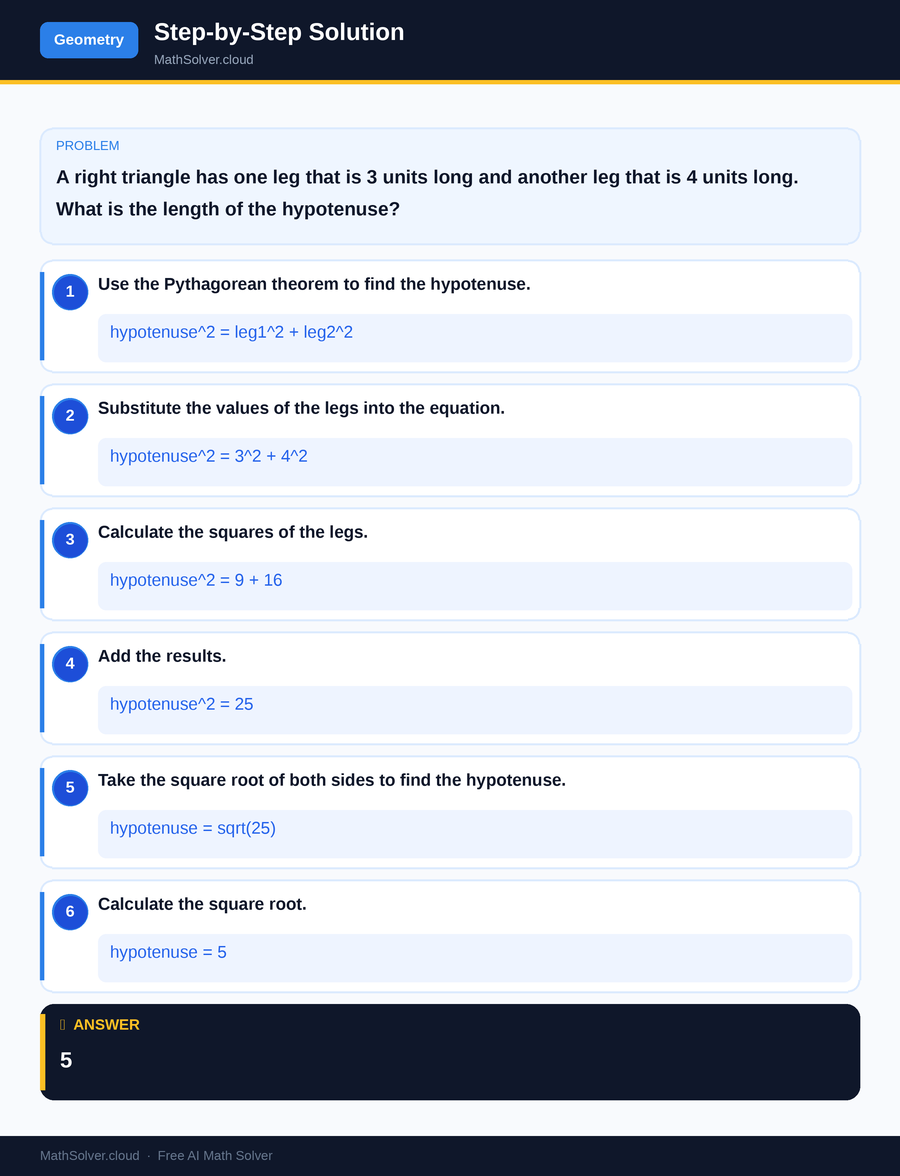
MathSolver Chrome extension solving this problem step-by-step
Example 2

MathSolver Chrome extension solving this problem step-by-step
Common Mistakes to Avoid
One common mistake students make when using the Pythagorean Theorem is confusing the hypotenuse with the legs. Remember, the hypotenuse is always the longest side of a right triangle and is opposite the right angle. Another frequent error is incorrectly performing arithmetic operations, especially when squaring numbers or taking square roots. These small errors can lead to incorrect results, so double-check your calculations for accuracy.
Another pitfall is misapplying the theorem to non-right triangles. The Pythagorean Theorem only applies to right triangles, where one angle is exactly 90 degrees. Using it for other types of triangles can lead to incorrect conclusions. To avoid these mistakes, ensure you correctly identify right triangles and accurately perform all calculations.
Real-World Applications
The Pythagorean Theorem is not just a theoretical concept; it has several practical applications in the real world. One common use is in construction and architecture, where it helps ensure structures are built with precise right angles. For example, carpenters use it to create perfectly square corners in buildings.
Another application is in navigation and geography, where the theorem helps calculate distances between points on a map. Whether you're plotting a course for a ship or determining the shortest path between two locations, the Pythagorean Theorem is indispensable.
Frequently Asked Questions
❓ How does a pythagorean theorem equation solver work?
❓ Why do students struggle with the Pythagorean Theorem?
❓ How can AI help with pythagorean theorem equation solver?
❓ What should I do if my solution seems incorrect?
❓ How is the Pythagorean Theorem used in video games like Geometry Dash?
🚀 Solve any math problem instantly
2,000+ students use MathSolver every day — join them for free
📥 Add to Chrome — It's Free