Mastering the Pythagoras Equation Solver
📋 In this guide
A Pythagoras equation solver is a tool designed to help students solve problems involving the Pythagorean theorem, which is a fundamental principle in geometry. Many students struggle with this concept because it involves understanding the relationship between the sides of right triangles and applying algebraic manipulation. With the help of a Pythagoras equation solver, students can simplify these tasks and gain confidence in solving geometry problems. By the end of this article, you'll have a thorough understanding of how to use a Pythagoras equation solver effectively, and you'll be equipped with strategies to tackle related problems with ease.
Students often find the Pythagorean theorem challenging because it requires both a conceptual understanding of geometry and the ability to perform algebraic calculations. Missteps can occur in the setup or arithmetic, leading to incorrect answers. This article will guide you through the process of solving Pythagorean problems step by step, allowing you to grasp the core concepts and avoid common mistakes. Additionally, you'll learn how these skills can be applied to other types of equations, such as algebra equations and quadratic equations, broadening your mathematical capabilities.
By mastering the use of a Pythagoras equation solver, you'll not only improve your ability to work with right triangles but also enhance your overall problem-solving skills. Whether you're a student aiming to excel in math or someone interested in practical applications of mathematics, understanding the Pythagorean theorem is essential. We'll explore various examples and real-world applications, and by the end, you'll see how these principles extend beyond the classroom into fields like physics, engineering, and even biology, where concepts like the photosynthesis equation come into play.
Step-by-Step: How to Solve Pythagoras Equation Solver
Step 1: Identify the Right Triangle Components
The first step in using a Pythagoras equation solver is to correctly identify the components of the right triangle you're dealing with. A right triangle has three sides: the hypotenuse (c), which is the longest side opposite the right angle, and the two legs (a and b), which form the right angle. Start by determining which side you need to find and which sides you already know. This might involve labeling the sides based on the problem statement or a given diagram. Accurate identification is crucial as it sets the stage for correctly applying the Pythagorean theorem.
Step 2: Apply the Pythagorean Theorem
Once you've identified the sides of your triangle, the next step is to apply the Pythagorean theorem: a^2 + b^2 = c^2. If you're solving for the hypotenuse, simply square the lengths of the two legs, add them together, and then find the square root of the sum to get the hypotenuse. If you're solving for one of the legs, rearrange the equation to solve for the unknown side. For example, if you know the hypotenuse and one leg, the equation becomes a^2 = c^2 - b^2, which you can solve by finding the difference and taking the square root.
Step 3: Perform the Necessary Calculations
After setting up your equation, it's time to perform the necessary calculations. Be meticulous in squaring each side and ensure that your arithmetic is correct. Use a calculator if needed to prevent errors, especially when dealing with non-integer values or complex calculations. Double-check your work, particularly when subtracting or adding squared terms, as mistakes here are common. Your goal is to arrive at a precise numerical value for the unknown side, which will be the solution to your problem.
Step 4: Verify Your Solution
Finally, verify your solution by plugging the values back into the original equation to ensure they satisfy the Pythagorean theorem. This step is crucial for confirming the accuracy of your work. If the equation holds true with your calculated values, you've successfully solved the problem. If not, review each step to identify any mistakes, whether in identifying sides, setting up the equation, or performing calculations. This verification process reinforces your understanding and boosts confidence in your problem-solving abilities.
🤖 Stuck on a math problem?
Take a screenshot and let our AI solve it step-by-step in seconds
⚡ Try MathSolver Free →Worked Examples
Example 1
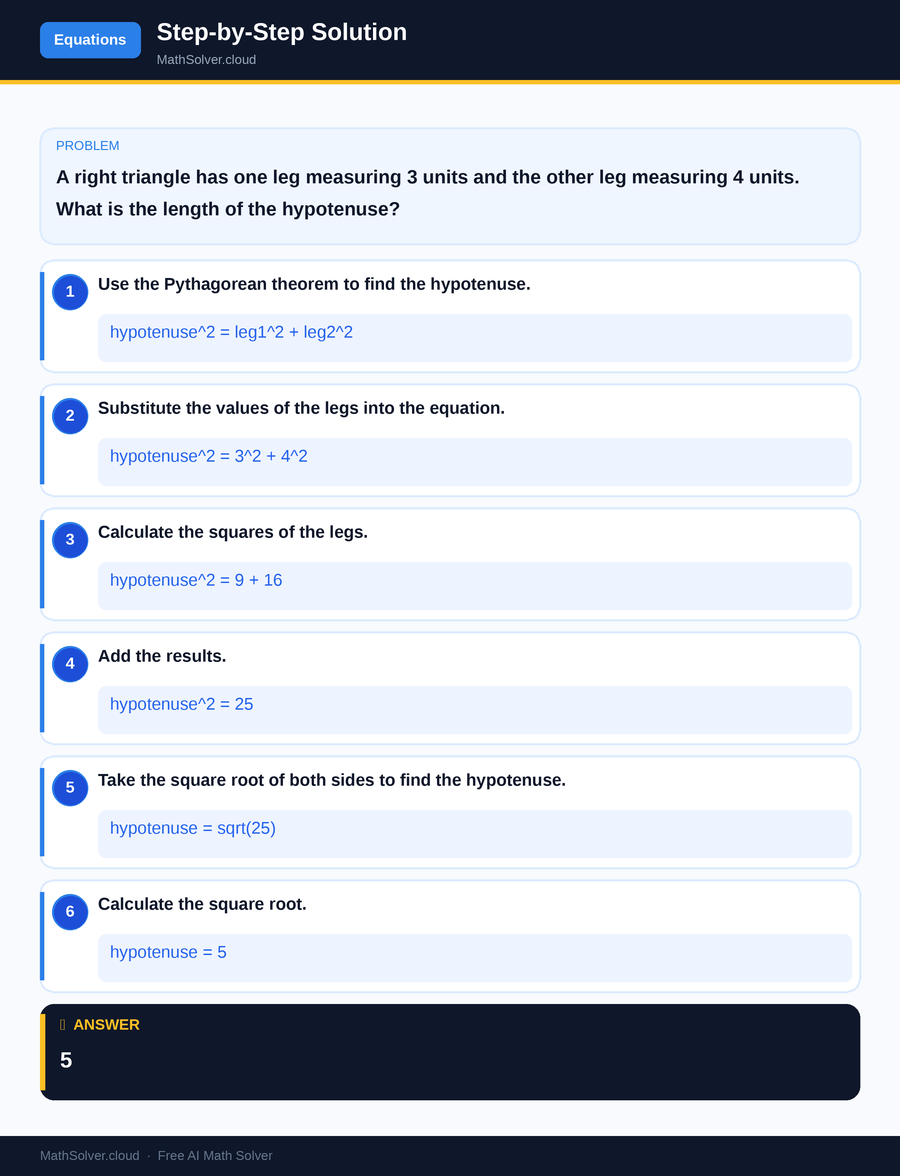
MathSolver Chrome extension solving this problem step-by-step
Example 2
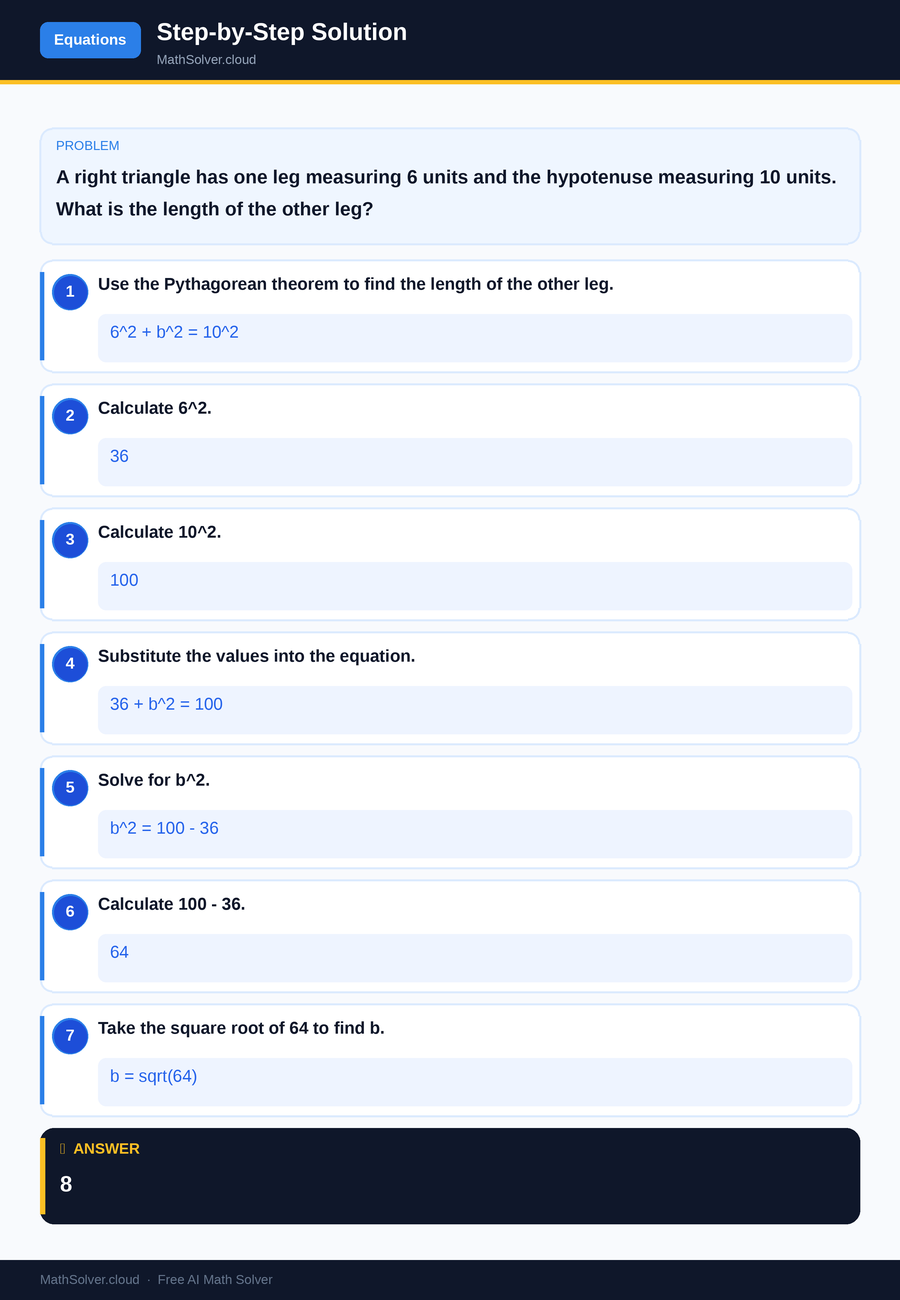
MathSolver Chrome extension solving this problem step-by-step
Common Mistakes to Avoid
One common mistake students make is misidentifying the hypotenuse, which is always the longest side opposite the right angle. Confusing the hypotenuse with one of the legs can lead to incorrect application of the theorem. To avoid this, always check the triangle's orientation and ensure that you've correctly labeled each side before proceeding with calculations.
Another frequent error is incorrect arithmetic, especially when dealing with squared terms. Students may miscalculate squares or forget to take square roots at the end. To prevent these mistakes, take your time with each calculation step and use a calculator if necessary. Double-check each computation, particularly when subtracting or adding squared values, to ensure accuracy.
Real-World Applications
The Pythagoras equation solver is not just a theoretical tool; it has practical applications in various fields. For instance, architects and engineers use it to ensure structural integrity when designing buildings, bridges, and other constructions. By determining precise measurements of triangular components, they can create safe and stable structures.
In the field of physics, the Pythagorean theorem is essential for solving kinematic equations, where understanding the relationship between distance, velocity, and time often involves right triangle calculations. Moreover, in biology, the principles of geometry, including those of the Pythagorean theorem, play a role in understanding natural patterns and phenomena, similar to how the photosynthesis equation models the conversion of light energy into chemical energy.
Frequently Asked Questions
❓ What is the best way to use a Pythagoras equation solver for homework problems?
❓ Why do students often confuse multi step equations with the Pythagorean theorem?
❓ How can AI tools like the MathSolver Chrome extension assist with the Pythagoras equation solver?
❓ Can understanding the Pythagorean theorem help with solving algebra equations?
❓ How can I practice solving two step equations related to the Pythagorean theorem?
🚀 Solve any math problem instantly
2,000+ students use MathSolver every day — join them for free
📥 Add to Chrome — It's Free