Understanding Physics Equations
📋 In this guide
Physics equations are the mathematical tools that allow us to describe, predict, and analyze the physical world around us. From the motion of planets to the flicker of a candle, these equations provide a framework for understanding how and why things work. However, these equations can be intimidating for many students. The symbols, constants, and varying units can seem overwhelming at first glance. In this article, we'll break down the key components of physics equations and guide you through some common problems and scenarios.
Many students find physics equations challenging for several reasons. First, they often require a combination of math skills, such as algebra and calculus, alongside a deep understanding of physical principles. Moreover, physics problems can be multi-faceted, demanding a strategic approach to identify which equations and principles apply to a given scenario. This article aims to demystify some of the most common physics equations by explaining their components and applications.
By the end of this guide, you'll have a clearer understanding of basic physics equations, and you'll be better equipped to tackle problems involving forces, motion, and energy. We'll also explore how advanced tools, like quantum physics equations, play a role in modern science. Whether you're a high school student preparing for an exam or a curious learner, this comprehensive exploration into the world of physics equations will provide valuable insights and practical skills.
Step-by-Step: How to Solve Physics Equations
Step 1: Identifying the Problem Type
The first step in solving a physics problem is to identify what type of problem you're dealing with. This involves recognizing the relevant physics concepts and equations. For instance, if the problem involves motion, you'll likely use kinematic equations. If it involves forces, Newton's laws are your go-to. Understanding whether you're dealing with work physics equations, forces, or energy helps narrow down the applicable equations.
Step 2: Listing Known and Unknown Variables
Once you've identified the type of problem, list all the known and unknown variables. This step is crucial because it allows you to see what information you have and what you need to find. For example, in a problem involving the motion of a car, you might know the initial velocity, acceleration, and time, but need to find the distance traveled. Clearly listing these variables helps create a structured approach to solving the equation.
Step 3: Selecting the Appropriate Equation
With your variables in place, select the appropriate physics equation that relates these variables. For instance, if you're solving a problem about a car's motion, you might use the equation: d = v_i*t + 0.5*a*t^2, where d is distance, v_i is initial velocity, a is acceleration, and t is time. Ensure that the equation you choose matches the known and unknown variables in your list.
Step 4: Solving the Equation and Checking Your Work
Finally, solve the equation using algebraic manipulation to isolate the unknown variable. Substitute the known values into the equation and calculate the result. Always double-check your work for accuracy, ensuring units are consistent and the calculation is correct. This step might also involve verifying the solution's reasonableness within the context of the problem.
🤖 Stuck on a math problem?
Take a screenshot and let our AI solve it step-by-step in seconds
⚡ Try MathSolver Free →Worked Examples
Example 1

MathSolver Chrome extension solving this problem step-by-step
Example 2
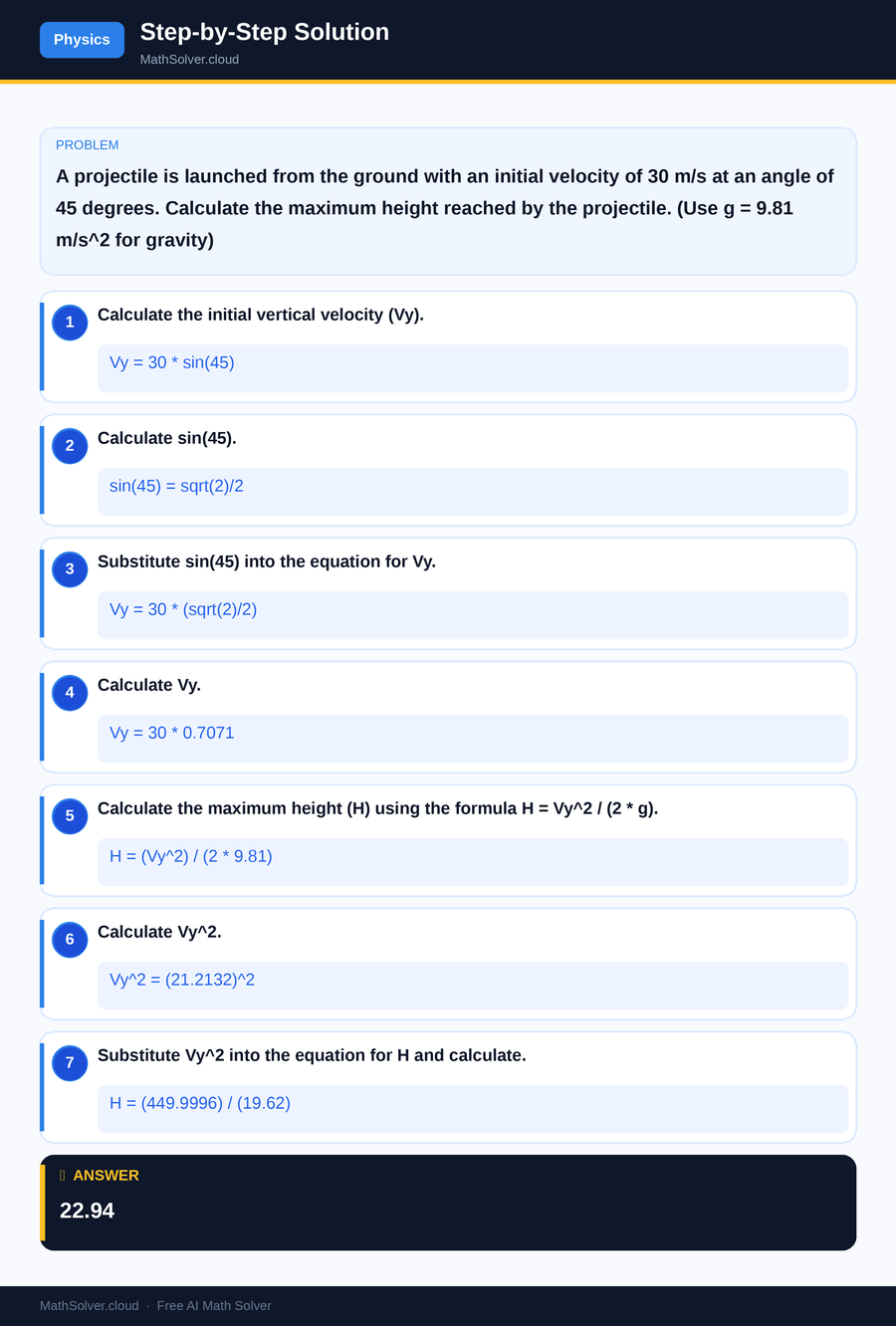
MathSolver Chrome extension solving this problem step-by-step
Common Mistakes to Avoid
A common mistake students make with physics equations is not properly converting units. For example, mixing meters with kilometers or seconds with minutes can lead to incorrect results. Always ensure that your units are consistent throughout the problem. Another frequent error is misidentifying the forces in physics equations, leading to incorrect applications of Newton's laws. Carefully diagramming forces and double-checking your equations can help avoid these pitfalls.
Additionally, students often forget to consider the direction of forces and motion, especially in problems involving vectors. Remember that direction can significantly impact the result, so it's essential to pay attention to signs and angles. Always verify your final answer to ensure it makes sense in the given context.
Real-World Applications
Physics equations are not just theoretical—they have profound real-world applications. For example, engineers use them to design vehicles and buildings, ensuring safety and efficiency. The angular velocity equation is crucial in designing rotating machinery, from car engines to wind turbines.
In the medical field, physics equations help in understanding radiation therapy and medical imaging techniques. The principles behind these equations allow for precise calculations that are vital for patient safety and treatment effectiveness. For more insights into the applications of physics equations, refer to our complete Physics & Formulas guide on MathSolver.cloud.
Frequently Asked Questions
❓ What are physics equations used for?
❓ Why do students struggle with physics equations?
❓ How can AI help with physics equations?
❓ What is the role of quantum physics equations?
❓ How do I choose the right physics equation for a problem?
🚀 Solve any math problem instantly
2,000+ students use MathSolver every day — join them for free
📥 Add to Chrome — It's Free