Mastering the Physics Equation Sheet
📋 In this guide
A physics equation sheet is a vital tool for students tackling the complex world of physics, as it serves as a concise collection of formulas and equations that are essential for solving various physics problems. However, many students find themselves overwhelmed by the sheer volume of information and the challenge of understanding when and how to apply each equation correctly. This article aims to demystify the physics equation sheet, providing you with a clear understanding of its components and practical uses. By the end, you'll be better equipped to navigate your studies and apply these formulas with confidence.
Students often struggle with physics equation sheets due to the abstract nature of the subject and the need to comprehend not just what the formulas state, but also the underlying principles they represent. The challenge lies in selecting the right equation for a given problem, identifying all necessary variables, and manipulating the formula to reach a solution. This article will guide you through the process, offering strategies for effectively using these sheets and avoiding common pitfalls.
With a focus on empowering students, we'll delve into a step-by-step guide for using a physics equation sheet efficiently, work through practical examples, and highlight real-world applications. Whether you're preparing for exams like the AP Physics or the MCAT, or you're simply looking to improve your problem-solving skills, this article will provide valuable insights. You'll also learn about the different types of physics equation sheets, such as the AP Physics equation sheet, the AP Physics equation sheet C, and the AQA physics equation sheet, and how to leverage them to your advantage.
Step-by-Step: How to Solve Physics Equation Sheet
Understanding the Basics
Before diving into the physics equation sheet, it's crucial to have a solid grasp of basic physics concepts. Familiarize yourself with fundamental units of measurement, such as meters for distance and seconds for time, as these will appear frequently. Understanding these basics will help you interpret the equations correctly and apply them to real-world scenarios. Additionally, review the core principles of physics, such as Newton's laws of motion, as they form the foundation for many equations on the sheet.
Identifying Key Equations
Next, examine the physics equation sheet to identify the key equations relevant to your studies. These typically include formulas for motion, force, energy, and momentum. Highlight these equations and make note of what each variable represents. For example, in the motion equation v = u + at, it's important to know that "v" stands for final velocity and "a" for acceleration. Understanding these components will enable you to recognize when each equation is applicable.
Applying the Equations
Once you're familiar with the key equations, practice applying them to various problems. Start with simple exercises to build your confidence, then gradually tackle more complex scenarios. To apply an equation, identify the known variables from the problem statement and input them into the formula. Solve for the unknown variable using algebraic manipulation. This process not only reinforces your understanding of the equations but also enhances your problem-solving skills.
Reviewing and Refining Your Approach
Finally, regularly review your physics equation sheet and refine your approach. As you work through problems, note any difficulties you encounter and seek clarification on those areas. Consider creating a personalized equation sheet that highlights the formulas you find most challenging or frequently used. This customized sheet can serve as a quick reference during exams or study sessions, ultimately boosting your efficiency and confidence.
🤖 Stuck on a math problem?
Take a screenshot and let our AI solve it step-by-step in seconds
⚡ Try MathSolver Free →Worked Examples
Example 1

MathSolver Chrome extension solving this problem step-by-step
Example 2
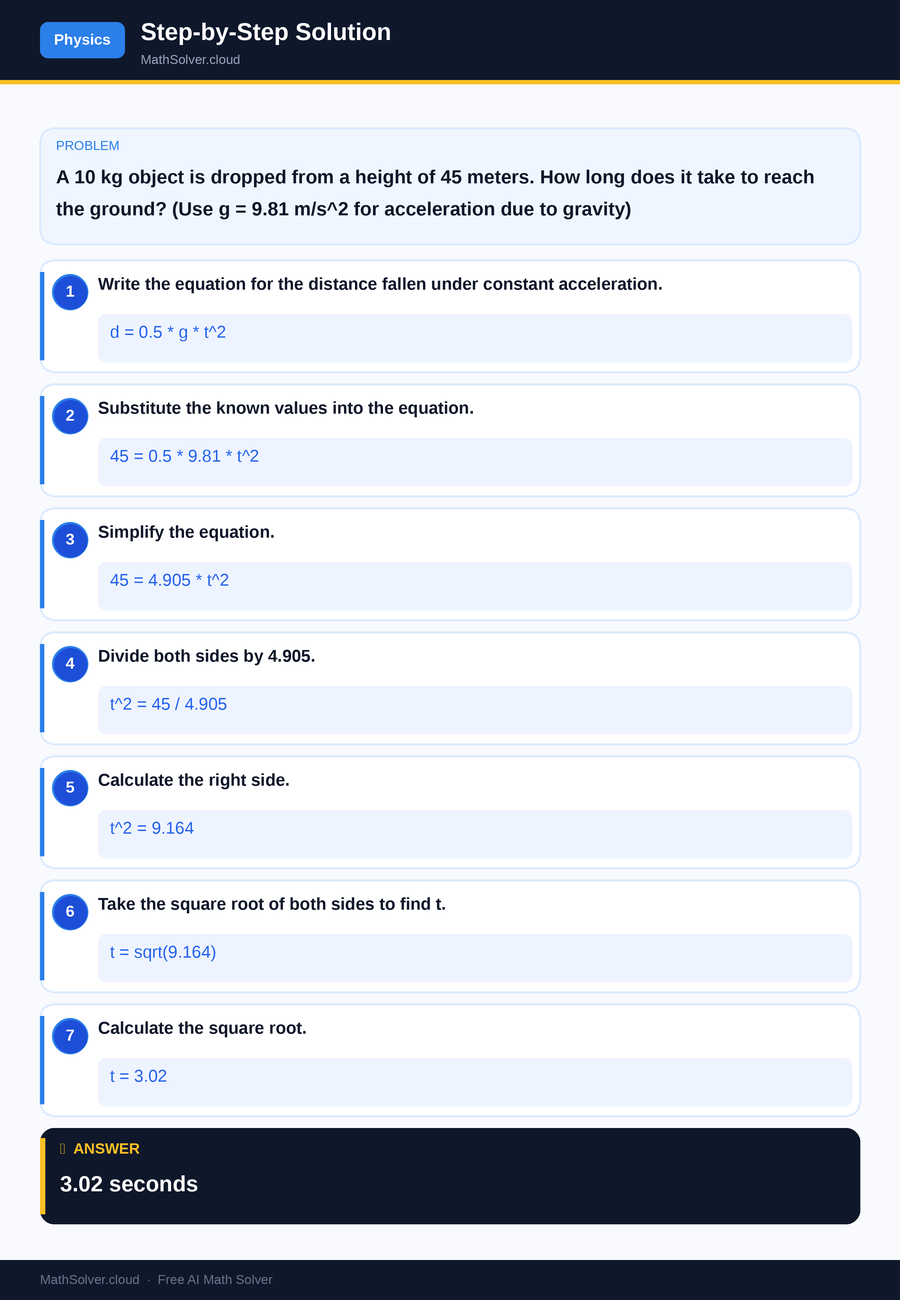
MathSolver Chrome extension solving this problem step-by-step
Common Mistakes to Avoid
One common mistake students make when using a physics equation sheet is not properly identifying the variables in a given problem. Misinterpreting which value corresponds to each variable, such as confusing initial velocity with final velocity, can lead to incorrect solutions. To avoid this, always double-check the problem statement and ensure you understand what each variable represents before plugging them into an equation.
Another frequent error is neglecting units. Physics equations rely heavily on consistent units to produce accurate results. Always ensure that your measurements are in the correct units before performing calculations. For instance, mixing up meters and centimeters or seconds and minutes can drastically alter your answers. Converting all quantities to standard units before solving can help prevent this issue.
Real-World Applications
Physics equation sheets are not only academic tools but also have practical applications in various fields. Engineers use them to design and analyze systems, ensuring that structures can withstand forces and perform as intended. For instance, when designing a bridge, engineers calculate the forces acting on different components to ensure stability and safety.
In the medical field, physics equations are crucial for imaging technologies such as MRI and CT scans. Understanding the principles of electromagnetism and wave behavior allows technicians to optimize image quality and ensure accurate diagnostics. Similarly, pilots rely on physics equations to calculate flight trajectories, ensuring safe takeoffs and landings.
Frequently Asked Questions
❓ What is a physics equation sheet, and how is it useful?
❓ Why do students struggle with physics equation sheets?
❓ How can AI help with physics equation sheets?
❓ What is the difference between the AP Physics equation sheet and the AP Physics equation sheet C?
❓ How can I create a personalized physics equation sheet for my studies?
🚀 Solve any math problem instantly
2,000+ students use MathSolver every day — join them for free
📥 Add to Chrome — It's Free