Mastering the Percent Difference Equation
📋 In this guide
The percent difference equation is a mathematical formula used to express the difference between two numbers as a percentage of their average. This concept is crucial in many fields, including science, economics, and education, yet many students find it challenging to grasp. The confusion often stems from the formula's reliance on understanding both percentages and averages, which can be tricky if you’re not comfortable with basic arithmetic operations. In this article, you will learn everything you need to know about the percent difference equation, from understanding the core formula to applying it in real-world scenarios.
Students often struggle with the percent difference equation because it involves multiple steps and requires precision in calculation. Unlike simple subtraction or percentage calculations, this equation requires averaging the two values in question, which is an additional layer of complexity. Furthermore, identifying the correct context to use this formula, instead of other similar formulas like percentage increase or decrease, can add to the confusion. By the end of this guide, you’ll be able to confidently solve problems involving percent difference, recognize common mistakes, and understand its applications across various fields.
In the following sections, we will break down the percent difference equation into manageable parts. We’ll start with the key formula, then guide you through a step-by-step process to solve it, and finally tackle real-world examples and applications. This comprehensive approach will ensure that you not only understand how to calculate percent difference but also know when and why to use it. Let's dive in and demystify this essential mathematical tool.
Step-by-Step: How to Solve Percent Difference Equation
Step 1: Determine the Values
The first step in using the percent difference equation is to clearly identify the two values you are comparing. These values can represent anything from the number of apples sold in different weeks to the distances traveled by a car on different tanks of gas. The key is to ensure these values are comparable and relevant to the context you’re examining. For example, if you are comparing sales from two consecutive weeks, ensure you have accurate figures for both weeks.
Step 2: Calculate the Absolute Difference
Once you have your two values, the next step is to find their absolute difference. The absolute difference is simply the positive difference between the two numbers, which you can calculate by subtracting the smaller value from the larger one, or taking the absolute value of their subtraction. This step is crucial because it forms the numerator of the percent difference equation.
Step 3: Find the Average of the Values
After determining the absolute difference, you need to find the average of your two values. This is done by adding the two values together and dividing by two. The average serves as the baseline or reference point in the percent difference equation, allowing you to express the difference as a proportion of the typical value between the two.
Step 4: Calculate and Interpret the Percent Difference
With the absolute difference and average in hand, you can now plug these into the percent difference formula. Divide the absolute difference by the average and then multiply the result by 100 to convert it to a percentage. This final step gives you the percent difference, which represents how much the two values differ relative to their average. Interpreting the percent difference can provide insights, such as identifying trends or evaluating performance.
🤖 Stuck on a math problem?
Take a screenshot and let our AI solve it step-by-step in seconds
⚡ Try MathSolver Free →Worked Examples
Example 1
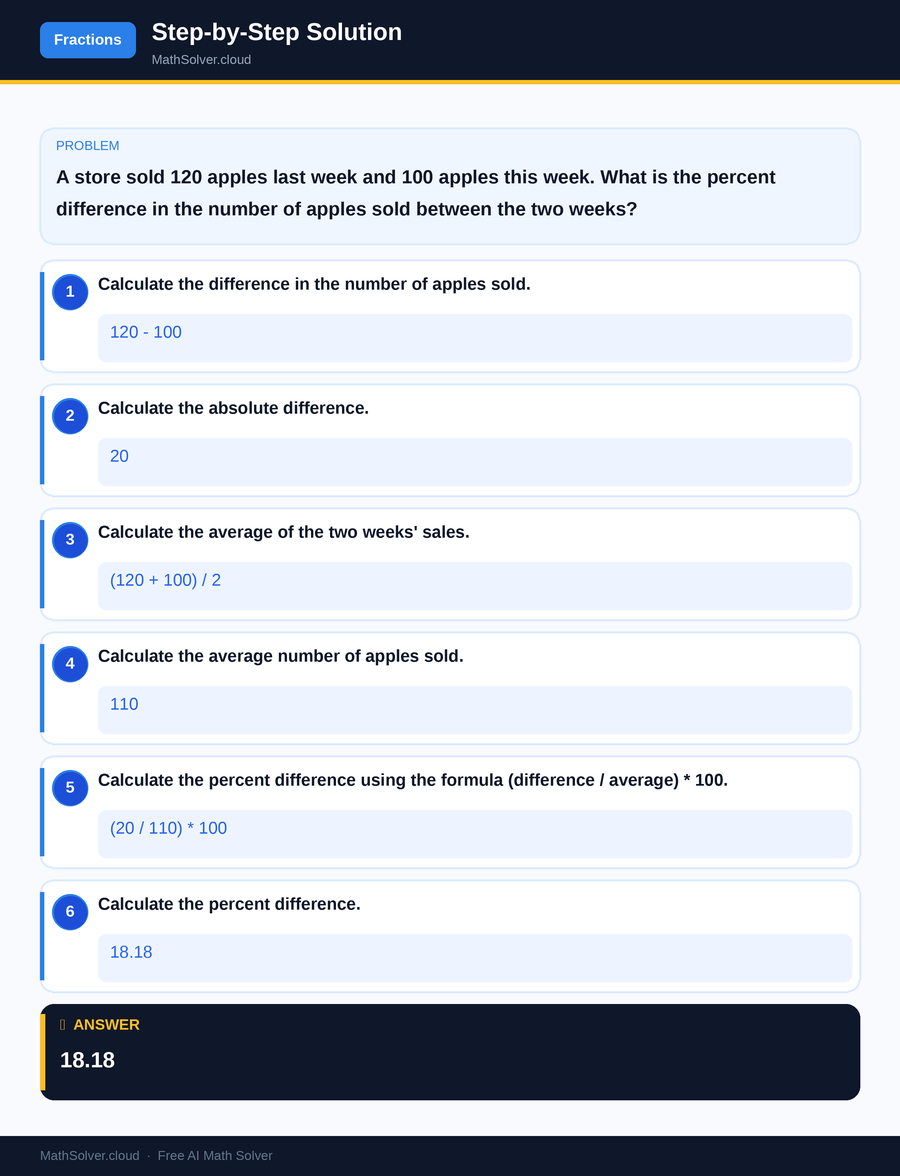
MathSolver Chrome extension solving this problem step-by-step
Example 2
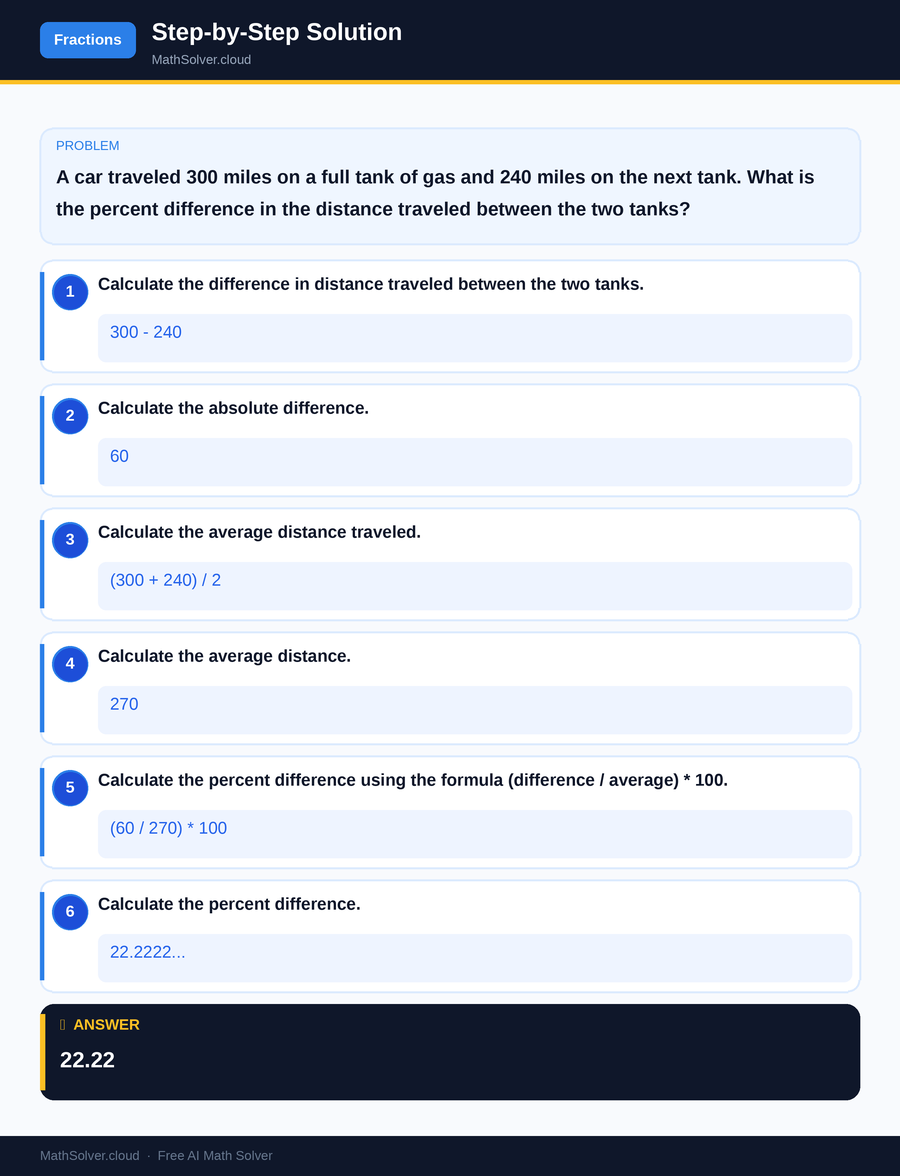
MathSolver Chrome extension solving this problem step-by-step
Common Mistakes to Avoid
One common mistake students make when using the percent difference equation is failing to use the absolute difference. This can lead to a negative percentage, which is incorrect since percent difference should always be a positive value. Always ensure to use the absolute value of the difference between your two numbers.
Another frequent error is confusing percent difference with percentage increase or decrease. The percent difference equation is used to compare two values without implying that one is a baseline for growth. To avoid this confusion, remember that percent difference involves the average of the two values, not just one of them as a reference.
Real-World Applications
The percent difference equation is widely used in various fields to compare data points effectively. In science, it's often applied in experiments to measure variability between trials, helping researchers understand consistency and reliability. For instance, in physics, you might use the percent difference equation to compare experimental results with theoretical predictions, ensuring that the outcomes align with expectations.
In business, percent difference calculations are crucial for performance analysis, such as comparing sales figures from different periods. This can help businesses identify trends and make informed decisions about marketing strategies or inventory management. Understanding percent differences can also aid in financial analyses, allowing analysts to assess fluctuations in stock prices or financial metrics.
Frequently Asked Questions
❓ What is the percent difference equation?
❓ Why do students struggle with the percent difference equation?
❓ How can AI help with the percent difference equation?
❓ When should I use the percent difference equation instead of percentage increase or decrease?
❓ Can percent difference be used in financial analysis?
🚀 Solve any math problem instantly
2,000+ students use MathSolver every day — join them for free
📥 Add to Chrome — It's Free