Mastering the Percent Change Equation
📋 In this guide
The percent change equation is a fundamental concept in mathematics that helps quantify how much a value has increased or decreased in percentage terms. Many students encounter this equation in various mathematical contexts, yet they often find it challenging to apply correctly. This difficulty can arise from confusion about the difference between absolute change and relative change or simply from arithmetic mistakes. However, mastering the percent change equation is crucial because it appears in diverse fields such as finance, economics, and science.
Students often struggle with the percent change equation because it involves understanding the relationship between the original and new values. Additionally, the concept of percentage itself can be tricky, especially when students are also learning other complex topics like algebra equations or quadratic equations. This article aims to demystify the percent change equation, providing you with a clear and concise guide that will make this mathematical tool more approachable.
By the end of this article, you'll have a solid grasp of the percent change equation and be able to apply it confidently in both academic and real-life scenarios. We'll start by defining the equation, then walk through a step-by-step guide, followed by worked examples and common mistakes to avoid. We'll also explore real-world applications and answer frequently asked questions to enhance your understanding further.
Step-by-Step: How to Solve Percent Change Equation
Step 1: Identify the Original and New Values
The first step in using the percent change equation is to determine the original value and the new value. The original value is the starting point or the initial quantity, while the new value is the changed quantity. For example, if you're calculating the percent change in the price of a product, the original value would be the initial price, and the new value would be the adjusted price. Identifying these values accurately is crucial, as they form the basis of your calculations.
Step 2: Calculate the Difference Between the Values
Once you've identified the original and new values, the next step is to calculate the difference between them. Subtract the original value from the new value to find this difference. This step will tell you whether the change is positive (an increase) or negative (a decrease). For instance, if the original price of a shirt was $50 and the sale price is $40, the difference is $40 - $50 = -$10, indicating a decrease.
Step 3: Divide the Difference by the Original Value
After finding the difference, the next step is to divide it by the original value. This division gives you the relative change in terms of the original value. Continuing with the shirt example, you would divide -$10 by $50, resulting in -0.2. This number represents the change as a fraction of the original value. Understanding this step is vital for interpreting the results accurately.
Step 4: Convert the Fraction to a Percentage
The final step in the percent change equation is to convert the fraction obtained in Step 3 into a percentage. Multiply the fraction by 100 to achieve this conversion. In our ongoing example, multiplying -0.2 by 100 results in -20%. This final percentage indicates a 20% decrease in the shirt's price. Remember, a positive result indicates a percentage increase, while a negative result indicates a percentage decrease.
🤖 Stuck on a math problem?
Take a screenshot and let our AI solve it step-by-step in seconds
⚡ Try MathSolver Free →Worked Examples
Example 1

MathSolver Chrome extension solving this problem step-by-step
Example 2
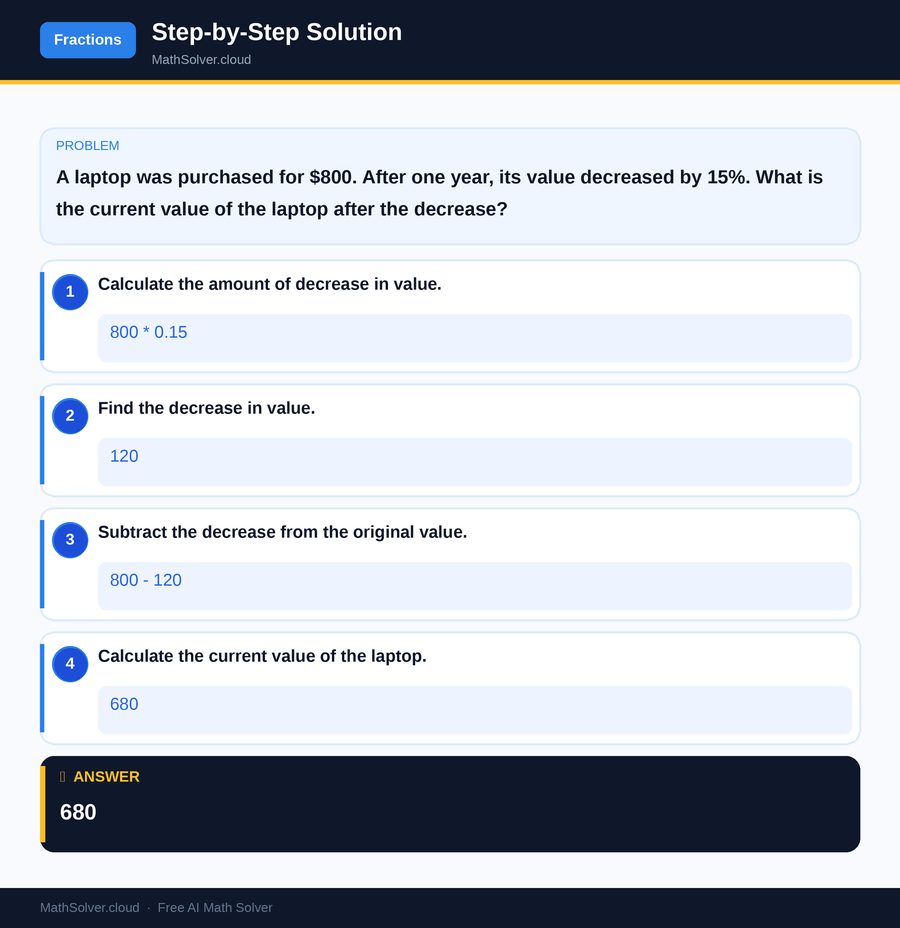
MathSolver Chrome extension solving this problem step-by-step
Common Mistakes to Avoid
One common mistake students make with the percent change equation is confusing the order of subtraction. Always subtract the original value from the new value to determine whether the change is an increase or decrease. Another frequent error is forgetting to multiply by 100 at the end of the calculation, which leads to incorrect results. Ensuring these steps are followed accurately will prevent errors in your calculations.
Additionally, students sometimes misinterpret a negative result as an error. In the context of the percent change equation, a negative result indicates a decrease, not a mistake. Understanding this can help avoid unnecessary confusion and reinforce the correct interpretation of the solution.
Real-World Applications
The percent change equation is widely used in real-world applications. For example, in finance, it helps investors calculate the percentage change in stock prices over time, providing insights into market trends. Understanding these trends is crucial for making informed investment decisions and managing financial risks.
In science, the percent change equation is used to analyze experimental data. For instance, changes in temperature, mass, or volume during a chemical reaction can be quantified using this equation. This application is particularly relevant in fields like chemistry and biology, where understanding changes is essential. The photosynthesis equation, for example, involves analyzing changes in reactants and products.
Frequently Asked Questions
❓ What is the percent change equation used for?
❓ Why is the percent change equation important in math?
❓ How can AI help with the percent change equation?
❓ How does the percent change equation differ from solving exponential equations?
❓ Can the percent change equation be used in proportional relationships?
🚀 Solve any math problem instantly
2,000+ students use MathSolver every day — join them for free
📥 Add to Chrome — It's Free