Mastering One Step Equations
📋 In this guide
One step equations are a fundamental concept in algebra, where the goal is to isolate the variable on one side of the equation using a single operation. Despite their simplicity, students often struggle with one step equations due to a lack of understanding of the foundational arithmetic operations required to solve them. Moreover, the transition from arithmetic to algebra can be challenging, as it introduces abstract thinking and the use of symbols to represent unknown values.
The key to mastering one step equations lies in understanding the inverse operations that allow you to isolate the variable. Students will learn how to manipulate equations efficiently to find the value of the unknown. By focusing on the logic behind solving these equations, students can build a strong math foundation that will aid in tackling more complex problems in the future. This article will guide you through the process of solving one step equations, providing step-by-step instructions, examples, and insights into common pitfalls.
As you progress, you'll discover useful strategies for solving one step equations and gain confidence in your problem-solving abilities. By the end of this guide, you'll be equipped with the skills to handle one step equations with ease and apply these techniques to more advanced mathematical concepts, such as two step equations and multi step equations.
Step-by-Step: How to Solve One Step Equations
Step 1: Identify the Operation
The first step in solving one step equations is to identify the operation that is being performed on the variable. This could be addition, subtraction, multiplication, or division. By determining the operation, you can then decide which inverse operation to use to isolate the variable. For example, if the equation is x + 5 = 12, the operation is addition, and the inverse operation needed is subtraction.
Step 2: Use the Inverse Operation
Once you have identified the operation, apply the inverse operation to both sides of the equation. The inverse operation will help you isolate the variable. For instance, if the equation involves addition, you will use subtraction to cancel out the added number. If the equation is 5x = 20, you would divide both sides by 5 to isolate x. The goal is to perform the inverse operation to both sides to maintain the balance of the equation.
Step 3: Simplify Both Sides
After applying the inverse operation, simplify both sides of the equation. This involves performing any arithmetic needed to reduce the equation to a simple form where the variable stands alone. For example, after dividing both sides of the equation 5x = 20 by 5, you get x = 4. Ensuring that both sides of the equation are simplified is crucial in confirming that the variable is properly isolated.
Step 4: Check Your Solution
The final step is to verify your solution by substituting the value back into the original equation. This ensures that your solution is correct and that the equation holds true. For example, substituting x = 4 back into the equation 5x = 20 results in 20 = 20, confirming that the solution is accurate. Checking your work is an important habit to develop as it helps prevent errors and builds confidence in your problem-solving skills.
🤖 Stuck on a math problem?
Take a screenshot and let our AI solve it step-by-step in seconds
⚡ Try MathSolver Free →Worked Examples
Example 1
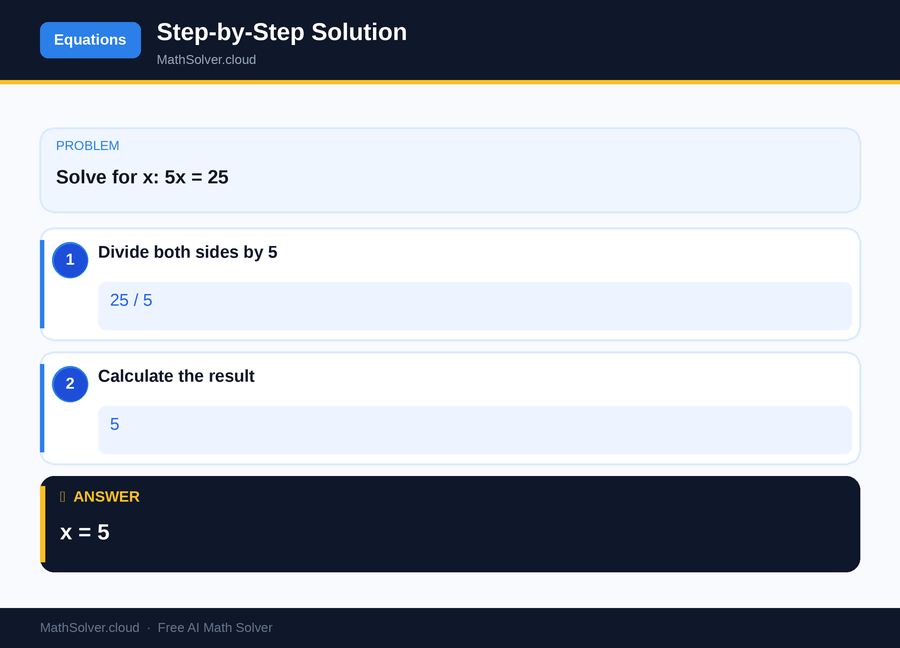
MathSolver Chrome extension solving this problem step-by-step
Example 2
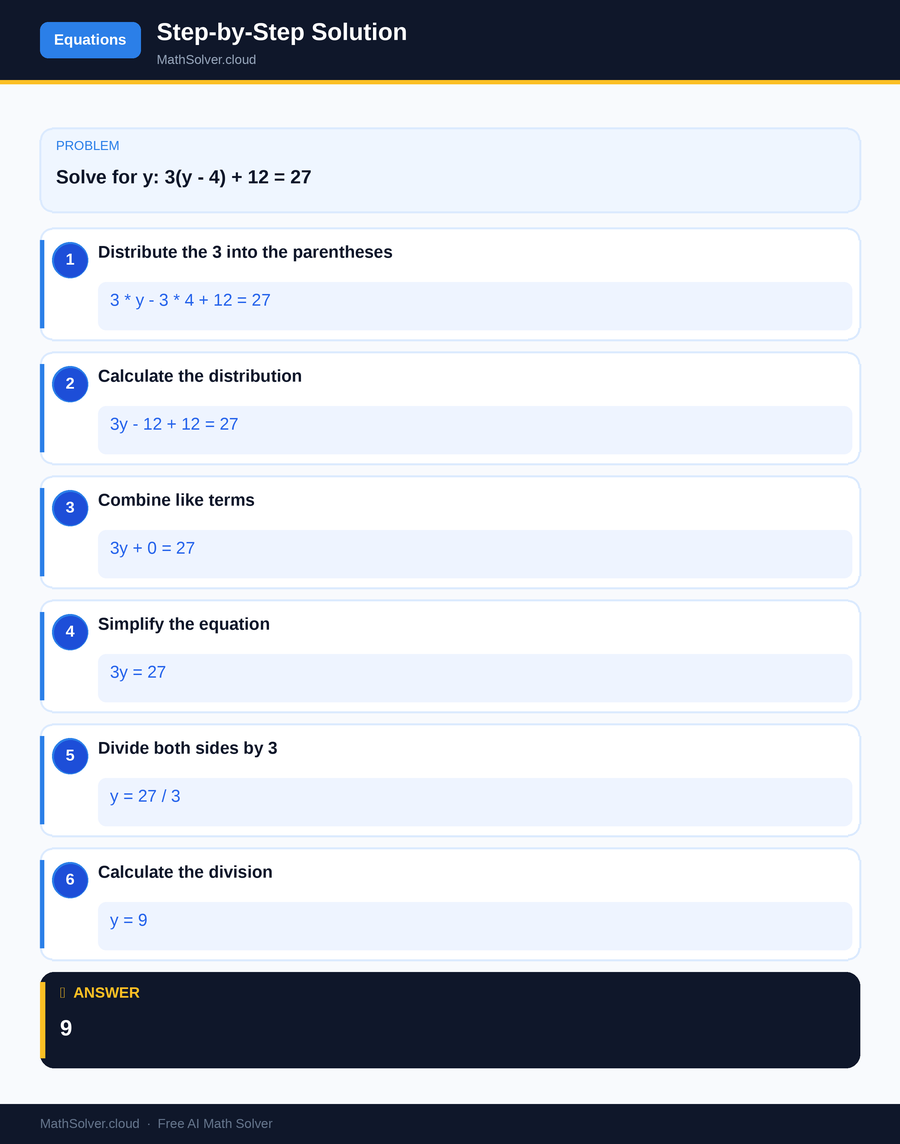
MathSolver Chrome extension solving this problem step-by-step
Common Mistakes to Avoid
One common mistake students make when solving one step equations is neglecting to perform the inverse operation on both sides of the equation. This can lead to incorrect solutions and a misunderstanding of how equations work. To avoid this, always remember to balance the equation by applying the same operation to both sides.
Another error is failing to simplify the equation completely. Students might stop prematurely, thinking they have isolated the variable, but without simplifying, the solution may not be accurate. Always ensure that the variable stands alone on one side, and verify your solution by substituting it back into the original equation to check its validity.
Real-World Applications
One step equations have practical applications in various real-world scenarios. For example, consider calculating discounts during a sale. If an item’s original price is reduced by a certain amount, you can use a one step equation to determine the new price by subtracting the discount from the original price.
Another instance is in cooking, where you may need to adjust a recipe. Suppose a recipe requires 4 cups of flour, but you only want to make half of the recipe. You can use a one step equation to find out how much flour you need by dividing the original amount by 2.
Frequently Asked Questions
❓ What are one step equations?
❓ Why do students struggle with one step equations?
❓ How can AI help with one step equations?
❓ What is the difference between one step and two step equations?
❓ Can one step equations have real-life applications?
🚀 Solve any math problem instantly
2,000+ students use MathSolver every day — join them for free
📥 Add to Chrome — It's Free