One Step Equations Worksheet: A Comprehensive Guide
📋 In this guide
A one step equations worksheet is an essential tool for students learning algebra. It focuses on solving equations that require just a single operation to isolate the variable. While these worksheets may seem simple, students often struggle with understanding the underlying concepts and consistently applying the correct operations. By mastering one step equations, students build a strong foundation for tackling more complex algebraic problems, such as two step equations and multi step equations. Through consistent practice and guidance, students can become proficient in identifying the appropriate steps required to solve these equations efficiently.
Students often find themselves challenged by one step equations worksheets because they need to understand the properties of numbers and operations fully. For instance, they might confuse when to add or subtract or when to multiply or divide. This confusion can lead to errors, which is why guided practice is crucial. A comprehensive one step equations worksheet, especially those available in PDF format, provides numerous problems that help students reinforce their understanding and avoid common mistakes.
When working through a one step equations worksheet, students will learn to identify the correct operations to solve equations like x + 5 = 10 or 2x = 8. By doing so, they will develop critical thinking skills and the ability to approach more complex problems, such as those found in a two step equations worksheet or when solving multi step equations. This article will guide you through the steps of solving one step equations, provide examples, and discuss common mistakes and real-world applications.
Step-by-Step: How to Solve One Step Equations Worksheet
Step 1: Understand the Equation
The first step in solving a one step equation is to understand the structure of the equation. A one step equation typically involves a single operation applied to a variable. For instance, in the equation x + 5 = 10, the operation is addition. Recognizing the operation is crucial because it determines the inverse operation required to solve the equation. Take a moment to identify whether the equation involves addition, subtraction, multiplication, or division.
Step 2: Identify the Inverse Operation
Once you've identified the operation in the equation, the next step is to determine the inverse operation. The inverse operation is what you'll use to isolate the variable. For example, if the operation in the equation is addition, the inverse operation is subtraction. Similarly, if the equation involves multiplication, the inverse operation would be division. Recognizing the appropriate inverse operation is key to solving one step equations accurately.
Step 3: Apply the Inverse Operation
After identifying the inverse operation, apply it to both sides of the equation. This step is crucial because it maintains the balance of the equation. For instance, if the equation is x + 5 = 10, subtract 5 from both sides to isolate x. The goal is to isolate the variable on one side of the equation, leaving the solution on the other side. Ensure that you perform the same operation on both sides to keep the equation balanced.
Step 4: Verify Your Solution
The final step is to verify your solution. After isolating the variable, substitute your solution back into the original equation to ensure it satisfies the equation. For example, if you solve x + 5 = 10 and find x = 5, substitute 5 back into the equation to check: 5 + 5 = 10, which is correct. Verifying your solution helps confirm that you have solved the equation correctly and boosts your confidence in handling similar problems.
🤖 Stuck on a math problem?
Take a screenshot and let our AI solve it step-by-step in seconds
⚡ Try MathSolver Free →Worked Examples
Example 1
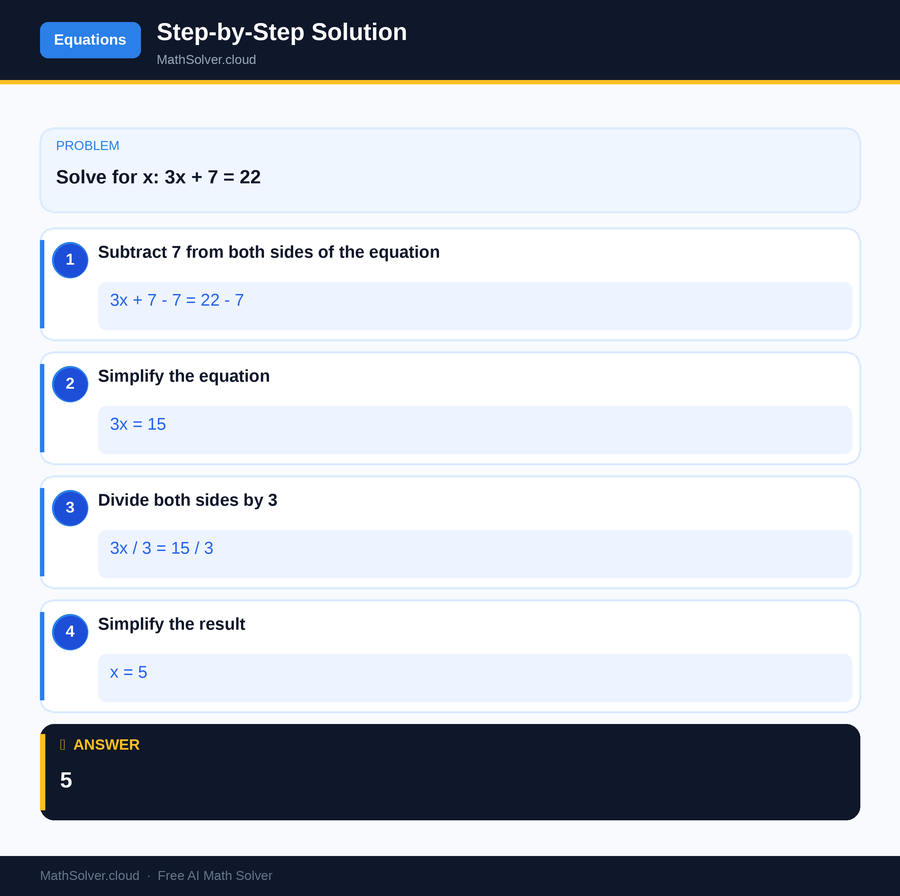
MathSolver Chrome extension solving this problem step-by-step
Example 2
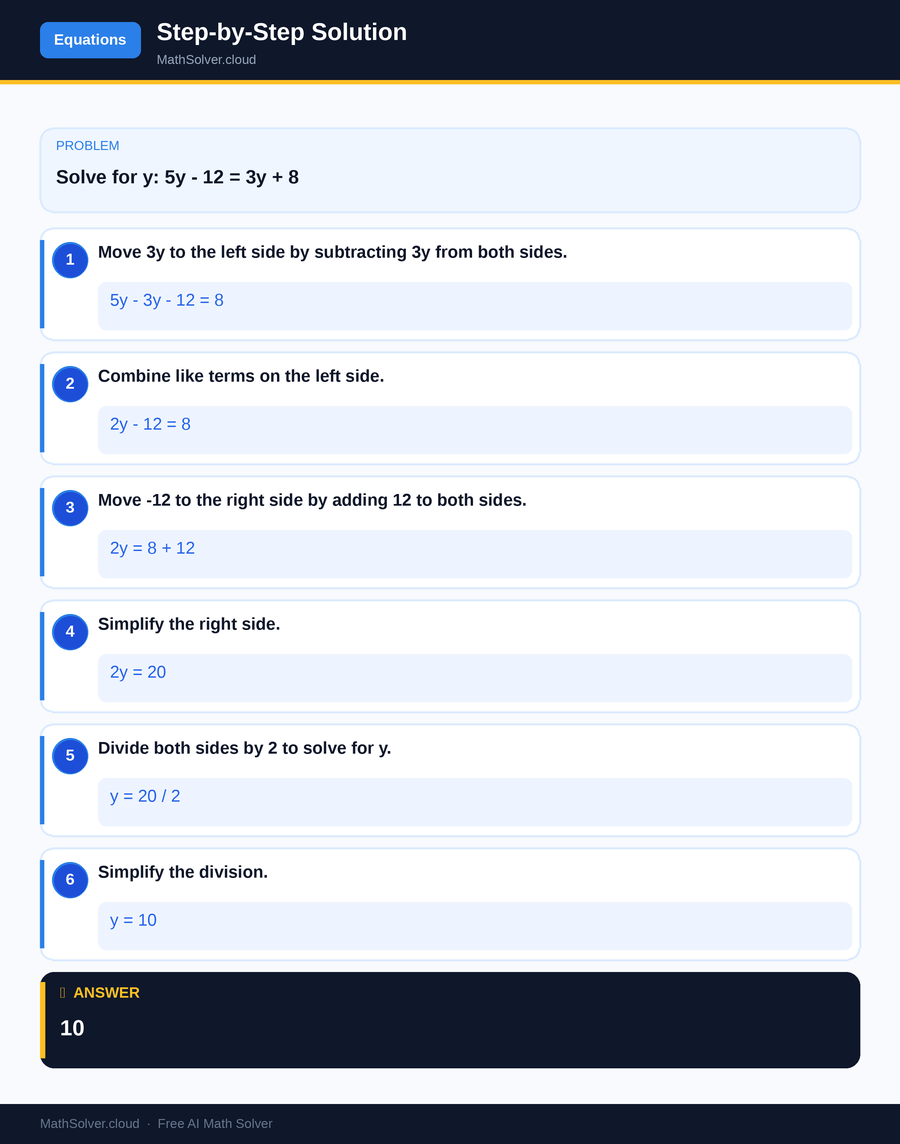
MathSolver Chrome extension solving this problem step-by-step
Common Mistakes to Avoid
A frequent mistake students make when solving one step equations is neglecting to apply the inverse operation to both sides of the equation. This oversight can lead to incorrect solutions, as the balance of the equation is disrupted. Always remember that whatever operation you perform on one side of the equation, you must also perform on the other side. This ensures the equation remains balanced and the solution is accurate.
Another common error is misidentifying the operation present in the equation. For instance, students might confuse multiplication with addition, leading to incorrect choice of the inverse operation. Carefully analyze the equation to determine the operation before proceeding with the solution. Practicing with a variety of one step equations worksheets pdf can help reinforce these concepts and reduce mistakes.
Real-World Applications
One step equations worksheets are not just academic exercises; they have practical applications in real life. For example, consider budgeting. If you know your total expenses and want to determine how much you can save, you can set up a simple one step equation to solve for your savings. Similarly, when cooking, you might have a total amount of an ingredient and need to figure out how much you can use per serving.
In business, one step equations come into play when calculating profits or losses. If a company knows its total income and expenses, it can use a one step equation to determine its net profit by subtracting expenses from income. Understanding these equations enables you to make informed decisions in everyday life, highlighting the importance of mastering them through practice with solving one step equations worksheets.
Frequently Asked Questions
❓ What is a one step equations worksheet?
❓ Why do students struggle with solving one step equations?
❓ How can AI help with a one step equations worksheet?
❓ What should I do if I'm stuck on a one step equation?
❓ Can one step equations worksheets help with more complex problems?
🚀 Solve any math problem instantly
2,000+ students use MathSolver every day — join them for free
📥 Add to Chrome — It's Free