Mastering the Net Force Equation
📋 In this guide
The net force equation is a fundamental concept in physics that describes how forces acting on an object are combined to determine the object's acceleration. Many students find the net force equation challenging because it involves understanding and applying several principles of physics, such as vector addition and Newton's laws of motion. However, mastering this equation is crucial for solving problems involving motion and forces. In this article, you'll learn not only what the net force equation is but also how to apply it through step-by-step guides and worked examples. By the end, you'll feel confident in tackling problems involving net force in both academic and real-world settings.
Students often struggle with the net force equation because it requires a good grasp of how different forces interact in various directions. Forces are vector quantities, which means they have both magnitude and direction. When multiple forces act on an object, you have to account for all these directions and magnitudes to find the net force, which can be a bit tricky at first. This complexity can lead to mistakes, especially when dealing with friction, air resistance, and other resistive forces that oppose motion.
By learning the net force equation, students gain a deeper understanding of how motion works and how different forces influence objects in motion. This knowledge is essential for tackling more complex physics topics, such as angular velocity equations and other math formulas found on an AP Physics equation sheet. Through this article, you'll gain clarity on the net force equation, learn how to find it, and see its relevance in real-world applications.
Step-by-Step: How to Solve Net Force Equation
Step 1: Identify All Forces Acting on the Object
The first step in solving a physics net force equation problem is to identify all the forces acting on the object. These can include applied forces, gravitational forces, frictional forces, and any other forces that might be relevant to the scenario. It's important to note both the magnitude and direction of each force. This helps to visualize the problem and understand how the forces interact. Drawing a free-body diagram can be particularly useful in this step, as it provides a visual representation of the forces acting on the object.
Step 2: Determine the Direction of Each Force
Once you've identified all the forces, the next step is to determine the direction of each force. Forces are vectors, which means you need to consider both their magnitude and direction. In most problems, you'll be dealing with forces acting in one or two dimensions, like horizontally or vertically. Assign positive and negative signs to the forces based on their direction; for example, forces to the right might be positive, and forces to the left might be negative. This directional consideration is crucial for correctly calculating the net force.
Step 3: Calculate the Net Force
With all forces identified and their directions determined, you can now calculate the net force. Sum up all the forces, taking into account their magnitudes and directions. If some forces oppose each other, they will subtract from each other. The resulting value is the net force acting on the object. This step often involves basic algebra equations, as you're summing up numbers and possibly solving for unknowns.
Step 4: Apply the Net Force Equation
Finally, apply the net force equation to find the acceleration of the object or any other unknown variable. Use the formula: Net Force (F_net) = mass (m) * acceleration (a). Depending on the problem, you might need to rearrange the equation to solve for acceleration or another variable. This step solidifies your understanding of how the net force influences the motion of the object.
🤖 Stuck on a math problem?
Take a screenshot and let our AI solve it step-by-step in seconds
⚡ Try MathSolver Free →Worked Examples
Example 1
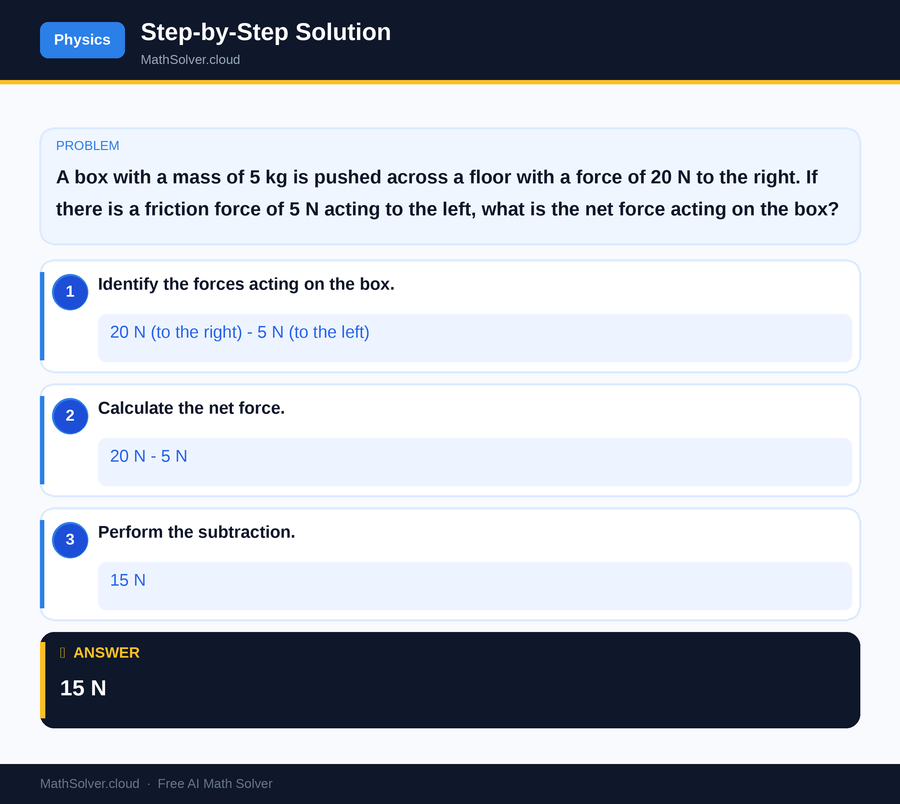
MathSolver Chrome extension solving this problem step-by-step
Example 2
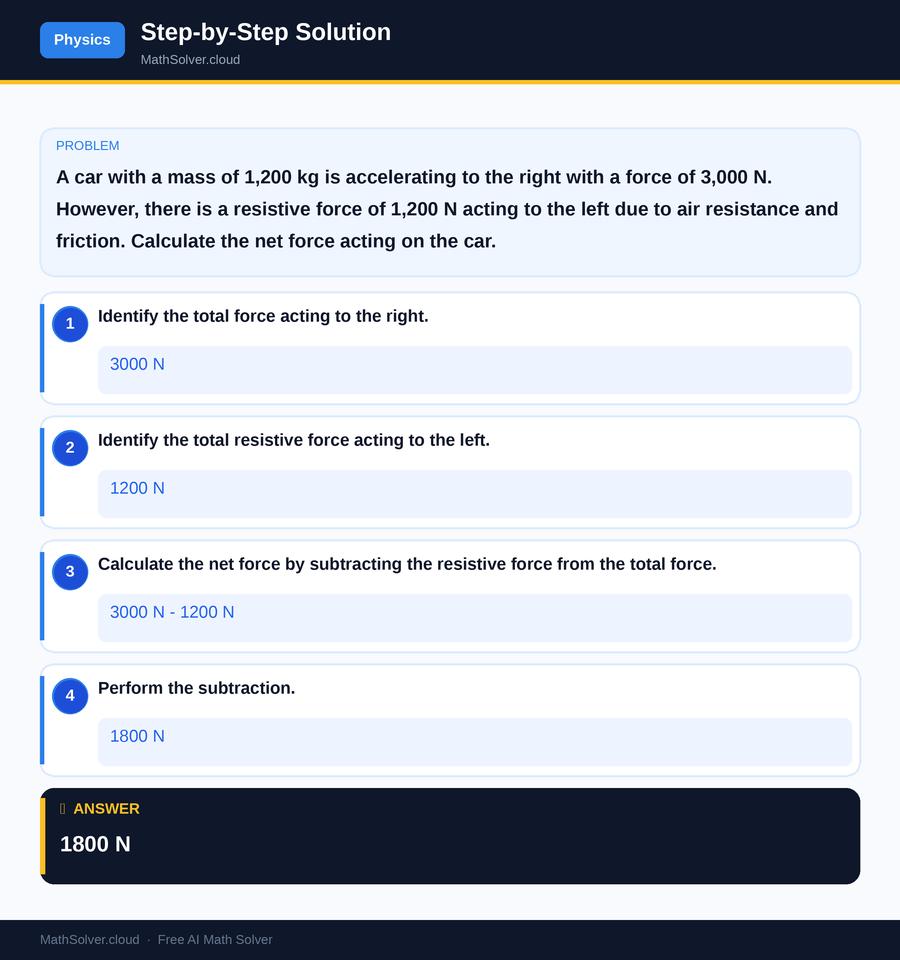
MathSolver Chrome extension solving this problem step-by-step
Common Mistakes to Avoid
One common mistake students make is failing to account for all forces acting on the object, especially friction or air resistance, which can significantly affect the net force. Another frequent error is not correctly assigning positive and negative signs to forces based on their directions. This can lead to incorrect calculations of the net force.
To avoid these mistakes, always start with a clear free-body diagram and double-check that all forces are included. Pay close attention to the direction of each force and use consistent sign conventions. Practice with various problems to become familiar with identifying and calculating forces in different scenarios.
Real-World Applications
The net force equation is not just an academic exercise; it has real-world applications that are crucial in various fields. For instance, engineers use it when designing vehicles to ensure they can accelerate and decelerate safely under different conditions. Understanding net force helps in calculating the necessary engine power and brake force.
In sports, coaches and athletes use the concept of net force to enhance performance. For example, in track and field, understanding how different forces affect a sprinter's acceleration can help improve training techniques and equipment. The net force equation is also valuable in analyzing the forces in play during car crashes, helping to design safer vehicles and infrastructure.
Frequently Asked Questions
❓ What is the net force equation?
❓ How do you calculate the net force on an object?
❓ How can AI help with net force equation problems?
❓ Why is it important to understand the net force equation in physics?
❓ How is the net force equation used in engineering?
🚀 Solve any math problem instantly
2,000+ students use MathSolver every day — join them for free
📥 Add to Chrome — It's Free