Mastering the Multi Step Equations Worksheet
📋 In this guide
A multi step equations worksheet is an essential tool for students who are learning to solve equations that require more than one operation to find the solution. For many, multi step equations can be challenging because they involve a series of steps, each requiring careful execution and understanding. Students often struggle with maintaining the correct order of operations and properly handling variables and constants. By working through a multi step equations worksheet, students can practice and master these skills, gaining confidence and proficiency in solving complex problems.
In a typical multi step equations worksheet, students will encounter problems that require them to perform multiple operations, such as addition, subtraction, multiplication, and division, as well as distribute and combine like terms. The challenges presented in these worksheets help students develop a deeper understanding of algebraic principles and prepare them for more advanced mathematical concepts. With practice, students can learn to approach these problems systematically and efficiently, reducing errors and improving their overall problem-solving abilities.
As students work through their multi step equations worksheets, they will learn to apply their knowledge of algebraic operations and develop strategies for tackling complex problems. This process not only enhances their mathematical skills but also fosters critical thinking and logical reasoning, which are valuable in many areas of life. By mastering multi step equations, students can build a strong foundation in algebra that will serve them well in future math courses and real-world applications.
Step-by-Step: How to Solve Multi Step Equations Worksheet
Step 1: Simplify Both Sides of the Equation
The first step in solving a multi step equation is to simplify both sides of the equation as much as possible. This may involve distributing any constants outside parentheses, combining like terms, and simplifying fractions or decimals. By reducing the complexity of each side, you can make it easier to isolate the variable in subsequent steps. Be sure to perform these operations carefully to avoid errors.
Step 2: Apply the Properties of Equality
Once the equation is simplified, use the properties of equality to begin isolating the variable. The properties of equality state that you can add, subtract, multiply, or divide both sides of an equation by the same non-zero value without changing the equation's solution. Use these properties to eliminate any constants or coefficients attached to the variable, working systematically to bring the variable closer to isolation.
Step 3: Isolate the Variable
After applying the properties of equality, focus on isolating the variable on one side of the equation. This may require moving terms from one side to the other by adding or subtracting them. Ensure that each operation is applied to the entire side of the equation to maintain balance. Continue this process until the variable stands alone on one side, which indicates that you have found the solution.
Step 4: Verify the Solution
The final step in solving a multi step equation is to verify the solution by substituting it back into the original equation. This step ensures that the solution satisfies the equation and that no errors were made during the solving process. If the left and right sides of the equation are equal after substitution, the solution is correct. If not, review each step to identify and correct any mistakes.
🤖 Stuck on a math problem?
Take a screenshot and let our AI solve it step-by-step in seconds
⚡ Try MathSolver Free →Worked Examples
Example 1

MathSolver Chrome extension solving this problem step-by-step
Example 2
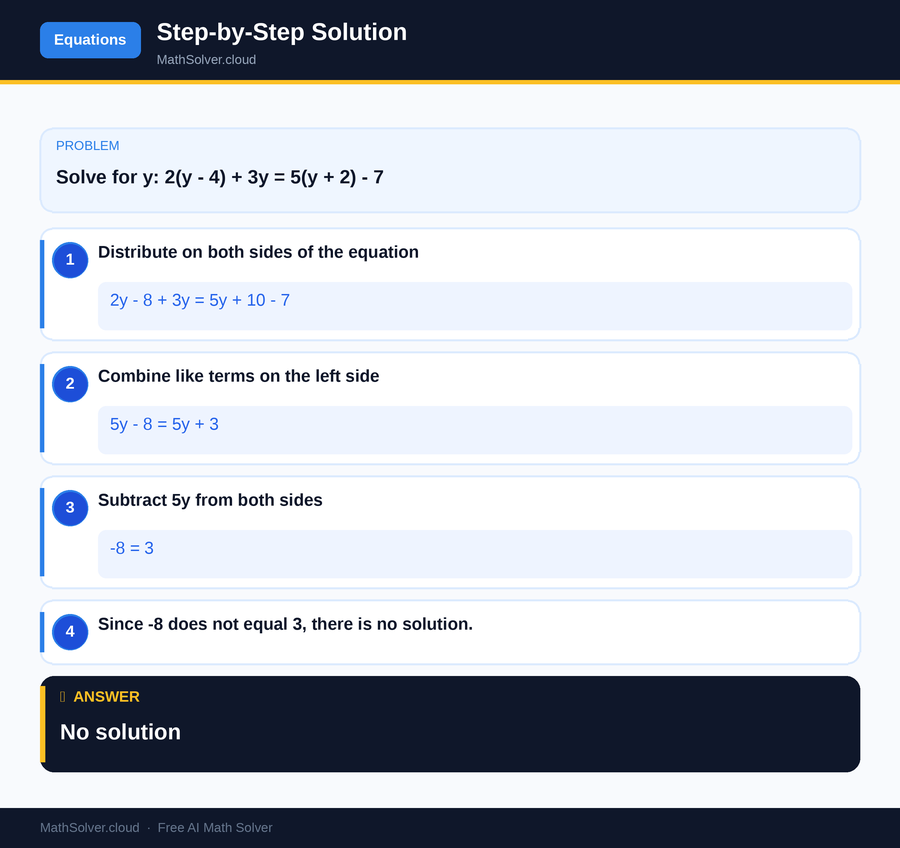
MathSolver Chrome extension solving this problem step-by-step
Common Mistakes to Avoid
One common mistake students make while working on multi step equations worksheets is neglecting to apply the distributive property correctly. Failing to distribute a constant across terms within parentheses can lead to incorrect simplification. Always double-check your distribution to ensure each term within the parentheses is multiplied correctly.
Another frequent error is forgetting to apply an operation to both sides of the equation, which can disrupt the balance necessary for an accurate solution.
Additionally, students sometimes confuse the order of operations, leading to incorrect simplifications. Remember to follow the PEMDAS/BODMAS rule—parentheses/brackets, exponents/orders, multiplication and division (from left to right), addition, and subtraction (from left to right). By adhering to the correct order and double-checking each step, you can minimize errors and arrive at the correct solution more reliably.
Real-World Applications
Multi step equations worksheets are not just an academic exercise; they have practical applications in various real-life scenarios. For instance, multi step equations are used in budgeting and financial planning, where individuals must balance income and expenses over a period. Understanding how to manipulate equations allows one to predict savings and expenditures accurately.
In engineering and science, multi step equations are crucial for modeling and solving problems that involve multiple variables and constraints. Engineers use these equations to determine forces in structures, calculate electrical currents, and design complex systems. Mastering the skills practiced in multi step equations worksheets is essential for success in these fields.
Frequently Asked Questions
❓ What is a multi step equations worksheet?
❓ Why do students struggle with solving multi step equations?
❓ How can AI help with multi step equations worksheet?
❓ What is the difference between two step equations and multi step equations?
❓ Can I find multi step equations worksheets in PDF format?
🚀 Solve any math problem instantly
2,000+ students use MathSolver every day — join them for free
📥 Add to Chrome — It's Free