Demystifying Matrix Math Equations
📋 In this guide
Matrix math equations are a fundamental concept in higher-level mathematics, particularly in the fields of algebra and calculus. They can be incredibly powerful, allowing us to solve complex systems of equations, transform data, and understand linear mappings. However, many students find matrix math equations challenging due to their abstract nature and the meticulous attention to detail they require. Mistakes in arithmetic or misapplication of rules can lead to incorrect results, which makes understanding these equations essential for success in mathematics.
In this article, we aim to demystify matrix math equations by providing a clear and comprehensive guide. Whether you're struggling with understanding the operations involved or need a refresher on the topic, this guide will walk you through the basics and beyond. You'll learn about key formulas, common pitfalls, and applications that make matrices an indispensable tool in various fields. By the end of this guide, you'll have a solid understanding of how to tackle matrix math equations with confidence.
Additionally, we will explore how tools like math solver platforms and AI technologies can assist in solving these equations. With advancements in technology such as the MathSolver Chrome extension, students have access to powerful resources that simplify the learning process, allowing them to solve algebra equations and much more with ease. Let's dive into the world of matrices and see how they can be both fascinating and practical.
Step-by-Step: How to Solve Matrix Math Equations
Step 1: Understanding Matrix Dimensions
The first step in working with matrix math equations is to understand the dimensions of the matrices involved. The dimensions are given by the number of rows and columns, expressed as m x n, where m represents the number of rows, and n represents the number of columns. When performing matrix operations, such as multiplication, the number of columns in the first matrix must match the number of rows in the second matrix. This ensures that the dot product can be calculated. Always double-check dimensions before attempting any operations to avoid errors.
Step 2: Performing Matrix Multiplication
Matrix multiplication is a key operation in matrix math equations. To multiply two matrices, take each element of the row in the first matrix and multiply it by the corresponding element of the column in the second matrix. Then, sum these products to get a single element of the resulting matrix. Repeat this process for each row of the first matrix and each column of the second matrix. This operation is not commutative, meaning that AB does not equal BA in general, so order matters.
Step 3: Solving Matrix Equations
Solving matrix equations involves finding an unknown matrix that satisfies a given equation. This often requires the use of inverse matrices. If AX = B, where A and B are known matrices, we can find X by calculating the inverse of A, denoted as A^-1, and then multiplying both sides by this inverse. Therefore, X = A^-1B. Ensure that the matrix A is invertible; otherwise, the inverse does not exist, and other methods must be considered.
Step 4: Using Technology and Tools
Advancements in technology have made solving matrix math equations more accessible. Tools like MathSolver provide step-by-step solutions, making it easier to understand complex problems. The MathSolver Chrome extension allows users to take a screenshot of a problem and receive instant solutions, making it a valuable resource for students. Additionally, platforms like Mathway and other math AI tools can help solve algebra equations, kinematic equations, and more, further simplifying the process of learning and applying matrix math.
🤖 Stuck on a math problem?
Take a screenshot and let our AI solve it step-by-step in seconds
⚡ Try MathSolver Free →Worked Examples
Example 1

MathSolver Chrome extension solving this problem step-by-step
Example 2
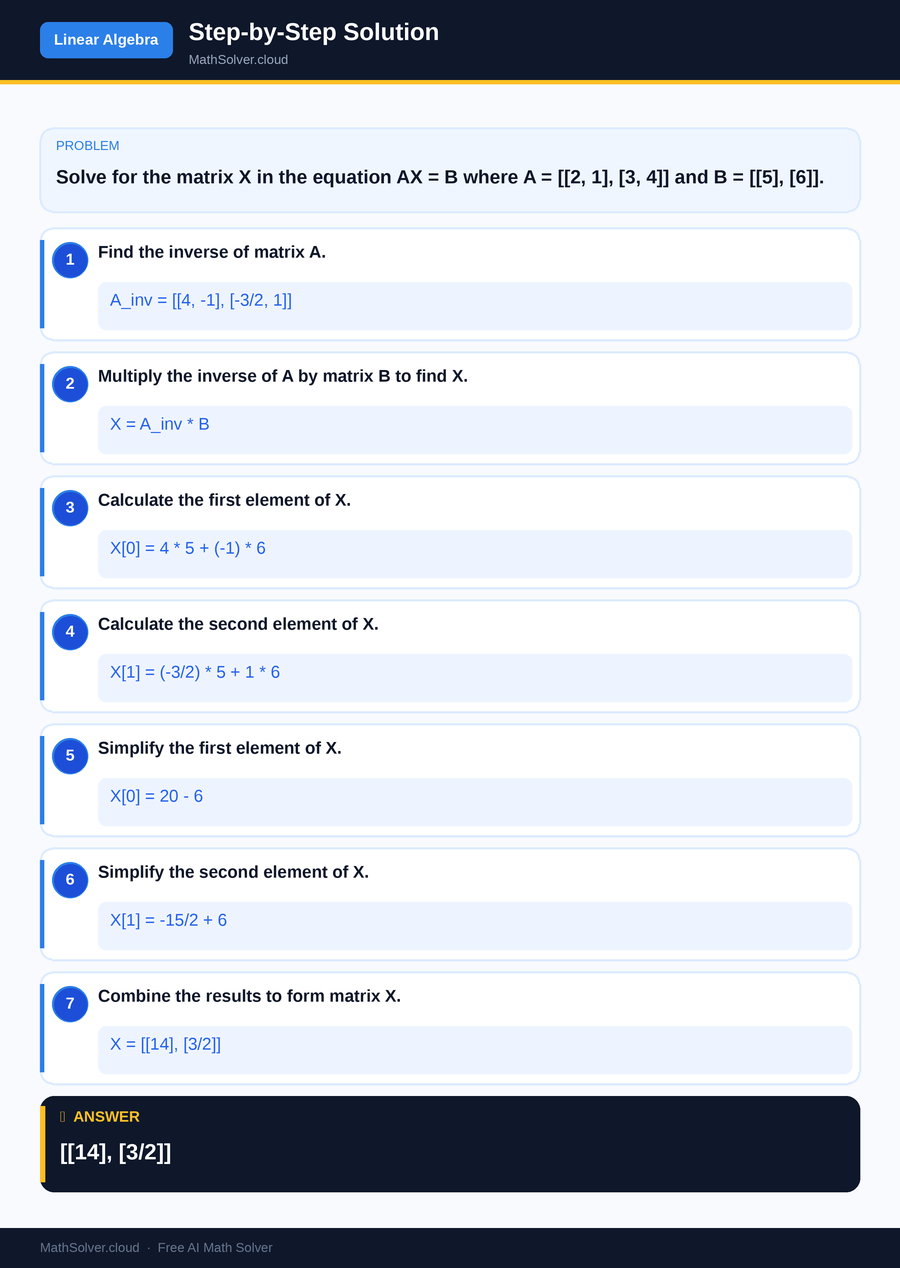
MathSolver Chrome extension solving this problem step-by-step
Common Mistakes to Avoid
A frequent mistake in matrix math equations is incorrect dimensional matching. Students often attempt to multiply matrices without checking if their dimensions are compatible. Always verify that the number of columns in the first matrix matches the number of rows in the second matrix to avoid errors. Another common error is miscalculating the determinant or inverse of a matrix. Double-check your calculations, especially when dealing with fractions or negatives, as a small mistake can lead to incorrect results.
Additionally, students sometimes confuse the operations and properties of matrices. Remember that matrix multiplication is not commutative, meaning the order of multiplication matters. Practice these operations thoroughly to build confidence and accuracy in solving matrix-related problems.
Real-World Applications
Matrix math equations have numerous real-world applications across various fields. In computer graphics, matrices are used to perform transformations such as scaling, rotating, and translating objects. This application is crucial in the design and rendering of video games and simulations. Matrices are also fundamental in engineering, where they help solve systems of linear equations that model physical systems, such as electrical circuits or structural analysis.
In the field of data science, matrices are used in machine learning algorithms, particularly in the representation and transformation of data sets. They enable the manipulation and analysis of large data sets, making them essential tools in predictive modeling and AI. Understanding matrix math equations is vital for professionals in these fields, highlighting their importance beyond the classroom.
Frequently Asked Questions
❓ What are matrix math equations used for?
❓ Why are matrix dimensions important in matrix math equations?
❓ How can AI help with matrix math equations?
❓ What is a common mistake when multiplying matrices?
❓ How can I solve matrix math equations manually?
🚀 Solve any math problem instantly
2,000+ students use MathSolver every day — join them for free
📥 Add to Chrome — It's Free