Mastering Matrix Equations
📋 In this guide
A matrix equation is an equation in which the unknown variable is a matrix. Students often find matrix equations challenging because they involve concepts like matrix multiplication, determinants, and inverses, which can be quite different from the arithmetic operations they are used to. In this article, students will gain a comprehensive understanding of matrix equations, including how to solve them and apply them in real-world scenarios. They will also learn about common mistakes to avoid and how tools like matrix equation solvers can assist in the process.
Matrix equations are a fundamental part of linear algebra and are crucial for solving systems of linear equations. When students first encounter matrix equations, they might feel overwhelmed by the abstract nature of matrices and the operations involved. However, with a clear explanation and practical examples, students can master this topic and apply it confidently in their studies and future careers.
Throughout this article, we will explore the definition and key formulas associated with matrix equations, provide step-by-step guidance on solving them, and examine real-world applications. Additionally, we will present worked examples and address frequently asked questions, ensuring a thorough understanding of matrix equations. By the end of this article, students will be equipped with the knowledge and tools needed to tackle matrix equations effectively.
Step-by-Step: How to Solve Matrix Equation
Step 1: Understand the Problem
The first step in solving a matrix equation is to understand the given matrices and the operations involved. Analyze the equation and identify the matrices A, B, and any unknown matrices like X. Pay attention to the dimensions of each matrix, as this will determine whether matrix multiplication is possible. Understanding the problem fully is crucial before attempting any calculations or transformations.
Step 2: Perform Matrix Operations
Once you understand the problem, perform the necessary matrix operations. This may include matrix addition, subtraction, or multiplication, depending on the structure of the equation. Remember that matrix multiplication is not commutative, meaning that AB is not necessarily equal to BA. Carefully follow the order of operations to avoid mistakes.
Step 3: Isolate the Unknown Matrix
To solve the matrix equation, you need to isolate the unknown matrix (such as X) on one side of the equation. This often involves using the inverse of a matrix. If the equation is in the form AX = B, you can multiply both sides by the inverse of A (denoted as A^-1) to find X = A^-1B. Ensure that the matrix A is invertible by checking that its determinant is not zero.
Step 4: Verify the Solution
After finding the unknown matrix, verify your solution by substituting it back into the original equation. Perform the matrix operations to check if the left-hand side equals the right-hand side of the equation. Verification ensures that the solution is correct and that no calculation errors were made during the process.
🤖 Stuck on a math problem?
Take a screenshot and let our AI solve it step-by-step in seconds
⚡ Try MathSolver Free →Worked Examples
Example 1
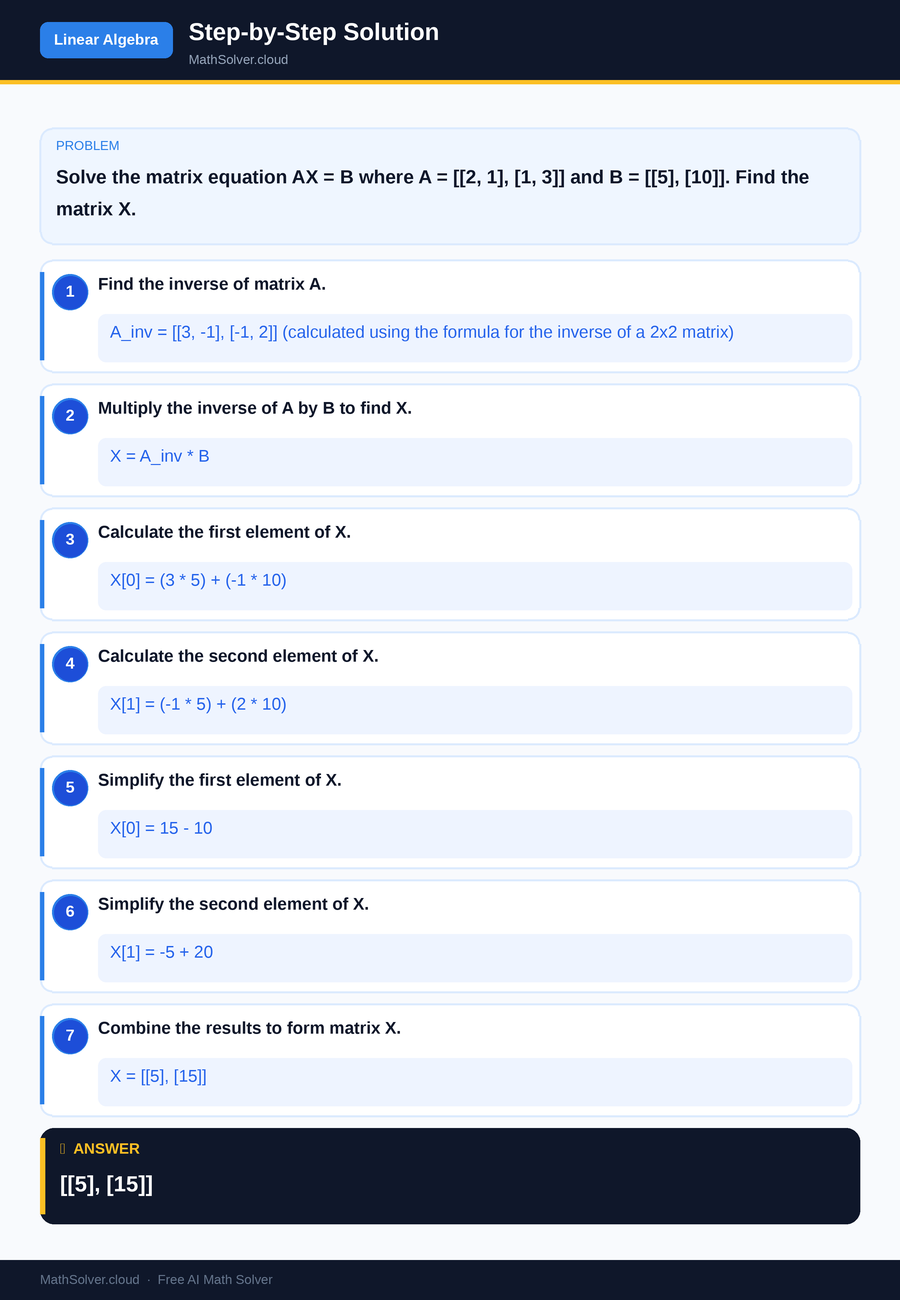
MathSolver Chrome extension solving this problem step-by-step
Example 2
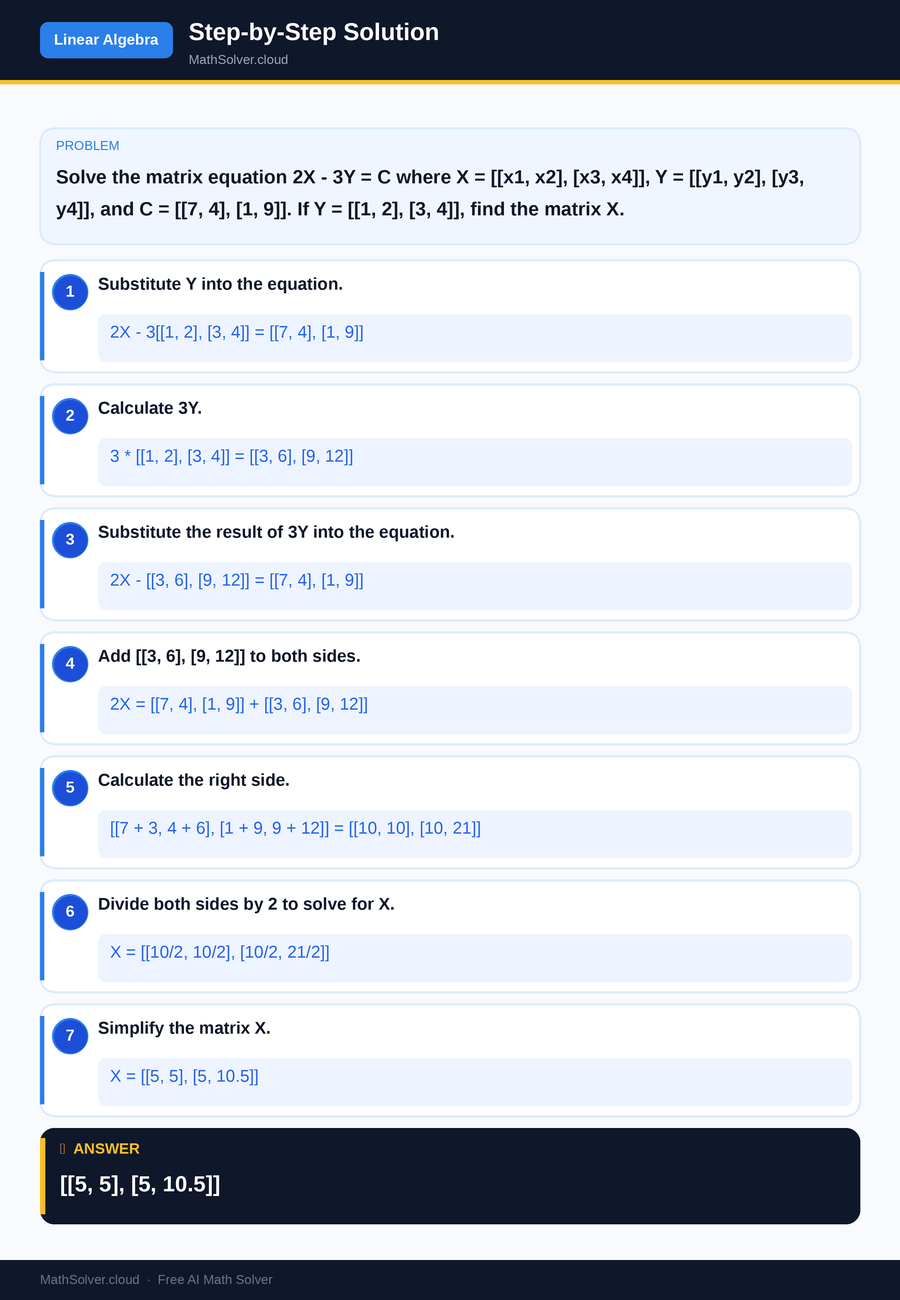
MathSolver Chrome extension solving this problem step-by-step
Common Mistakes to Avoid
One common mistake when solving matrix equations is neglecting to check the dimensions of matrices before performing operations. Matrix multiplication requires that the number of columns in the first matrix matches the number of rows in the second matrix. Failing to verify this can lead to errors and incorrect solutions. Always ensure that the matrices are compatible for the operations you intend to perform.
Another frequent error is assuming that matrix multiplication is commutative. Unlike regular numbers, the order in which you multiply matrices matters. AB is not the same as BA, and assuming otherwise can lead to significant mistakes in calculations. Always follow the correct order of operations and verify each step to avoid these pitfalls.
Real-World Applications
Matrix equations are widely used in various fields, such as engineering, computer graphics, and economics. In engineering, matrix equations are crucial for structural analysis and design. Engineers use matrices to model and solve complex systems of equations, which are essential for determining stress and strain in structures.
In computer graphics, matrix equations are used to transform and manipulate images and animations. Operations like rotating, scaling, and translating objects in a 3D space rely heavily on matrix equations. This allows for the realistic rendering and manipulation of images in video games and simulations, demonstrating the practical application of matrix equations in everyday technology.
Frequently Asked Questions
❓ What is a matrix equation?
❓ Why do students struggle with matrix equations?
❓ How can AI help with matrix equations?
❓ What is the importance of the determinant in matrix equations?
❓ How can I practice solving matrix equations effectively?
🚀 Solve any math problem instantly
2,000+ students use MathSolver every day — join them for free
📥 Add to Chrome — It's Free