Comprehensive Guide to Math Equation Solver
📋 In this guide
A math equation solver is a powerful tool designed to help students and educators tackle mathematical problems efficiently. Whether you're dealing with simple arithmetic or complex algebraic equations, a math equation solver can break down the steps needed to find solutions. Many students often struggle with solving equations because the process can seem daunting or confusing, especially when multiple steps are involved. This article will guide you through understanding what a math equation solver is, why it’s an invaluable resource, and how you can effectively use it to enhance your learning experience.
Students frequently find themselves overwhelmed when faced with equations, particularly when they involve multiple steps or unfamiliar concepts. This is where a math equation solver becomes an essential companion. Not only does it provide the final answer, but it also elucidates the process, offering a math equation solver with steps to ensure the student comprehends each part of the solution. By demystifying the steps, students gain confidence and improve their problem-solving skills.
Throughout this guide, you'll learn how to use a math equation solver step by step, explore common mistakes to avoid, see real-world applications of these solvers, and get answers to frequently asked questions. Our goal is to make you comfortable and proficient with using a math equation solver, whether it's online or in a classroom setting. Let's dive into the specifics.
Step-by-Step: How to Solve Math Equation Solver
Step 1: Understanding the Equation
Before solving any equation, it's crucial to understand what type of equation you're dealing with. Is it a two-step equation, a multi-step equation, or something else? Two-step equations require two operations to solve, while multi-step equations can involve several layers of operations. Identifying these will guide your approach. Start by writing down the equation clearly, ensuring all terms and operations are visible. This clarity is vital as you move through the solving process.
Step 2: Simplify the Equation
The next step involves simplifying the equation, if necessary. This can include combining like terms, which are terms that have the same variables raised to the same power, or distributing any factors across parentheses. Simplification reduces complexity and brings you closer to isolating the variable. Look for opportunities to make the equation more manageable, such as by canceling out terms on both sides of the equation.
Step 3: Isolate the Variable
Now it's time to isolate the variable, which is often the most critical step in solving an equation. Depending on the equation type, you may need to add, subtract, multiply, or divide both sides of the equation to get the variable alone. For example, if the equation is 2x + 3 = 11, subtract 3 from both sides to get 2x = 8. Then divide both sides by 2 to find x = 4. This process may vary slightly with more complex equations, but the goal remains the same: get the variable on one side of the equation.
Step 4: Verify Your Solution
Once you've isolated the variable and found a solution, it's essential to verify that your solution is correct. Substitute the value back into the original equation to ensure that both sides are equal. This step confirms the accuracy of your solution and helps reinforce your understanding of the equation-solving process. If the equation doesn't balance, recheck your steps to find where you might have gone wrong.
🤖 Stuck on a math problem?
Take a screenshot and let our AI solve it step-by-step in seconds
⚡ Try MathSolver Free →Worked Examples
Example 1
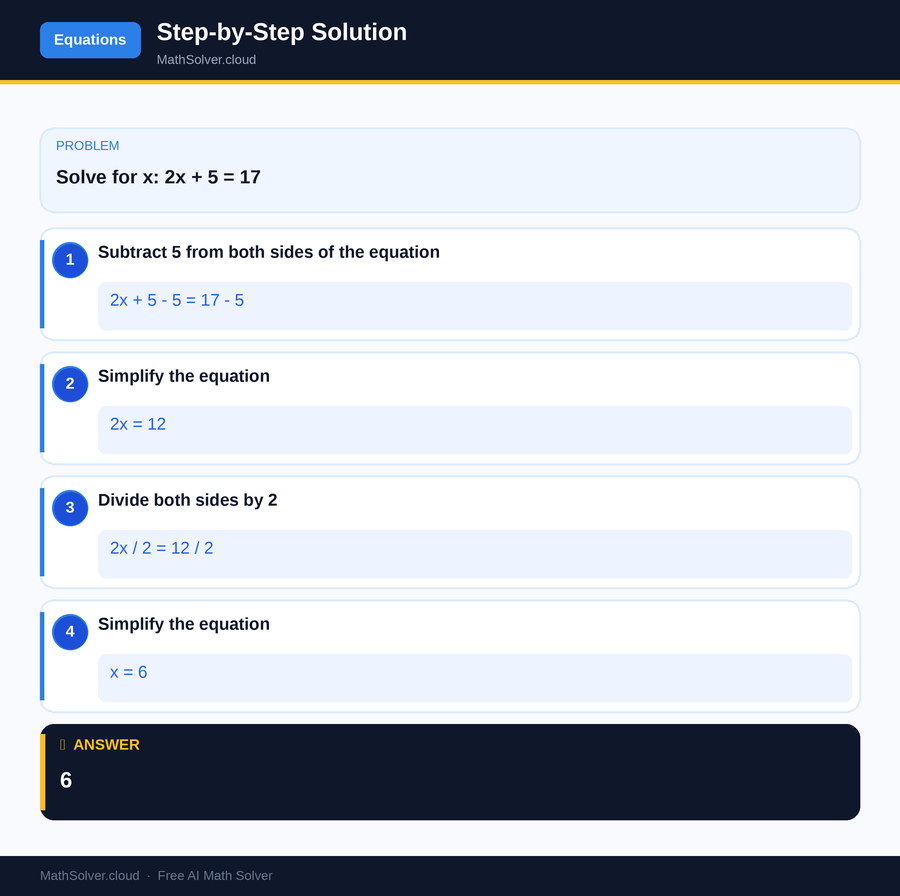
MathSolver Chrome extension solving this problem step-by-step
Example 2
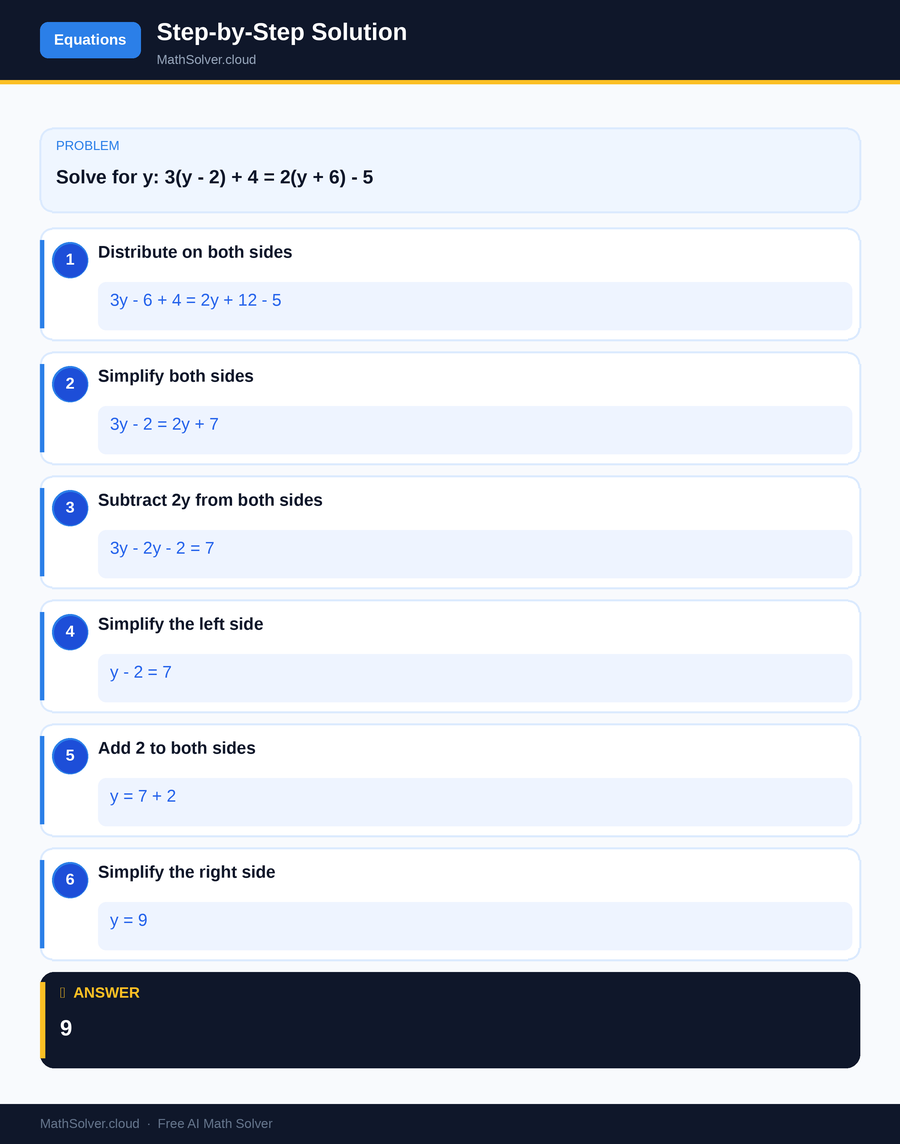
MathSolver Chrome extension solving this problem step-by-step
Common Mistakes to Avoid
One common mistake students make is failing to properly distribute terms across parentheses, especially in multi-step equations. Always ensure each term inside the parentheses is multiplied by the factor outside before proceeding with further simplification. Missteps here can lead to incorrect solutions.
Another frequent error is neglecting to perform the same operation on both sides of the equation. This can result in an unbalanced equation and an incorrect solution. Always remember that what you do to one side, you must do to the other to maintain equality.
Real-World Applications
Math equation solvers are widely used in various real-world scenarios. For instance, engineers frequently use them to calculate load distributions and stress factors in structures. By solving equations, they ensure that bridges, buildings, and other constructions are safe and reliable.
In finance, professionals use math equation solvers to determine loan repayments and interest rates. By solving equations, they can forecast future financial scenarios and make informed decisions. These applications highlight the solver’s importance beyond academic contexts and its role in practical problem-solving.
Frequently Asked Questions
❓ What is a math equation solver?
❓ Why do students struggle with solving equations?
❓ How can AI help with math equation solvers?
❓ What types of equations can math equation solvers handle?
❓ How can I practice solving equations effectively?
🚀 Solve any math problem instantly
2,000+ students use MathSolver every day — join them for free
📥 Add to Chrome — It's Free