Demystifying the Math Definition for Proportion
📋 In this guide
The math definition for proportion is a fundamental concept that revolves around the idea of two ratios being equivalent. Proportions are everywhere in mathematics, and understanding them is crucial for solving a variety of problems, from simple arithmetic to complex algebraic equations. Yet, many students find themselves grappling with this concept, often due to a lack of clarity on what proportions truly represent or how to set them up properly. In this article, we will demystify the math definition for proportion, providing a comprehensive guide that will help you understand, apply, and master this essential mathematical concept.
Students often struggle with proportions because they require a clear understanding of ratios and the ability to manipulate them. Missteps in setting up equations or cross-multiplying can lead to incorrect answers, causing frustration. But worry not, as this guide will walk you through the process step by step, ensuring you grasp the math definition for proportion and how to apply it effectively. We will also provide practical examples, common mistakes to avoid, and real-world applications to solidify your understanding.
By the end of this article, you'll be equipped with the knowledge to approach proportion problems confidently. You'll learn key formulas, work through examples, and discover how tools like math solvers and AI-powered apps like MathSolver, Mathway, and Photomath can assist you in mastering proportions. Let's dive in and unlock the power of proportions together!
Step-by-Step: How to Solve Math Definition For Proportion
Step 1: Understanding Ratios
Before diving into proportions, it's essential to understand ratios. A ratio is a comparison between two numbers, expressed as "a:b" or "a/b." Ratios represent how much of one thing exists relative to another. For instance, if you have a ratio of 2:3, it means for every 2 units of the first quantity, there are 3 units of the second. Grasping ratios is the first step in understanding the math definition for proportion.
Step 2: Setting Up Proportions
Once you understand ratios, the next step is setting up proportions. A proportion involves two equal ratios, such as "a/b = c/d." To set up a proportion, identify the quantities you are comparing and their respective ratios. Ensure both ratios are in the same units or context. Setting up the correct proportion is crucial for solving problems accurately.
Step 3: Solving Proportions
Solving proportions often involves cross-multiplying to find an unknown variable. If you have "a/b = c/d," you can cross-multiply to get "a * d = b * c." This equation allows you to solve for the unknown variable. Rearrange the equation to isolate the variable and solve it. Being methodical in this step will help you avoid mistakes and find the correct solution.
Step 4: Checking Your Answer
After solving, it's important to check your answer. Substitute your solution back into the original proportion to ensure the equality holds. If "a/b = c/d" was the original proportion, verify that both sides of the equation are indeed equal with your solution. This step confirms that your math is correct and helps reinforce your understanding of proportions.
🤖 Stuck on a math problem?
Take a screenshot and let our AI solve it step-by-step in seconds
⚡ Try MathSolver Free →Worked Examples
Example 1
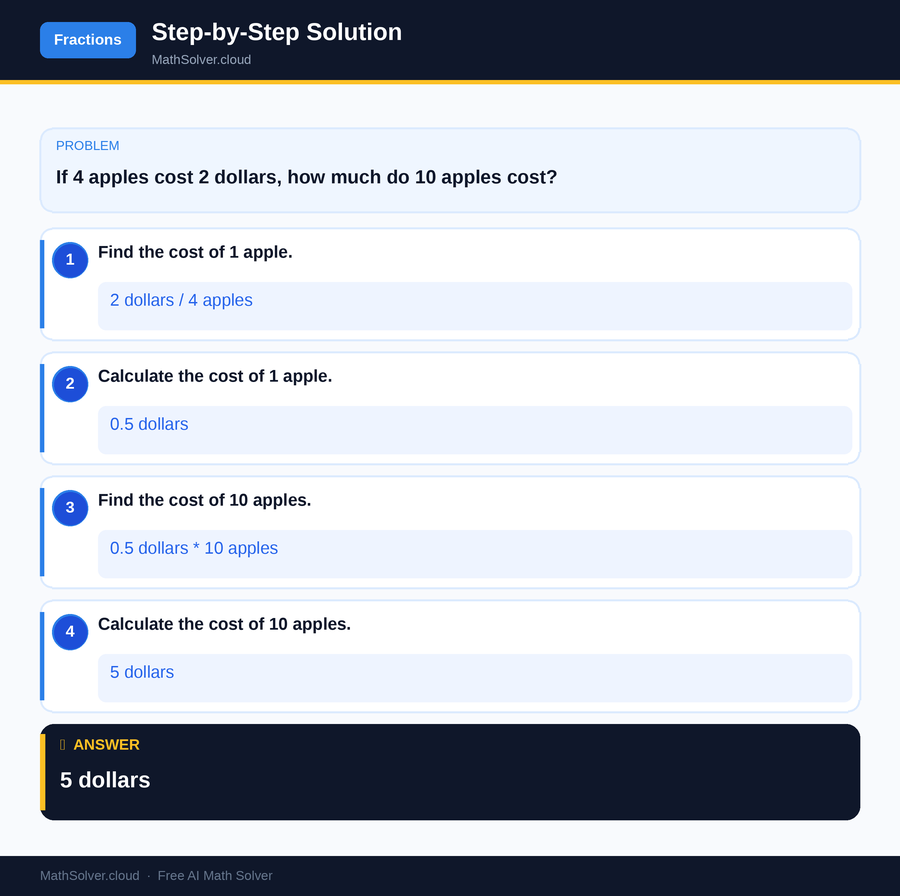
MathSolver Chrome extension solving this problem step-by-step
Example 2
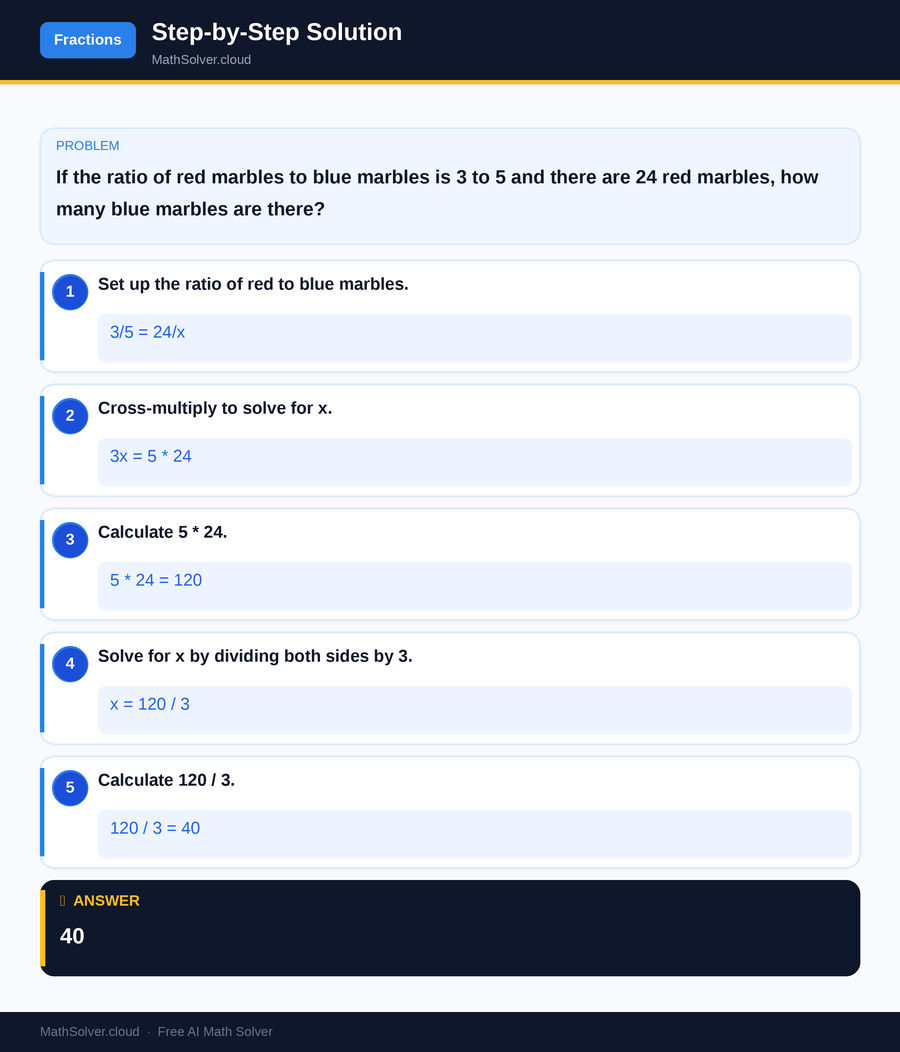
MathSolver Chrome extension solving this problem step-by-step
Common Mistakes to Avoid
One common mistake students make with the math definition for proportion is misidentifying the ratios. Always ensure the quantities you compare are in the same units and context. Another error is incorrect cross-multiplication. Remember to multiply across the equal sign correctly, as reversing the factors can lead to incorrect solutions. By paying attention to these details, you'll solve proportion problems accurately.
Another pitfall is neglecting to check your solution. Always substitute your answer back into the original proportion to verify that both sides are equal. This not only confirms your solution but also deepens your understanding of the concept. Avoid these mistakes, and you'll find mastering proportions much more manageable.
Real-World Applications
The math definition for proportion is not just a theoretical concept; it's widely used in real-world scenarios. For instance, in cooking, recipes often require adjusting proportions to serve different numbers of people. Understanding proportions ensures that the taste and consistency remain consistent regardless of the serving size.
In finance, proportions are used to calculate interest rates, compare investments, and assess financial ratios. Engineers and architects apply proportions when designing structures to ensure stability and aesthetics. These real-world applications highlight the importance of mastering proportions beyond the classroom.
Frequently Asked Questions
❓ What is the math definition for proportion?
❓ Why do students struggle with proportions?
❓ How can AI help with math definition for proportion?
❓ What is a practical example of using proportions?
❓ Which equation represents the proportional relationship in the table?
🚀 Solve any math problem instantly
2,000+ students use MathSolver every day — join them for free
📥 Add to Chrome — It's Free